
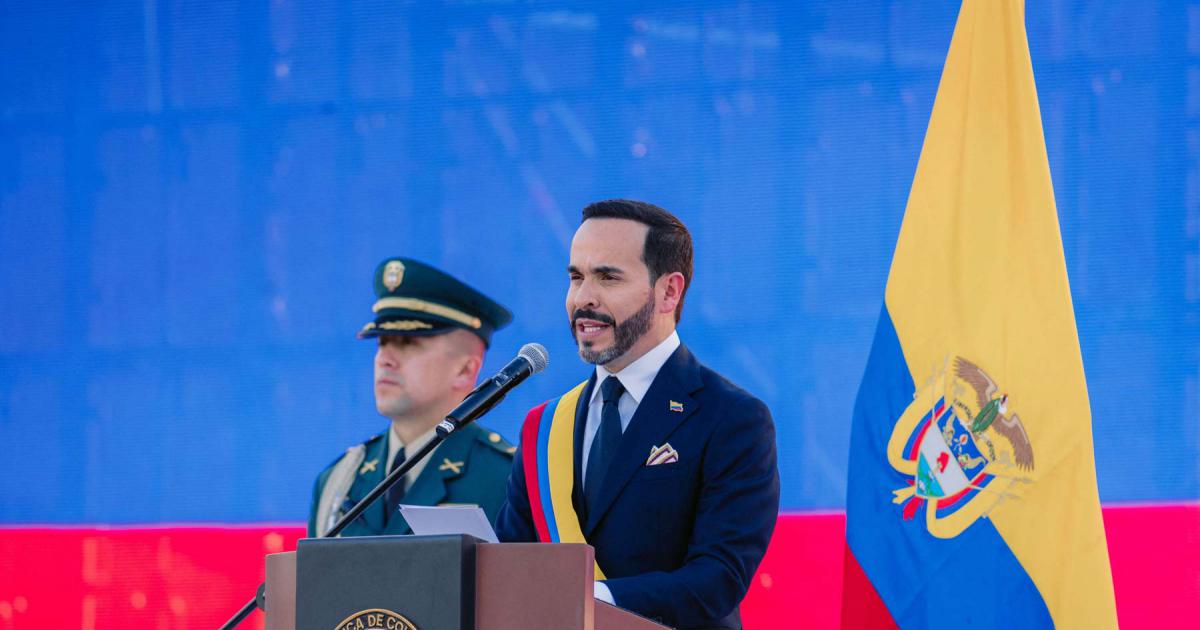
BOGOTA – Colombia has recognised Israeli sovereignty over the occupied Syrian Golan Heights, becoming only the second country after the United States to formally recognise Israel’s claim to the strategic territory, in a striking foreign-policy shift under newly-inaugurated President Abelardo de la Espriella.
The Colombian Foreign Ministry said on Monday: “Colombia recognises Israeli sovereignty over the Golan.”
“Given the persistent regional instability in the Middle East and considering the strategic importance of the Golan Heights to Israel’s security, the government of Colombia recognises Israeli sovereignty over this territory, as well as the state’s right to defend itself against external threats.”
The decision was welcomed by Israeli Foreign Minister Gideon Saar, who thanked de la Espriella for what he described as a historic move.
“I thank Colombia and my good friend, Colombian President Abelardo de la Espriella, for his historic decision to recognise Israeli sovereignty over the Golan Heights, following our meeting in the Colombian city of Barranquilla last Thursday,” Saar wrote on X.
Saar, who returned to Israel on Monday after travelling to Colombia to attend events surrounding the new president’s inauguration, said the decision demonstrated de la Espriella’s commitment to Israel.
“With this decision, which is one of his first decisions in office, the Colombian president has demonstrated his leadership, values and commitment to Israel and its security.”
He added: “Israel is a small country without strategic depth, and therefore the existence of defensible borders is essential to ensure the survival of the Jewish people in their historic homeland.”
Saar said he would continue working “to ensure that more countries join the United States (led by President Donald Trump) and Colombia (led by President de la Espriella) in recognising Israeli sovereignty over the Golan Heights.”
The move marks a dramatic departure from Colombia’s policy during the government of former president Gustavo Petro, whose administration sharply criticised Israel over the Gaza war, severed diplomatic relations with Israel and halted Israeli arms imports.
De la Espriella, who took office on August 7, campaigned on restoring close ties with Washington and Israel and has moved rapidly to reverse several of Petro’s policies.
The Golan Heights has been under Israeli control since the 1967 Arab-Israeli war, when Israel captured most of the territory from Syria. Israel extended its laws and administration to the Golan in 1981, a move rejected by the United Nations and most of the international community.
The United States broke with that longstanding international position in March 2019, when Trump, during his first presidency, formally recognised Israeli sovereignty over the territory. Colombia’s decision makes it the second UN member state to do so.
The United Nations continues to regard the Golan as Syrian territory under Israeli occupation. The international position has not changed despite the US recognition in 2019 and Colombia’s move this week. The distinction is significant because the UN Charter and Security Council resolutions reject the acquisition of territory by force, while Security Council Resolution 497 declared Israel’s 1981 annexation of the Golan “null and void”.
The territory is strategically important because of its elevated position overlooking northern Israel and southern Syria. It also commands approaches towards Damascus and has long been viewed by Israel as a crucial defensive buffer.
The Golan’s strategic importance has become even more pronounced since the collapse of Bashar al-Assad’s government in December 2024. Israel subsequently expanded its military presence on the Syrian side of the ceasefire line, including by moving into the UN-monitored buffer zone and taking control of strategic positions around Mount Hermon. The developments have further altered the security environment along Israel’s northern frontier.
Colombia’s recognition therefore comes at a particularly sensitive moment. It is not simply a symbolic diplomatic gesture towards Israel but also an endorsement of the Israeli argument that control of the Golan is central to its national security.
The decision also signals how quickly Bogota’s foreign policy is changing under de la Espriella. His government has sought to restore diplomatic relations with Israel, strengthen security and defence cooperation and reverse measures adopted by Petro. Colombia has also moved to withdraw from South Africa’s case against Israel at the International Court of Justice and has announced plans linked to strengthening its diplomatic presence in Jerusalem.
For Israel, the recognition offers a diplomatic breakthrough on an issue where it has faced decades of international opposition. Saar has made improving ties with Latin American countries a broader foreign-policy priority, with Israel designating 2026 as the “Year of Latin America”.
The move also gives Israel a new diplomatic argument for seeking wider recognition of its sovereignty over the Golan, particularly among governments aligned with Washington and increasingly concerned with Israel’s security position following the upheaval in Syria.
For Colombia, meanwhile, the decision places the country firmly on a new foreign-policy trajectory after years of tension with Israel. It also underscores the extent to which the arrival of a new administration in Bogota is reshaping the country’s position on some of the Middle East’s most contentious questions.
The immediate significance of the decision is diplomatic rather than territorial: Israel already exercises control over the Golan, while Colombia has no direct role in the territory. But by formally recognising Israeli sovereignty, Bogota has chosen to break with the overwhelming international consensus and align itself with Washington and Jerusalem on one of the region’s most disputed territorial questions.
The decision could also be closely watched by other governments considering closer relations with Israel. Whether Colombia’s move remains an isolated departure from the international consensus or encourages other states to follow will be an important test of the diplomatic impact of Israel’s expanding regional security argument.