
I’m Professor David Nutt, psychiatrist,
neuropsychopharmacologist, and brain scientist.
I’m here today to answer your questions from the internet.
This is Psychedelic Therapy Support.
[upbeat music]
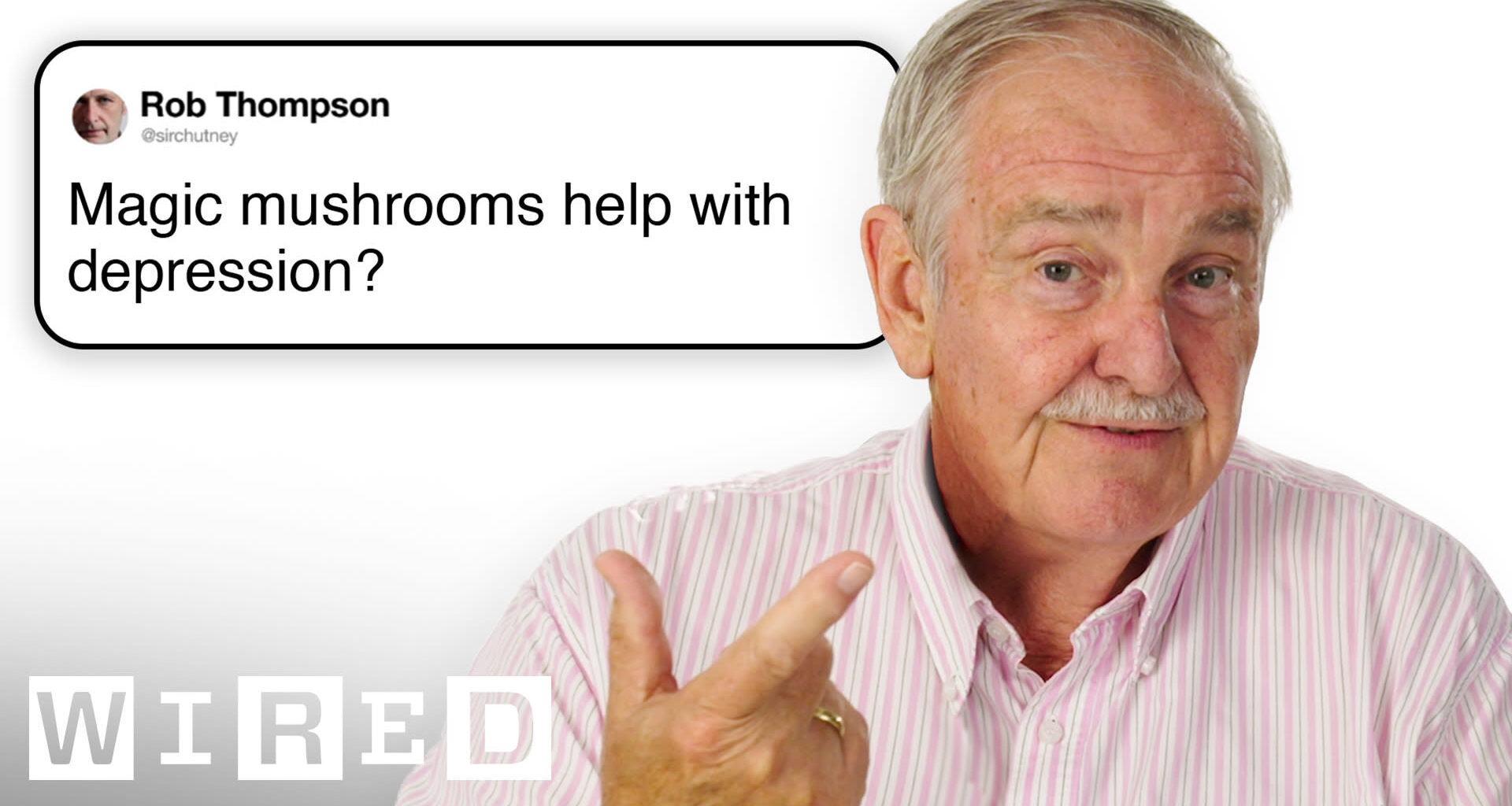
This is from sirchutney.
Apparently, magic mushrooms help combat depression.
Well, it’s hard to feel sad when you’re in a knife fight
with Kermit the Frog.
That’s not anything any of our patients have described,
but I think what you’re getting to is the fact
that there is a conception of prejudice
that psychedelics distort thinking
so you are no longer depressed.
Psychedelics for depression do not work
simply by giving people a good time.
That’s what critics say.
They say, Oh, well, of course.
You know, you give people a really happy trip,
and they come out of it.
They’re not depressed anymore because they’ve had fun
and then that depression will come back.
The truth is, most of our patients,
whether it’s depression or anorexia or PTSD,
the trips are very challenging
because they are having to deal with the consequences
and the reality of their mental illness,
so it’s actually quite insensitive to imply
that they’re just getting off their heads
and having fun and getting better, because they’re not.
They’re working through, often, very deep trauma.
But the second thing to say is that the process
of changing your experience of yourself during the trip
and the plasticity which comes
as a result of the psychedelic,
they put people into a much better place
so they can then use cognitive processes,
psychotherapeutic processes to then lay down new ways
of thinking about their past and new plans for the future.
And that’s where the long-term [keyboard keys tapping]
therapeutic benefits comes from.
This is from foxxytroxxy.
How well understood are the effects of psychedelics
on the brain and consciousness?
The key feature of the state
is that the brain becomes much more integrated.
Parts of the brain which haven’t connected
before become connected,
and that is why people have profound insights often.
But also afterwards, there’s an enduring impact
on learning and memory we call neuroplasticity,
and that is probably responsible
for the very long-term benefits
and insights that psychedelics produce.
The most remarkable surprise
from our research with psychedelics
was the fact that they switch off parts of the brain
rather than switch them on,
which regulate what we see and how we see
and how we think and how we feel.
And that then lets the brain
reorganize itself in a way [keyboard keys tapping]
which is normally not allowed.
[mouse button clicks]
This one is from Chance_Impact_2425.
Psychedelics do cause psychosis, right?
And the answer is wrong.
There is no evidence in the modern era
where we have nearly 20 years
of experimental studies with psychedelics.
However, if you have a vulnerability to psychosis
and if you are psychotic,
psychedelics can destabilize you,
so they can make psychosis [keyboard keys tapping]
different and sometimes worse.
[mouse button clicks]
This is from Crazy_Horse_Rider.
What to do when you’re overwhelmed by the experience?
If the trip is becoming very disturbing
and causing anxiety and fear,
then you need to have prepared an exit strategy.
So, the first thing to say is that you should never trip
unless there’s someone with you who is not tripping,
who can talk you down, who can reassure you,
ground you in the reality that you’re actually still you
and you’re still where you are and you’re still alive,
and you’re not having morphed [keyboard keys tapping]
into some atom in another universe.
This question is from Bouncybeach.
Change my view,
the experiences of someone
who has had a psychedelic trip are no more valid
than a person with psychosis hallucinations.
I’m afraid, Bouncybeach, you are wrong
for a number of reasons.
The main one is that people with psychosis hallucinations
end up being very disturbed by them
and actually often acting out on them
and harming themselves or other people.
That doesn’t happen with psychedelic hallucinations.
But the more important difference
is that people with psychosis
have beliefs which are fixed and usually wrong.
They may think that a neighbor is poisoning them
or that a friend is harming them in some way.
Psychedelics do exactly the opposite.
They actually make people more understanding of themselves
and of their external world.
But I wanna say one other thing,
and this is also very important.
We now know from at least seven studies
that have looked at this that the hallucinations
of psychedelics do not correlate
with the positive changes in mood and attitude and behavior,
so they’re incidental.
What’s critical to the benefit of psychedelics,
if people are getting insights,
getting a sense of being more than they were.
Those powerful subjective experiences,
not the hallucinations, predict good outcome.
So, this question is from highlyaffected.
My therapist keeps telling me about the advances
of psychedelics to treat complex PTSD,
and I’m starting to think she may be implying something.
There is definitely some evidence
that psychedelics can help with PTSD.
There is also some evidence that another drug called MDMA,
that can also be useful in complex PTSD.
And also, really critical to say
that the best outcomes come from having therapy
between the sessions, i.e., after the trips.
I’ve recently seen data from the new group
of patients who are being treated in Australia.
Australia two years ago made MDMA
and psilocybin available for therapy,
and MDMA was specifically indicated
for treatment-resistant PTSD.
And there’s a colleague of mine,
a professor Gunewardene in Sydney who’s now done
over 40 people with chronic complex PTSD with MDMA.
And the results are rather spectacular.
So, for mdmatherapy,
What exactly happens
during an MDMA-assisted therapy session?
The way we engage with these sessions
is to prepare the patients
as to what they’re going to experience,
and they will often experience the coming-up phase.
They might feel a bit of a heart pounding.
They might feel a bit of anxiety.
We reassure them that we’re measuring their blood pressure.
No harm’s gonna come to them.
But the key is when the drug starts to change the brain,
and what we say is,
Go where you need to go.
Use the effect of the MDMA to allow you to deal
with the things that traumatize you.
Go back to the bomb in Iraq.
Go back to the road traffic accident.
Go back to you perhaps being traumatized
through rape or assault.
Go back to those situations, and then we will be with you.
We will support you through reliving those experiences,
which will be unpleasant.
Now, the way MDMA works is to allow people to re-engage
with the memory without the emotion
that comes back [keyboard keys tapping]
with the memory overwhelming them.
[mouse button clicks]
This is dogwater79.
MDMA worsened my depression.
Am I an alien?
Never done any studies on MDMA and aliens,
so I can’t comment on that.
It’s not impossible that MDMA could worsen your depression.
We know that if you use a lot of MDMA
and you do a lot of other things when you’re taking it,
you know, if you dance for hours and hours
and hours and exhaust yourself,
you get very disruptive sleep for a few days.
Yes, MDMA can produce low mood.
That was actually one of the arguments that was used
to try to justify the banning of MDMA because people say,
Well, this is a form of brain damage.
In fact, ridiculous studies were done
where animals were poisoned with enormous doses of MDMA.
Yes, it will cause brain damage.
And in our MDMA study, we looked very carefully at this.
We took people who had quite severe alcohol dependence.
We gave them two MDMA trips,
and after each one, we looked very carefully
at whether there was a negative impact on their mood,
and there wasn’t.
In fact, there was a positive impact on their mood
because MDMA in a therapeutic session, though challenging,
can also lead to improvements in mood and insight.
So, we can say if it’s done right,
MDMA doesn’t cause depression.
[mouse button clicks]
This is from klotsak.
How does ketamine therapy work?
Do you actually have to live through your trauma again?
And the answer is that you don’t.
So, ketamine therapy disrupts your thinking.
And for some people, that’s just good enough.
That gets rid of the thinking about the trauma.
It just cuts it.
But for other people, the trauma may come to the fore,
and you may have to work through it,
so we cannot predict.
What happens for most people is that there’s a period
of two or three days after the ketamine,
where they’re much more able
to think rationally about the past,
the present, and the future.
And that also helps them if they need
to deal with the trauma,
but you don’t have to relive the trauma.
It’s not the same, really, as using MDMA for PTSD,
where re-engaging with the trauma
is quite critical to the benefit.
[mouse button clicks]
This is from girlbrained69.
Canceling this week’s therapy appointment
because I sorted out my inner child healing in a K-hole.
The K-hole is a term that’s used by people who take ketamine
where they get into a state
where they’re completely dissociated.
It’s definitely happened upon something we’re using a lot.
Because ketamine is easier to work with,
because it’s a medicine,
even though it’s an illegal medicine recreationally,
we and others are using ketamine as an alternative
to psilocybin or other psychedelics for therapy.
But we’re using it as a way
of changing the way people think about their problems
to facilitate therapy.
So, we, in our current studies, are doing three,
four, or five ketamine sessions,
usually one or two weeks apart with therapy in between,
and we’re getting outcomes there,
which are pretty similar
to what we get from a single psilocybin treatment.
So, ketamine produces changes in the brain
similar to psilocybin, but not as long-lasting.
And that’s why you need repeated doses
to build up to get the same-size effect.
So, this is from the TherapeuticKetamine subreddit.
Having my first ketamine infusion.
What to expect?
You will feel possibly a bit of flushing to start with.
Maybe your heart pounds a little.
And then you’ll go into a state
where the world doesn’t seem quite so real.
Your vision will start to distort a bit.
Your sense of control of your eyes and your body
will start to become a bit disrupted.
No one can predict what their brain
is gonna go into under ketamine,
but that state is transient.
Ideally, you use it if it takes you somewhere interesting
where you can grapple with a problem you’ve had in the past
or you’re having in present.
But afterwards with ketamine,
your brain is much more tranquil.
And you can then, with your therapist, work on the insights
that you have gained during the therapy,
and build them up and start using them
to develop new strategies for dealing
with how you feel, [keyboard keys tapping]
how you relate, how you deal with the future.
[mouse button clicks]
So, this one’s from kimberlymonthiebailey.
Okay, Trump signs executive order
to loosen restrictions on psychedelic drugs.
And, and what the fuck does that really mean?
I think it’s actually a very positive move,
and it’s positive for two reasons.
I mean, these drugs are still illegal,
so that makes research with them very, very difficult.
Each study takes two years to get permissions,
despite the fact we’ve done loads of them.
We’re still treated as if we’re using
a really dangerous drug in patients,
and that means that the research has been very, very slow,
so I’m hoping this executive order will accelerate access
and will reduce the costs so more studies can be done
and we will get to clinical trials
being finished and reported [keyboard keys tapping]
much more cost-effectively. [mouse button clicks]
This is from @MrcoLeK.
Crazy how nobody talks about ibogaine therapy.
The magic that it works on the brain
is nothing less than a miracle.
Well, I don’t disagree.
Ibogaine is atypical in the sense
that it doesn’t work through the serotonin system
as obviously as, say, psilocybin or LSD.
It’s atypical, and the effects are very, very odd
and very long-lasting.
Often, people are in a kind
of tripped-out state for several days.
Many people describe it as the most powerful,
disturbing experience of their life.
One thing I can say is that people
don’t get addicted to ibogaine.
It’s not very pleasant.
But it is very powerful,
and that is one of the reasons why it’s been used
in perhaps the most difficult of all disorders
to treat, which is addiction.
And there is reasonable evidence
that ibogaine can help break the thinking patterns,
the craving patterns, the behavioral patterns of addiction.
The problem with ibogaine
is that it can cause heart irregularities.
And worldwide, there’ve been over 30 deaths
from people using ibogaine.
We’re now recommending that anyone
who’s having ibogaine therapy at least does it
in a clinic where there’s a cardiologist
who can deal with any cardiac arrhythmias,
irregularities if they occur. [keyboard keys tapping]
So, this is Bryan Johnson,
who says he’s live streaming 5-MeO-DMT this weekend.
What should I expect?
So, 5-MeO-DMT is more usually known as toad.
This is very similar to DMT.
It was first found in the exudates
of the skin on the Sonora Desert toad.
It has an effect which is somewhat different from DMT.
It’s more powerful.
A lot of people say it’s 10 times more powerful than DMT.
It puts you into a state
where you really don’t know where you are.
People often describe it’s either complete blackness
or complete whiteness.
They’re often unaware of what they’re doing.
And we’ve just completed a study
of 5-MeO-DMT trying to image it.
Very difficult to image it because people were screaming,
shouting, running around in a very dissociated state.
We think that’s because the pharmacology
is half a psychedelic,
but it also has some other actions
which we think may change [keyboard keys tapping]
the brain experience. [mouse button clicks]
So, the next question is from __Bohem.
What are your opinions on the future
of psychedelics in the medical field?
We already know that psychedelics
can have powerful effects in some disorders,
particularly like cluster headaches.
Cluster headaches are the most extreme form of headache.
They’re associated with high rates of suicide,
and psychedelics can put cluster headaches to bed.
Another area of considerable research interest
at present is, can psychedelics help heal the brain
which has been traumatized?
One of the things we know is that they increase
the growth of neurons and synapses.
And there are preclinical studies
showing they can accelerate recovery from stroke.
So, currently, a study is going on
where people are given intravenous infusion
at a sub-psychedelic level of DMT, dimethyltryptamine
to see if we can accelerate recovery from stroke
by inducing this growth of neurons,
this phenomenon we call neuroplasticity.
And there are also other disorders
or neurodevelopmental disorders where people often discover
that psychedelics have helped them.
I think the best example of someone
with a sort of little neurological condition benefiting
from a psychedelic actually is Paul Stamets.
When he was young, he had a stammer,
and he took magic mushrooms, and the stammer went away.
And that makes perfect sense
because we know that stammering
is due to a failure of communication
between two sides of the brain.
And magic mushrooms increase connectivity across the brain,
so almost certainly cured his stammer
by increasing that connectivity.
So, this is from Alia2121.
Ayahuasca is not 10 years of therapy in one night,
and I hope this idea starts being marketed.
So, ayahuasca is a drinkable form of DMT,
dimethyltryptamine, is a cocktail of two herbs,
one which contains a psychedelic DMT,
and the other which contains a substance called harmaline.
Harmaline prevents the breakdown of DMT
by the gut and the liver.
Ayahuasca has been used for thousands of years
by Indigenous peoples in the Amazon basin
as part of religious and developmental
and cultural experiences.
Usually in group therapy, usually overnight,
usually with music, the processes are curated
by curanderos or shamans.
It’s very powerful.
For many people, ayahuasca
can be a life-changing experience.
The experience itself is very powerful,
but when it’s used as a therapy,
yes, one or two ayahuasca overnight
can cause profound benefits in people
with traumas, veterans, [keyboard keys tapping]
even with addiction. [mouse button clicks]
That’s all for today.
Thanks for watching Psychedelic Therapy Support.
And if you want to learn more,
feel free to read the book called Psychedelics
by me, Professor David Nutt.
[subtle groovy music]