
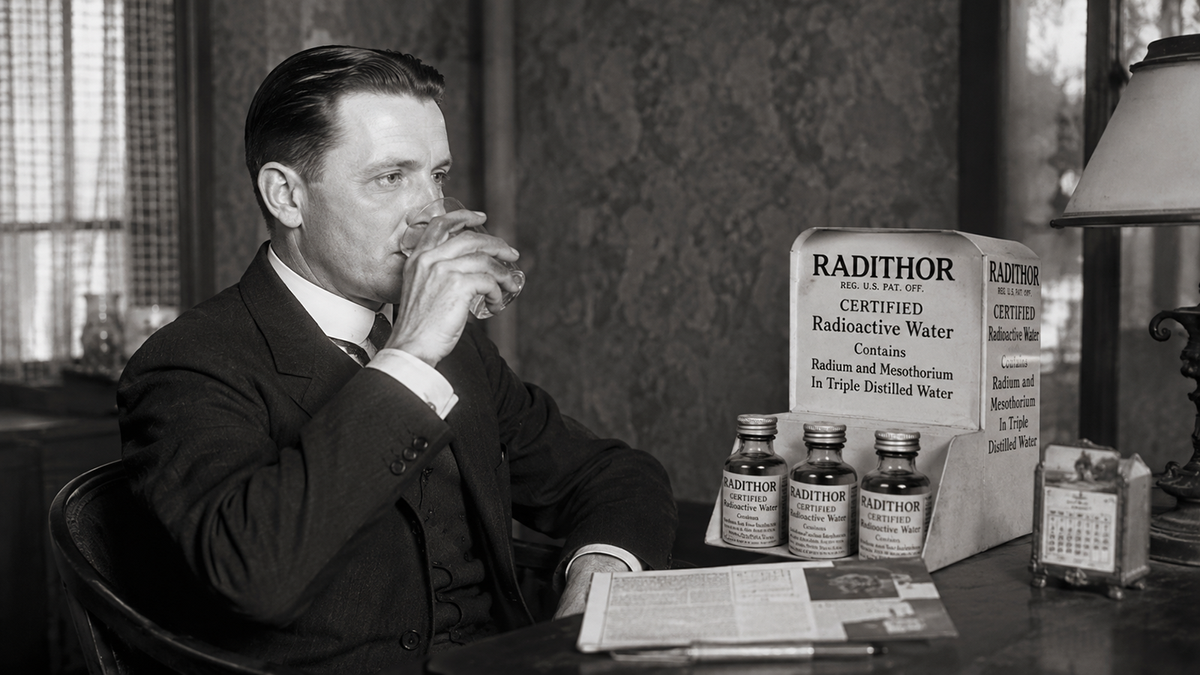
Radium creates a particularly dangerous problem when it enters the human body. Chemically, the element behaves somewhat like calcium, which means the body can deposit it in bone.
Once incorporated there, the radioactive material doesn’t simply sit quietly.
Radium and its decay products emit radiation, including alpha particles. Alpha particles don’t penetrate deeply from outside the body, but radioactive material deposited internally can continually irradiate nearby tissue.
Byers’ health began to collapse.
He lost weight and developed severe headaches. His teeth began falling out. His jaw suffered extensive damage as bone and surrounding tissue deteriorated. Contemporary accounts of his condition were so graphic that his case became national news.
Later analysis concluded that his skeletal radiation dose may have exceeded 350 sieverts, although comparing such prolonged, highly localized internal exposure with a single whole-body radiation dose isn’t straightforward.
Historical medical records attributed his death to a combination that included necrosis of the jaw, a brain abscess, anemia and terminal pneumonia. Modern toxicological references note that those conditions can have other causes individually, but Byers’ enormous radium exposure made his case an important example of chronic internal radiation poisoning.
The damage also reflected what physicians had already seen among the Radium Girls, workers who ingested radioactive material while painting luminous watch and instrument dials. Radium poisoning could produce devastating bone damage after the element accumulated inside the body.
Byers died on March 31, 1932, at Doctors Hospital in Manhattan. He was 51.
Because his remains still contained radioactive material, Byers was buried in a lead-lined coffin at Allegheny Cemetery in Pittsburgh. Scientists exhumed his remains decades later to measure the radium that remained in his bones. Those measurements helped researchers reconstruct the scale of his exposure.