
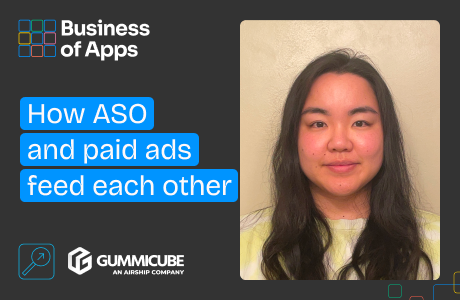
Stephanie Ino is Client Services Manager at Gummicube, an app store optimization company that has worked with mobile developers for over 16 years.
She spoke with tech journalist David Murphy about why paid and organic strategy need to move together, what Apple and Google actually reward, and how the right budget split changes with an app’s maturity.
Key takeaways:
Every acquisition channel eventually routes traffic back to the product page ASO built, making metadata and creative the foundation everything else depends on Apple Search Ads traffic sends Apple additional relevance signals that can lift organic ranking for the same keywords A Google Ads placement inside the Play Store itself sends a comparable signal, even though Google’s ranking algorithm stays largely opaque Younger apps should prioritize building organic relevance before leaning on paid budget Mature apps can shift toward Custom Product Pages and Custom Store Listings tailored to each paid channel’s specific strategy
ASO as home base
Gummicube built its business around custom technology for measuring and optimizing ASO at a global scale, later adding services and paid support on top of that foundation. Stephanie frames the product page as the center everything else eventually returns to.
“With ASO, when we’re optimizing for both metadata and creative, most of any channel will come back into that product page or store listing. We want to make sure we’re building out relevance for the terms we’re targeting, and that the creative converts those users into installs and downloads.”
That foundation requires continuous attention rather than a one-time setup.
“It’s never really a process that ends. Between store updates, new features, and different testing, we’re always figuring out something we can iterate on and improve to support relevance on each storefront, and to convert more of those users into our user base.”
How Apple Search Ads sends organic ranking signals
Two channels carry organic benefits alongside their paid function: Apple Search Ads on iOS and Google Ads on Android. Apple’s relationship between paid and organic is the more direct of the two.
“When we’re running Apple Ads, particularly for SERP results, it gives that boost and relevance so that Apple understands we have better potential to rank organically for those terms.”
The signal isn’t limited to search ad placements alone.
“Apple will take different signals from other placements as well, and also from the layer of Custom Product Pages, which is another lever we can pull from an ASO end.”
Google Ads and the Play Store black box
Google’s ranking algorithm offers far less visibility than Apple’s, but one specific placement produces a similar organic lift.
“Google Ads is a little bit of a black box. One of the placements within the Google Ads campaign is within the Play Store itself. If we have ads running on that Play Store placement, we get that additional relevance, giving a signal into the algorithm that we’re relevant for the terms we’re targeting organically, to potentially rank higher.”
The relationship runs in both directions. Paid traffic lands on organic assets, which means those assets need to already be optimized before paid spend scales.
“When we’re running paid channels and paid ads, they push users over into our organic assets, our product page or store listing. That’s where we want to make sure we have that foundation built out. We have our best converting creative assets, and our metadata built out with the same strategy, so we have a united, consistent strategy across different channels to get the best performance from both ends.”
Balancing paid and organic depends on app maturity
Stephanie was clear that there’s no fixed ratio between paid and organic spend that works across every app.
“It’s difficult to have a blanket answer for how to approach those two pieces. It’s really custom, based on the budget available and the app’s size and maturity.”
For a younger app without established algorithmic relevance, organic comes first.
“If we’re working with a younger app in the storefront, we don’t have that relevance built out yet within the algorithm. We want to focus on organic and ASO performance, build out that foundational element, so that when we have paid budget available, we can push traffic through with a higher potential for placement on the paid side, and come in at a lower acquisition cost.”
For an established app with existing brand awareness, the work shifts toward refining rather than building from zero.
“If we have a partner with a mature app that’s been in the storefront a long time and has brand awareness already, we can go into more customization with the current paid channel strategy, to see where there’s opportunity to lower costs and improve efficiency. Apps that are more mature typically have organic rankings and relevance already built out, so we can look into Custom Product Pages and Custom Store Listings to home in on assets and strategies alongside the other channels running.”
That alignment matters directly to Apple’s own ranking logic, which weighs both sides of the equation together.
“For Apple’s end, when they’re looking at the signals for relevance, they take into account both organic and paid. So we want to make sure the strategy between any partners we’re working with, on both the paid and organic side, is always consistent, and also custom to their unique situations and pain points.”