
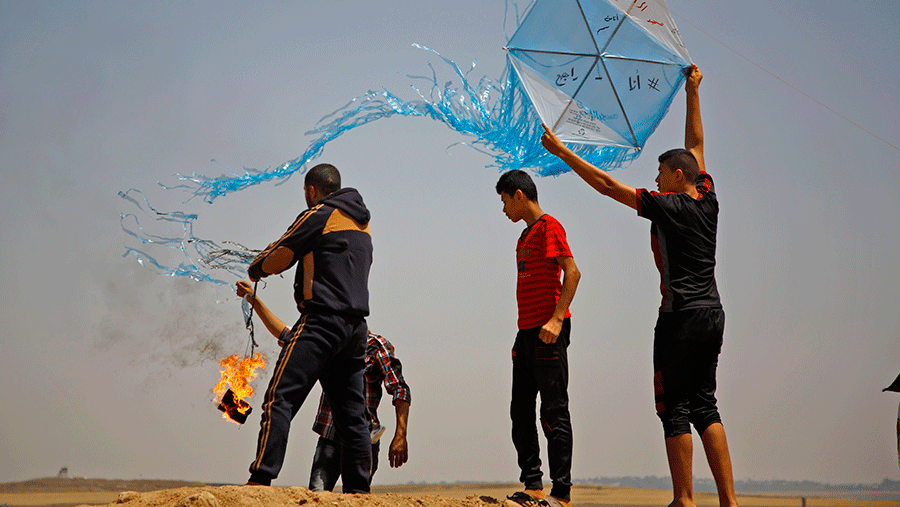
The IDF found nothing suspicious on the objects and said the public was never in danger, but Israeli leaders warned that further launches would bring a forceful response
One of the kites that crossed from Gaza into southern Israel carried a short message in Arabic: “We will never calm down.” It had no incendiary charge or explosive device and, according to the Israeli military, never endangered the public. But after several kites appeared around Nahal Oz in quick succession, residents and political leaders treated them as more than toys caught in the wind.
Ten kites launched from Gaza were located in recent days, none carrying explosives, a military source told Israel’s Kan public broadcaster. The source said the military was examining whether Hamas was testing Israel’s response, but did not present that assessment as a confirmed finding. Prime Minister Benjamin Netanyahu and Defense Minister Israel Katz subsequently warned that further launches could prompt targeted Israeli strikes and the evacuation of areas in Gaza used to send kites, balloons or drones across the border.
The first kite in the current sequence was found near Nahal Oz on Friday, August 21, the Israel Defense Forces told The Media Line. Three more were located when troops searched the area the following morning.
“No suspicious items were found on the kites,” the Israel Defense Forces (IDF) said. “According to initial assessments, the kites crossed the border from the Gaza Strip. At no stage was there a danger to the public,” the military added, saying it remained in continuous contact with nearby communities.
The count continued to rise after that initial statement. By Sunday, Israeli outlets reported that 10 kites had been recovered over several days. Some had unusually long strings, and at least one additional kite was found near Kfar Aza. Israeli security officials cited in local reports said children and young teenagers appeared to have launched them under direction from Hamas members. That conclusion has not been publicly supported with evidence, and the IDF’s direct response to The Media Line did not identify those responsible.
The timing, with all of them arriving together, does not look accidental
Brig. Gen. (res.) Yossi Kuperwasser, director of the Jerusalem Institute for Strategy and Security and a former head of the Research Division in IDF Military Intelligence, said the concentration of incidents made an accidental explanation unlikely.
“The timing, with all of them arriving together, does not look accidental,” Kuperwasser told The Media Line. “It is undoubtedly intended to play on the nerves of the residents of the Gaza border communities. At this stage, it is not intended to cause damage.”
Kuperwasser interpreted the kites as a possible signal from Hamas rather than an immediate attempt to cause physical harm. Israel continues to operate against Hamas members in Gaza, including operatives accused of participating in the October 7, 2023, attack.
“This is an attempt to signal that Hamas is finding it difficult to continue tolerating the current reality, in which Israel has considerable freedom of action in the Gaza Strip and repeatedly acts against Hamas operatives who pose a threat,” he said.
Hamas denied responsibility. Spokesperson Hazem Qassem called the kites “children’s toys in the refugee camps” and accused Israel of using the incidents as a pretext for continued military action. His account does not explain the Arabic messages found on some of the kites or the Israeli military’s assessment that they crossed the border from Gaza.
Israeli security officials have argued that conditions along the border are different from those before October 7. According to reports citing the IDF, Israeli forces now exercise operational control over approximately 63% to 64% of the Gaza Strip and retain broad freedom to act against perceived threats.
Kuperwasser drew a distinction between territorial control and control over the population. Hamas has lost extensive territory, he said, but most Gaza residents are concentrated in the 30% to 40% of the enclave where the organization retains influence. Its civilian and military structures have been weakened but continue to function, he said, while Hamas recruits personnel and attempts to rebuild capabilities damaged during the war.
For residents of Nahal Oz and other communities near Gaza, the concern is shaped by experience. Kites and balloons carrying incendiary devices were used repeatedly from 2018 onward to ignite fields, forests, and nature reserves in southern Israel. Nahal Oz itself was attacked on October 7, and residents have objected to suggestions that the latest incidents can be dismissed because no incendiary devices have been found on the kites recovered so far.
This is how it started before October 7
“This is how it started before October 7,” the kibbutz said in a statement reported by Israeli media. “Initially, seemingly innocent kites with Arabic writing on them were sent from the Gaza Strip. Then, when Hamas realized that the kites were falling in our fields, they attached incendiary materials to them, and thousands of dunams of wheat fields were burned.”
The physical damage caused by earlier airborne incendiary campaigns explains much of that reaction. During the first major wave in 2018, open-source satellite mapping cited by the Conflict and Environment Observatory identified approximately 22 square kilometers, or about 5,400 acres, of burn scars by the end of June. The organization cautioned that the precise number of kite-caused fires was difficult to establish because some fires may have had other causes.
Agricultural losses were estimated at nearly $2 million, including damage to crops and irrigation systems. Israel’s Nature and Parks Authority reported that 10,000 dunams, approximately 2,500 acres, of protected areas had been affected. Fires also killed animals that could not escape and damaged sensitive habitats near Be’eri, Carmia and the Besor Stream.
In June 2021, incendiary balloons launched from Gaza caused approximately 20 fires in southern Israel. Israeli aircraft struck Hamas military compounds and meeting sites in Gaza City and Khan Yunis the following morning. Those were the first Israeli strikes in Gaza after the ceasefire that ended the previous month’s 11-day conflict and the first conducted under the government of then-Prime Minister Naftali Bennett. No casualties were reported from the retaliatory strikes.
The kites recovered recently differ in one essential respect: investigators found no incendiary material, explosives, or sabotage devices. Nevertheless, Netanyahu and Katz decided that Israel should not wait for the kites to turn deadly before responding.
Following a security assessment attended by IDF Chief of Staff Lt. Gen. Eyal Zamir, the head of the National Security Council, and senior military officers, Netanyahu and Katz warned Hamas that continued launches would lead the IDF to increase “targeted strikes against those responsible.” They also said civilians could be evacuated from areas used to launch kites, balloons, and drones.
Katz separately announced a policy of “zero containment and zero tolerance,” saying that “a balloon and a kite will be treated like a drone, with or without explosives.” Katz also took an unusual public swipe at his predecessor. “I am not Yoav Gallant,” he wrote, adding that he would not permit a return to the policy that prevailed before October 7.
The first operational indication of the new approach came on Sunday. According to Israeli media reports, an airborne kite was intercepted and fell back inside the Gaza Strip, marking the first such interception since 2018.
Without Israeli military action, Hamas will not disarm
Kuperwasser expects the dispute over Gaza to move beyond the kites. Hamas is still recruiting and rebuilding, he said, while no force has yet compelled it to surrender its weapons. He dismissed the multinational stabilization force as insufficient for that task. “It is clear that without Israeli military action, Hamas will not disarm,” he said. When the IDF might undertake such an operation, he added, remains unclear.