
This is a rush transcript. Copy may not be in its final form.
AMY GOODMAN: This is Democracy Now!, democracynow.org. I’m Amy Goodman, with Nermeen Shaikh.
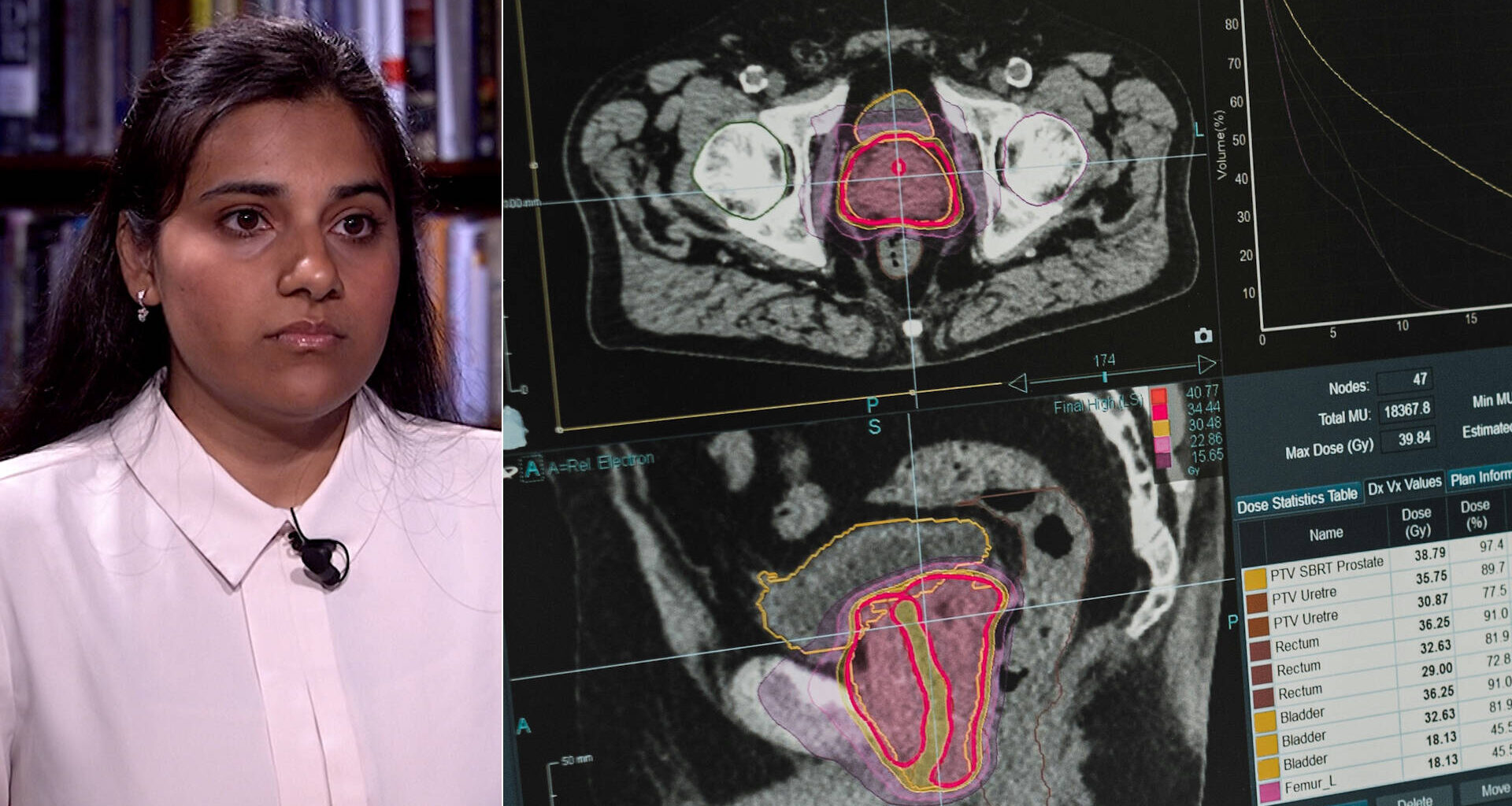
NERMEEN SHAIKH: We end today’s show with continuing our look at how artificial intelligence is changing the world. In recent weeks, we’ve looked at many of the risks of the latest AI technology, from autonomous weapons to rogue AI models to the rapid expansion of data centers. Well, today, we’ll shift our focus to the medical profession and how AI is being used in clinical settings, from radiology to surgery.
AMY GOODMAN: We’re joined right now by Shreya Johri. She’s a postdoctoral fellow at the Dana-Farber Cancer Institute, just completed her Ph.D. at Harvard Medical School last year, where she studied how artificial intelligence can be used to improve medical diagnoses and accelerate biological discovery.
Thanks so much for being with us. If you can start off by helping our audiences understand the different fields of medicine, from surgery to radiology, and how AI has helped and what you see the risks are?
SHREYA JOHRI: Absolutely. So, medicine is really broad. There are — there is surgery, where doctors have to perform procedures, to perform procedures on patients. There is radiology, which is a kind of diagnostic imaging modality, similar to endoscopy also. And there are also professions in medicine where doctors are conversing with patients to identify the symptoms of the patient, diagnosing the patients based on problems that they are having. So, many different kinds of medicine, submedicine professions.
And AI has been impacting different of these in different capacities. So, for example, radiology has been one of the historically most popular subfields within medicine, which AI has impacted a lot. About 76% of the FDA-approved AI models are actually for radiology, followed by cardiology and then others. So, radiology has been at the forefront of using AI for helping in different aspects of diagnosing patients. On the other hand, surgery, as you mentioned, is a little more newer in that space, because it is obviously more complicated. There is a lot of — a lot of things that the doctors have to make sure when they’re doing procedures on patients.
AMY GOODMAN: Judgment.
SHREYA JOHRI: Judgment and expertise that comes over time, things that are not just visual, but also you have to have that sense of pressure and touch of how your instrument is moving. For example, if you’re conducting a brain surgery, you have to be very, very careful. A little bit of shaking of your hand could actually injure the patient a lot. And so, those kind of more critical, more high-risk kind of procedures are still newer in the way AI is impacting them.
NERMEEN SHAIKH: And if you could talk about the difference, like what kinds of AI agents are being used, from large language models to computer vision, and what other AI? You said the majority, of course, is radiology that has been approved by the FDA. What are the others?
SHREYA JOHRI: Absolutely. So, there are two kinds, broader fields of AI. Computer vision is a field in which AI models are trained by many, many medical images. So, these medical images are typically labeled by doctors. That, for example, is a chest X-ray. So, a doctor will label that this chest X-ray has pneumothorax or another condition. And these images are shown multiple times to these models. And the models, after seeing multiple examples, learn from these images. The other kind of — so, the computer vision models are much more older in their use, and that’s why most of the FDA-approved models are also in this space.
Large language models are actually pretty newer. So, they came out in 2022. They were popularized by ChatGPT, which now almost everyone uses. And these are much more nascent in their adoption in clinic. So, these models are trained by, you know, like, downloading all of the data from the internet, all of the books, articles, any blog posts that get written, and these models are trained to predict — to complete sentences. So, these models would be shown partial sentence, and you would ask the models to complete the sentence. Eventually, when you show them multiple of these, and you already know what a good sentence looks like, the models start to learn how language looks like and how to generate new sentences that make sense.
Large language models have been less adopted so far in AI, just because it’s very nascent technology — not to say that they are not evolving rapidly. They are growing a lot in capability. But FDA right now does not have a proper protocol for how to even approve the use of these models for very important decisions, like a diagnosis or a treatment decision, because these models are still not as well understood.
So these models have been used in different medical practices and different hospitals for simpler tasks, so, for example, summarization of a patient’s history. So, if a patient has been coming to hospital for 10 years, you have many, many clinical notes, summarization of that. They’ve also been used for communicating with the patient more effectively, so doctors are spending less time on maybe writing notes for — notes that capture the patient’s condition, but they’re also able to talk more to patients and deliver better care and express more empathy for their condition, which actually has been shown to have better outcomes for patients. So, that’s the broader two separate use cases of these.
NERMEEN SHAIKH: And if you could talk about the way in which — like, how does AI help, for instance, in a colonoscopy? How does it help with a mammogram? And how widely is AI being used, at least here in the U.S., for those two tests?
SHREYA JOHRI: Of course. I can talk about a colonoscopy first. So, in colonoscopy, typically, there’s a live — there’s a monitor which has a live video feed of the patient’s colon, and the endoscopist looks at that in real time to identify masses of cells that have overgrown. So, these are called polyps, and they are typically either cancerous or precancerous, and it’s very important to treat them. The way AI has been deployed right now, and it’s also FDA-approved, is anytime the — in the real-time video stream, the model detects a abnormality, the model makes a box around it. So, the doctor can continuously see that box whenever there is some abnormality. So, just in case if it’s a very subtle abnormality, no one misses it. So, that has been used in colonoscopy especially for colon polyps, so colon cancer detection. And colon cancer screening is done for everyone over 45 years of age.
In mammograms, chest X-rays, CT scans, which is the scope of radiology, typically AI models have been used as either a second reader — so, a radiologist would read it, read the same image or the chest X-ray, and the AI would read the same, and they — people have tried to see how AI can help in either triaging of cases — for example, if it’s a high-risk case, a doctor reads it; if it’s a low-risk case, then AI plus a doctor reads it. And so, there are multiple studies that have explored how it can be used.
AMY GOODMAN: Can you talk about the Swedish study that just came out on breast cancer?
SHREYA JOHRI: Yes, yes, of course. So, in the Swedish study, they had a lot of patients who they divided into two groups. One group was — in one group, the mammograms were read by AI first, and then by a radiologist. In the other group, the mammograms were read by two radiologists. And they tried to compare if AI plus radiologists, separately, led to a higher detection of cancer, and what happened to the false positive rates across these two groups. And they found that — found a very nice finding that the radiologist — the radiologist followed by a human reviewer actually led to more cases that were being detected.
AMY GOODMAN: This is the radiologist and AI.
SHREYA JOHRI: Yes. And then, the false positive rates were actually similar. It’s a very promising study. It actually shows that you can have AI as a second reader and still have really good results.
One of the things also to note is that the final decision was still made by the radiologist. The AI was not autonomously acting here. And the radiologist read it after the AI, so radiologist was like the final decision-maker. So, I think those are nuances to keep in mind as we think about how AI will be deployed in medicine and how we are making sure that humans are taking decisions, end decisions, for a diagnosis or a treatment plan for a patient.
NERMEEN SHAIKH: Yeah, and just to clarify about that study, there were over 100,000 women, so it was a large-scale study. And also last week, another major development: The first brain surgery using live artificial intelligence assistance was performed successfully last week in London. So, if you could talk about the significance of that? How important is that?
SHREYA JOHRI: Yeah, I think it’s a really big milestone, I think, especially in the field of surgery, which is a very complicated field. In that clinical trial that was being done, the researchers had developed an AI model that could basically detect a small part of the intersection between a pituitary gland and the bone. And they were trying to make sure that whenever the surgeon reaches that part, they’re able to see clearly that this is where the pituitary gland is, this is where the bone is, so they don’t accidentally nick any of them. It’s very interesting, because if you look at the way they had deployed it and if you read into the details, it is nontrivial to have a really big AI model work in real time in the way that it was assisting in surgery. So, I think it was a very good example of how you can use AI that gets developed in a research lab, deploy it on hardware that is in the hospital, in a responsible way, and have doctors use it to perform surgeries.
One interesting thing about this study was that the AI could be switched on and off at any point in time by the doctors, which is the way in which you establish trust. So, for example, a doctor — there were a couple of patients in that study. In two of the cases, the doctor did not decide to use an AI, because they felt that they wanted to do it without the AI. And they were able to switch off the AI using a pedal at the bottom. So, it allows doctors to be still in control, but use the AI to the maximum benefit.
AMY GOODMAN: So, this is a critical point, is the doctor’s intervention. And I’m wondering if you can talk about — I mean, in breast cancer, it was stunning, something like the AI-supported screening detected 29% more cancers. But what —
NERMEEN SHAIKH: Yeah, that was the Swedish study.
AMY GOODMAN: Yes.
NERMEEN SHAIKH: Yeah.
AMY GOODMAN: In the Swedish study. And yet, what about the risks of people just, you know, relying on AI to diagnose themselves? And your concerns about this being used as a way to actually not help doctors, but to replace doctors?
SHREYA JOHRI: Yeah. I think, in real life, medical cases are quite complex. So, a lot of the times, we see accuracy being reported, but those are accuracy on cases which are simpler sometimes. It’s very important to note that doctors, when they make medical decisions, are looking at sometimes a lot of complexity of cases. For example, for mammograms, if someone has dense breast tissue, it is much more harder to detect that breast cancer. If it’s not as dense of a tissue —
AMY GOODMAN: We have 20 seconds.
SHREYA JOHRI: If it’s not that much of a dense tissue, then it becomes easier. So, I think it’s really important to note that doctors have to be responsible, have to take the responsibility of this, until we are more confident we have, like, frameworks developed that can, you know, like, deploy these AI models in a more responsible way.
AMY GOODMAN: Well, this is clearly the beginning of an extended discussion. Shreya Johri, we want to thank you so much for being with us, postdoctoral fellow at the Dana-Farber Cancer Institute, who studied how artificial intelligence can be used to improve medical diagnoses and accelerate biological discovery.
That does it for our show. I’ll be in Madison, Wisconsin, on Saturday night at the Barrymore Theatre, two events on Sunday in Chicago. Check out democracynow.org. I’m Amy Goodman, with Nermeen Shaikh.