
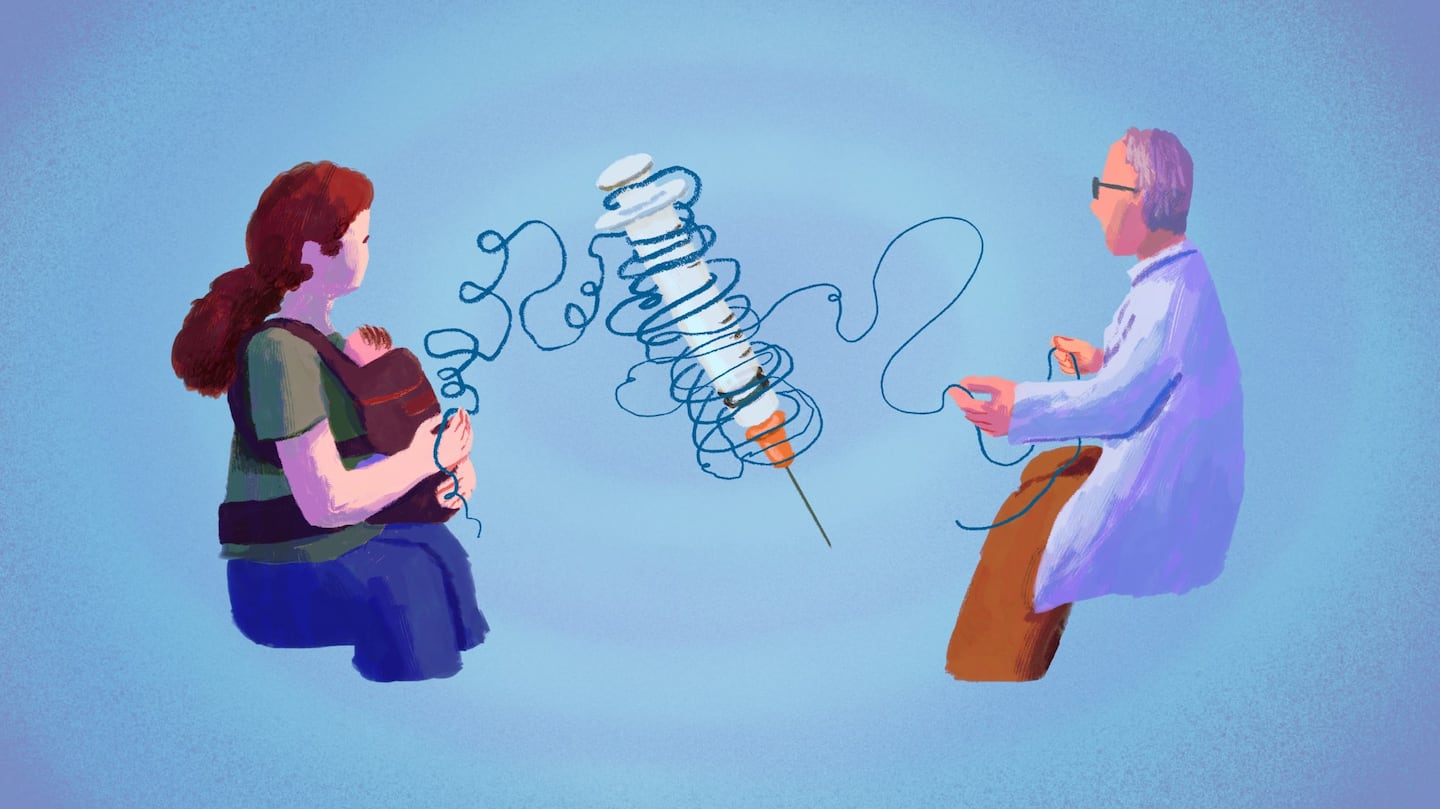
That wasn’t a good enough answer for her, and that was why she was here at Middleboro Pediatrics at 4:45 p.m., meeting a new doctor named Aaron Bornstein. They were auditioning each other. She was testing his willingness to take her concerns seriously, without judgment. He, meanwhile, was probing just how wary of his medical advice she might be if her daughter became his patient.
“My argument is —” but then her baby began to fuss, and she reached out to comfort her. “My argument is, what happened to my body, my choice?”
She looked at Bornstein. He was leaning back in his armchair, wearing a blue button-down, a popsicle-pattern tie, and butterfly-pattern socks — professorial with a dash of Ms. Frizzle. It was an outfit selected for the pressures of his job, which could involve explaining statistics for a parent while discussing zoo animals with a 5-year-old. The work had been getting harder. Conversations about vaccine hesitancy that might have happened once a month were now happening two or three times a week. Rhetoric that had lurked in conspiracy-minded corners of the internet was now coming from the federal government.
In January, the Trump administration bypassed normal procedures and slashed the number of recommended childhood vaccines, a change that public health experts saw as a dangerous deviation from evidence-based practice. A judge struck down the new schedule, but last month, President Trump signed an executive order demanding that life-saving combined immunizations be separated. Vaccine confidence is lowest in the MAGAverse — 80 percent of Democrats report trusting immunizations, while only 48 percent of Republicans do — but the trend is visible even in Massachusetts. Bornstein couldn’t help but notice “We The People” tattooed on this mom’s forearm.
This conversation was a compromise. Many independent pediatrics practices had dismissal policies like the one this mom had come up against in Fall River. But amid these federal changes, some doctors wondered about the best tack. Should they double down? Should they allow parents wiggle room, given that the government was recommending one vaccine schedule and the American Academy of Pediatrics another?
Middleboro Pediatrics wouldn’t tell parents to go elsewhere if they didn’t vaccinate. They welcomed those families. When a nearby clinic formalized a dismissal policy earlier this year, Middleboro got a flood of new patients. “Almost like a practice of last resort,” said Martin Gross, one of Bornstein’s partners.
They did have some stipulations, though. One was a meet-and-greet, so the pediatricians could understand a parent’s concerns — but also just how far that fear had spread. “If I think your child’s got a bad infection, will you reject my recommendations for antibiotics? Are you going to reject my ability to do an adequate evaluation?” Bornstein said. “I need a level of trust that you’re coming here because you want my guidance. If you’re going to reject all of that upfront because you don’t trust anything about my incentives or my expertise, then this is not a match.”
Misleading averages, alienated families
On the face of it, everything might not look so dire. Most parents report trusting childhood immunizations, and the most recent national coverage rate for the measles, mumps, rubella vaccine is 92 percent, a seemingly small drop from the 95 percent around which it hovered from 2015 to 2020.
Not too shabby, you might say. Then again, 95 percent is the level of uptake needed to prevent outbreaks. More measles cases were recorded in the US in 2025 and 2026 than in the previous 24 years combined, leading to the first measles deaths in nearly a decade. “The average is not really representative,” explained Rochelle Walensky, former director of the Centers of Disease Control and Prevention. “I always say: Your head is in the fridge, your feet are in the oven, and on average, you’re fine.”
Take the measles outbreak that engulfed Spartanburg, S.C., from October to June. The state’s MMR vaccination rate was 94 percent. The county’s was 89 percent. But at the school linked to the first cases, only 17 percent of students had proof of required immunizations.
Like politics, disease risk is local: a vast public health problem that often fell to each doctor as an individual, no matter if each appointment was only supposed to last 15 minutes. “The amount of time and effort involved in dealing with these families became untenable,” said retired pediatrician Jesse Hackell, who has authored AAP reports on vaccine hesitancy.
That is one argument for dismissal. Another is the contagion risk posed by having an unvaccinated child in a waiting room alongside infants and kids with immunodeficiencies. Yet another is to convey that getting your child vaccinated is the cornerstone of modern medicine and the best advice a pediatrician can give.
“Over 20 years, we probably only dismissed a handful of families — because drawing a line in the sand seems to indicate to most families how seriously we take this,” Hackell said.
But that could push away others who might’ve come around. “Families have been brave enough to come to health care, often feeling alienated from it, and then they get this coercive declaration, which then alienates them even more,” said Julie Leask, professor at the University of Sydney.
Middleboro’s meet-and-greets were a middle ground. They were inconvenient — uncompensated conversations, longer than appointments. They could be frustrating. There were sometimes insults, even threats. Practices could be penalized for taking such patients. Vaccination rates are among the metrics on which insurers measure physicians’ success.
Then again, dismissal is unenforceable for any Massachusetts physician who sees patients on Medicaid. But Middleboro’s reasoning was mostly philosophical. Kids don’t choose their families; vaccine-hesitant parents are not a single bloc. Taking this unpaid time, Bornstein hoped, might even help convince some to vaccinate once there was a sense of trust.
“We don’t kick people out. We work with people,” he told that mother, who asked not to be named in this article. “The one thing I will say is this. If we have a family who chooses not to vaccinate, there’s a form that we have you sign that just says we had that conversation. It helps protect us from liability.”
“Understandable. In case something did happen and she did get something that a vaccine could have …” she paused, “postponed, or, you know… prevented.”
She laughed, as if the idea were absurd. Bornstein didn’t correct her. “That’s exactly it,” he said, going on: “So whooping cough and measles are both very contagious diseases —”
She interrupted him: “Yeah, but it’s not just the measles vaccine, is it? It’s MMR.”
“It’s MMR,” he agreed. “But for those two, if a child has not been immunized by a certain age, we don’t let you in the waiting room, we room you directly from the car.”
She might have balked, or accused him of treating unvaccinated people as second-class citizens. There was still time for that. But now, all she said was, “OK.”
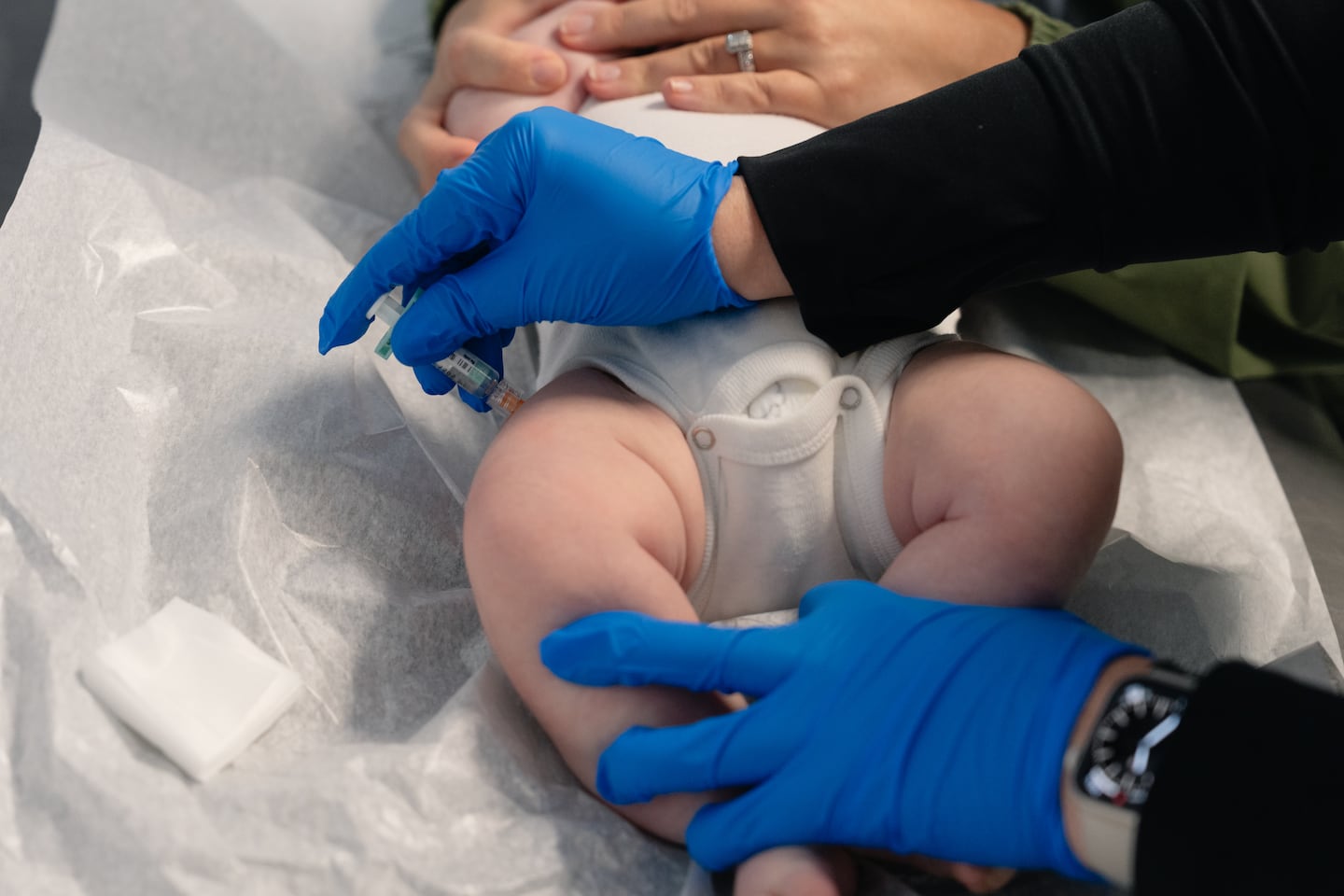 One of Aaron Bornstein’s patients receives a vaccine.Lucy Lu for STAT
‘I want my child healthy’
Bornstein could still feel the horror, over 25 years later. He was a medical resident in Chicago, working in the emergency room, when an unvaccinated infant arrived. The trouble was an abscess on the child’s neck, swollen, red. This wasn’t an illness that would have been prevented by a vaccine, but Bornstein could detect a through line of distrust. He needed to admit the kid, do blood tests, and start antibiotics, but the parents refused. Bornstein wasn’t sure what to do. Without treatment, the illness could be fatal. Treating against the parents’ wishes would entail calling authorities and requesting an emergency removal.
That was the sort of scenario he hoped to avert with these meet-and-greets. In that case, the conflict was resolved without child protective services. “An older, sager ER physician asked, ‘Is this their first kid?’” Bornstein recalled. “I said, ‘Yeah.’ He said, ‘Have them call the grandparents’ — and the grandparents made the kid stay in the hospital.”
The worry he had about mistrust extending beyond vaccines wasn’t just theoretical. More parents are now refusing the routine vitamin K shot to help newborns’ blood clot, leading to an uptick in hemorrhages.
“I got her vitamin K shot in the hospital because I’m not dumb. I want my child healthy,” the mother told Bornstein. “But I was like, can’t I just do the preservative-free one?” To her, the fact that they made shots without preservatives seemed like proof that the normal shots had unnecessary ingredients. She worried about those chemicals. But she also worried about seeming stupid for worrying, or being judged a negligent parent. She’d hated how the nurses made her feel bad for refusing the first dose of the hepatitis B vaccine.
She was 29, a truck driver living in a former shipping hub in Southeastern Massachusetts. “I was actually in school to be a doctor. I started college at 16,” she told Bornstein.
“You are someone who clearly pays attention to detail,” he said. “You’ll be the right person for our practice, I think.” He started gesticulating as he described the vaccine schedule, how whooping cough was most dangerous under the age of 1, which meant it was important for that vaccine to be given in infancy.
 Physician Aaron Bornstein at Middleboro Pediatrics in Lakeville, Mass.Lucy Lu for STAT
“But at the same time, everyone’s body is different,” the mother said. “You could have a majority of people that react perfectly fine to it, but there’s still going to be people that probably don’t react fine to it. But what happens if they just didn’t test those people?”
Bornstein smiled. Now he was getting somewhere. He wanted parents to bring up their specific concerns, something he could engage with. If they wouldn’t tell him what they were worried about, there was little he could do. He explained that her question was one scientists had to address in designing vaccine trials: Did they have enough people enrolled to look for those rare side effects? Last year, for instance, there’d been a big Danish study of data from 1.2 million people over 24 years; it showed that the conditions vaccine-skeptical groups often blamed on immunizations — autism, say — were no more common in the vaccinated group than in the unvaccinated.
The mom piped up. “I just feel it’s weird. Like my baby’s healthy. Why am I gonna then inject her with stuff?”
“It’s a great question,” Bornstein said. “Our job for you is to help interpret risk and benefit, right?”
He was a father himself, he said. He wouldn’t recommend anything that he wouldn’t give his own kid. He wanted to talk through the risks and benefits of every vaccine with her — yes, the risks, because vaccines, like medications, could indeed have side effects, and she should know about them — while also weighing that against what might happen if her child caught a preventable disease that she hadn’t been vaccinated against. But the choice would always be hers.
“I don’t have the authority to do anything to your child, right? I have the authority to give you advice,” he said. “We encourage vaccines. But it’s equally important that you feel comfortable with why we’re doing it, and that the risks are low enough. Your question: Why would we give it to a healthy kid? You know, the silly analogy is, it doesn’t help putting the seat belt in after the car crash has happened.”
Statistical risks, anecdotal anxieties
The example that always jumped to mind for Bornstein was an earlier version of the rotavirus vaccine, first recommended as a routine immunization in 1998, to prevent tens of thousands of infants needing to be hospitalized for severe, potentially life-threatening diarrhea annually. But doctors noticed an uptick in a condition called intussusception in which one bit of intestine slides inside another, like the segments of a pirate’s telescope. A study found the increase was linked to the vaccine, and it was taken off the market in 1999.
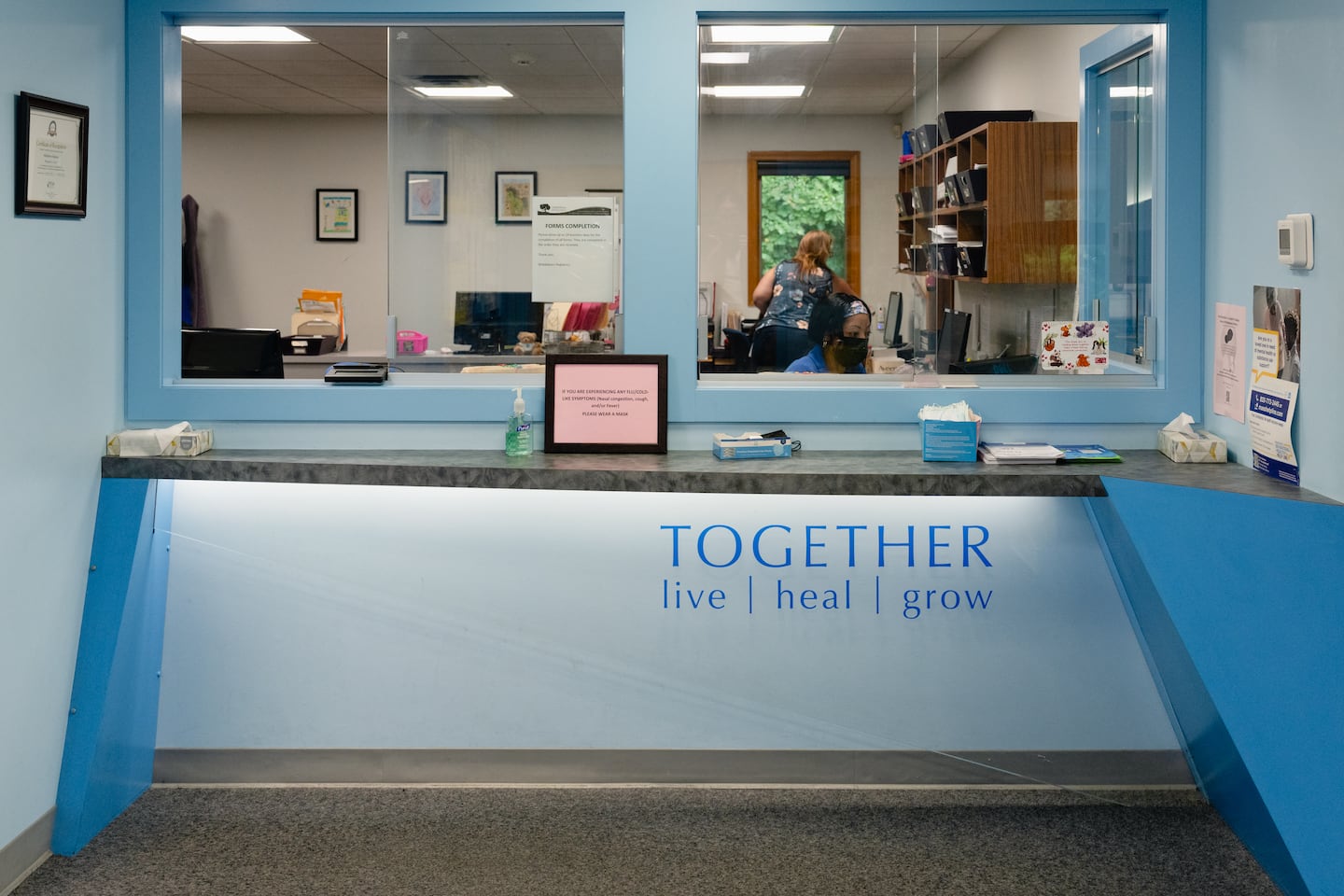 The front reception at Middleboro Pediatrics.Lucy Lu for STAT
Newer rotavirus vaccines are now available. They’re associated with a slight increase in intussusception risk, but that risk is a sliver of what it had been for the earlier vaccine, and the benefit was thought to outweigh it: Per one Australian study’s estimation, the vaccine might be linked to 14 cases of intussusception a year, but would prevent 6,500 gastroenteritis hospitalizations.
This mom was generally worried about undisclosed or undiscovered risks, but this episode hadn’t come to her attention. Her anxiety came from a more recent anecdote she’d heard.
Bornstein was explaining that the rotavirus vaccine was oral, that the disease had once been a leading cause of hospitalization in infants, that it caused severe vomiting and diarrhea and —
But then the mom interjected: “I don’t like that it’s oral. She chokes on her damn formula, I don’t need her choking on a vaccine.”
“It’s like 1 milliliter. It’s tiny.”
“My friend’s son just had that and choked on it. The nurse grabbed him from her and had to sit there and smack his back like crazy.”
“I would say that has not been our experience. Some of it —”
“That was in Maine, though.”
“Some of it is how you administer it. If you put a dropper in the back of the throat, it’s like putting a turkey baster in the back of your throat. You’re going to gag. You have to tuck it in the cheek.”
She kept telling this story, even as he explained that this had more to do with how that nurse had given the vaccine rather than the formulation itself, that pediatricians used to see a ton of kids hospitalized with rotavirus but now it was much rarer because of these newer vaccines.
Eventually, the discussion quieted down and moved on. She had a few insurance questions. Then it was time for her to go. She picked up the carrier, and headed out to the car.
Not everyone who did a meet-and-greet came back. Some didn’t want to talk so much about vaccines and stormed out. Others never called to book a first appointment. Bornstein walked down the hall back toward his desk, past patients’ artwork: a painting of stick figures with what looked like flowers for hands, a Thanksgiving drawing expressing gratitude for the existence of chorizo. He wasn’t sure whether this mother would enroll her daughter as a patient. But if he had to guess, he’d be seeing her soon.
STAT’s coverage of trust in science and public health is supported by the Dana Foundation, Greenwall Foundation, John Templeton Foundation, and Boston Foundation. Our financial supporters are not involved in any decisions about our journalism.