

Changes in A kinase anchoring proteins, or AKAPs, have been linked to several hallmarks of cancer, including the ability of tumor cells to grow and spread. One member of this family, AKAP2, is known to promote cancer cell migration in prostate and ovarian cancers, but its role in breast cancer has remained unclear.
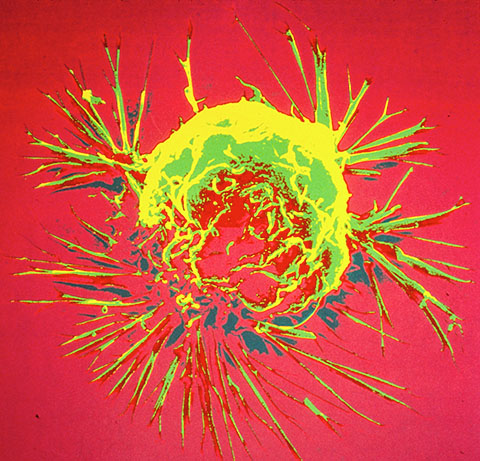
Bruce Wetzel and Harry Schaefer, National Cancer Institute, National Institutes of Health, via NIH Flickr
Shown is a 3D rendering of a breast cancer cell imaged by scanning electron microscopy. Although cancer cells are best identified by their internal features, scanning electron microscopy can reveal how cells respond to changing environments and show the distribution of binding sites for hormones and other biological molecules.
In a recent study published in the Journal of Biological Chemistry, Kacey Rosenthal, a graduate of the pharmacology program at the University of Washington School of Medicine, John D. Scott, a professor of pharmacology at UW, and their team found that AKAP2 is required for the growth and metastasis of triple-negative breast cancer, or TNBC.
The findings reveal a previously unknown role for AKAP2 in TNBC, one of the most aggressive forms of breast cancer.
“We found that in triple-negative breast cancer, AKAP2 is more highly expressed compared to other subtypes, and plays a role in how the cancer cells move and grow,” Rosenthal said. “The scale with which it impacted growth and motility was surprising.”
Scott’s laboratory previously showed that AKAP scaffold proteins organize signaling pathways involved in diseases including cancer, diabetes and cardiovascular disease. While their earlier work on breast cancer focused on another family member, dAKAP1, Rosenthal turned her attention to the lesser-studied AKAP2.
The researchers first showed that AKAP2 is elevated in TNBC tumors and cell lines. Using proximity proteomics, they then found that the protein localizes to cell junctions and focal adhesions.
To further explore AKAP2’s role in cell motility, they silenced AKAP2 in TNBC cells. They found that AKAP2 depletion decreased levels of focal adhesion kinase and diminished the phosphorylation of the cell-motility adapter protein paxillin. AKAP2 depletion also reduced the mean speed of cell migration by almost half.
The researchers then transplanted TNBC cells into mice and induced AKAP2 knockdown in their tumors. Tumors grew much more slowly and showed reduced metastatic potential. Notably, loss of AKAP2 appeared to reduce the number of metastatic lesions in the lungs of these mice.
“Just seeing the scale with which the tumors grew so much less than the controls was definitely surprising to us,” Rosenthal said. “I think that really supports the idea that these scaffold proteins bringing complexes together do have a really important function in health and especially in disease.”
“The findings also underscore why understanding the mechanisms that drive cancer cell movement is so important,” Scott said.
“If women with breast cancer are to succumb to the disease, that normally happens through metastasis, through the movement of cancer cells, which is exactly what we’re studying,” Scott said. “Understanding how these signaling complexes are organized in these cancer cells is a really important fundamental element that’s often overlooked in drug studies.”
While more work is needed before these findings translate into treatments, the study identifies AKAP2 as a promising target for TNBC. Scott said the long-term goal is to develop therapies that act within specific subcellular compartments — for example, targeting the cytoskeleton without affecting the nucleus — allowing researchers to more precisely disrupt the signaling networks that drive cancer growth and metastasis.