

MAST Studio Balances Open Halls with Enclosed Exhibition Spaces
At Gary Tatintsian Gallery in Dubai Design District, MAST Studio brings two distinct settings for viewing art into one space: open white exhibition halls and an intimate museum room. Designed by Vladislav Gaiduk, founder of the multidisciplinary architecture studio, the 338-sqm interior responds to a brief for a flexible gallery that meets international curatorial standards and accommodates work ranging from paintings to installations. The layout began with an L-shaped unit. MAST reorganized it around a clear rectangular volume, placing an office area at the center and an exhibition hall on either side. A separate portion contains the museum room and storage. Keeping partitions to a minimum gives large works room to be viewed, while walls that stop below the ceiling maintain continuity across the interior. The glazed shopfront shaped another key decision. Although useful for retail, the extensive windows reduced the wall space available for displaying art. MAST introduced walls parallel to the glazing, leaving a passage between the glass and the exhibition surfaces. The resulting arrangement allows the storefront to announce exhibitions and offers partial views from the street. Visitors can glimpse the interior through the openings, but must enter to see the works fully.

the glazed entrance gives the gallery a restrained street presence in Dubai Design District | all images ©Nikita Subbotin
Light and Materiality Define Two Distinct Exhibition Atmospheres
Light reinforces this balance between openness and enclosure. Gaps above the walls admit the soft, almost cave-like light described by the designers, while the white halls provide a neutral background for the collection. Furniture remains largely functional, including two shelving units made to MAST’s drawings for catalogs and documentation in the office area. The museum room introduces a different atmosphere. Set behind a large partition, its oversized entrance signals the importance of a space with more restricted access. Dark brick-colored MDF panels retain their raw texture, and subdued lighting directs attention towards the works. The panel joints give the walls a measured rhythm, creating the sense of a box enclosing the collection. The designers drew inspiration from the National Museum of Qatar in Doha and Louvre Abu Dhabi. Within the room, the material texture forms a dialogue with the contemporary gallery, echoing the juxtaposition of Chubarov’s painting and ancient objects in niches. Elsewhere, the exhibition brings together contemporary artists working in different media, including Peter Halley and Tony Matelli. Halley’s works explore interconnected spatial structures, while Matelli’s highly realistic sculpture introduces a theatrical tension. Across these different encounters, MAST’s interior provides a continuous, carefully proportioned setting that can adapt to future exhibitions.
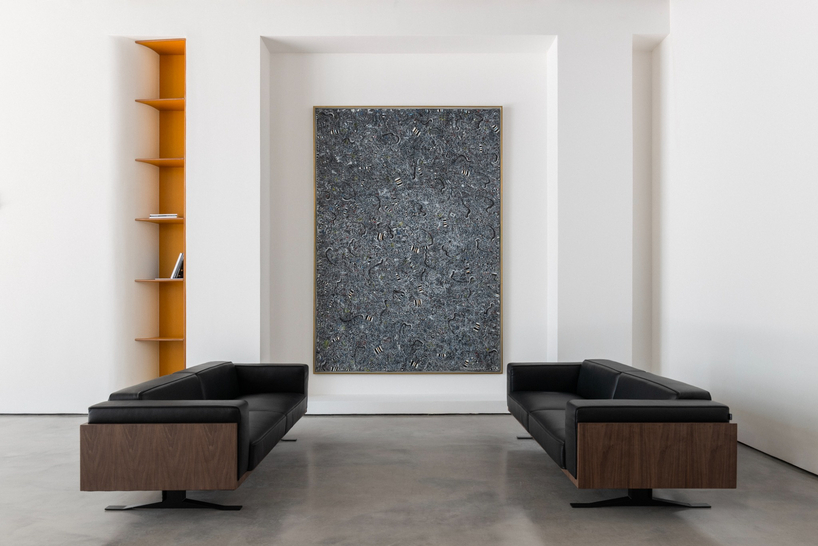
a seating area and recessed wall niches organize the central zone of the gallery

white display walls stop below the exposed ceiling, with Tony Matelli’s sculpture partially visible at the rear

dark seating and a yellow shelving niche punctuate the white interior

a narrow opening beside the facade brings daylight into the exhibition hall

a rounded partition edge marks the transition between the exhibition hall and central zone

walls stop below the ceiling, maintaining visual continuity between the exhibition zones