
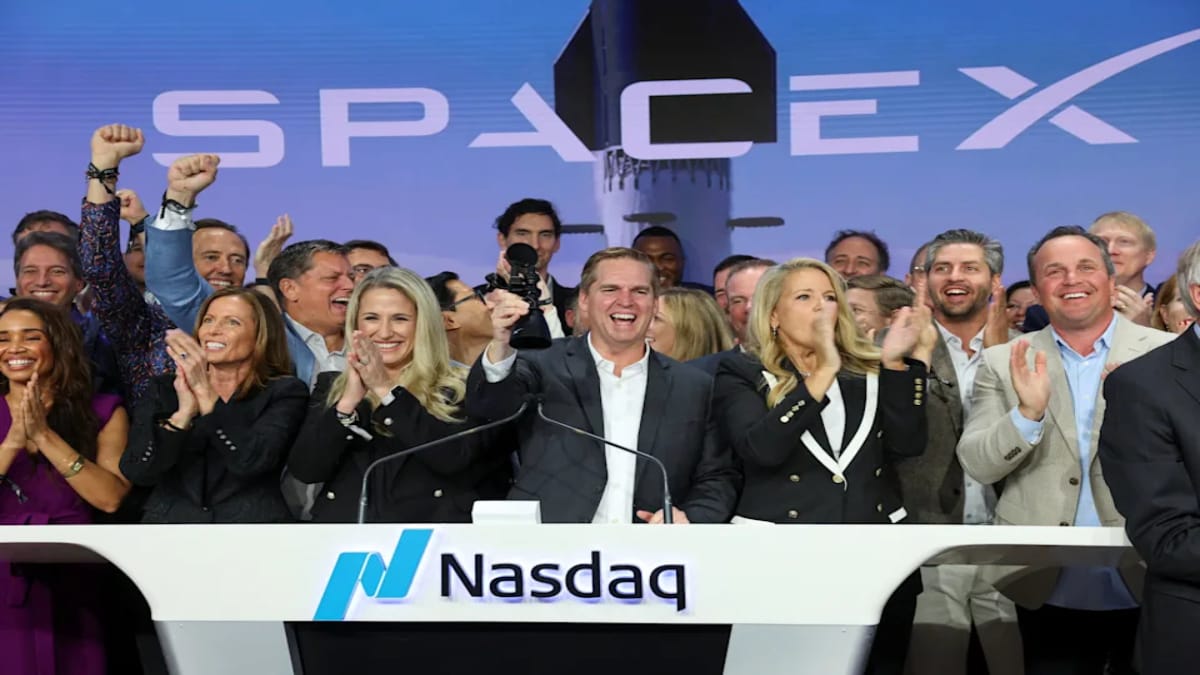
SpaceX is moving closer to one of its most ambitious revenue targets after securing another major deal to provide artificial intelligence computing capacity, strengthening the company’s position as an emerging player in AI infrastructure and pushing it closer to its goal of reaching $100 billion in annual recurring revenue (ARR) this year.
Speaking at the Goldman Sachs Communacopia & Technology Conference in San Francisco, SpaceX CFO Bret Johnsen revealed that the company had signed a new agreement under which it will lease computing capacity to third-party clients, marking another major expansion of its terrestrial computing business tied to artificial intelligence.
Johnsen said SpaceX was “on track” to reach its $100 billion ARR target, emphasizing that AI computing deals have become one of the company’s key growth drivers.
He disclosed that the new agreement, which was finalized earlier in September, is expected to generate approximately $1.11 billion per month starting December 1, equivalent to roughly $13 billion in annual recurring revenue.
From Rockets to Data Centers: AI Is Reshaping SpaceX’s Business Model
The new deal highlights a major transformation in SpaceX’s business model. The company, long associated with rocket launches, satellites, and space exploration, is increasingly benefiting from the unprecedented demand for computing power required to train and operate artificial intelligence models.
Computing is no longer merely a side business for SpaceX. It is rapidly becoming a major source of recurring revenue that could eventually rival — or even surpass — some of the company’s traditional businesses.
The latest agreement comes on top of several major computing contracts SpaceX has already secured.
Earlier this year, the company announced a deal with Anthropic worth $1.25 billion per month, equivalent to approximately $15 billion in annual recurring revenue, as well as another agreement with Google worth $920 million per month, or roughly $11.04 billion annually.
Market analysts have also pointed to another $6.7 billion, six-month agreement, equivalent to approximately $13.4 billion in annual recurring revenue.
According to analysts, that contract could be linked to the U.S. Department of Defense, although this has not been officially confirmed.
Why SpaceX Is Winning in the AI Compute Race
Louie DiPalma, an analyst at William Blair, said one of SpaceX’s biggest competitive advantages in the computing market is its ability to deploy computing capacity faster than its peers, allowing it to capitalize on unprecedented demand for AI infrastructure.
This highlights a fundamental shift in the AI race. Competition is no longer limited to developing advanced models and software; it increasingly revolves around securing the computing power, energy, data centers, and GPUs required to run those models at scale.
SpaceX is also benefiting from its close relationship with Nvidia, which provides the company with priority access to advanced graphics processing units, a critical advantage in a market facing enormous demand for high-performance chips used in AI applications.
In other words, SpaceX is not simply betting on AI as a product. It is moving into one of the most strategically important layers of the AI value chain: providing the computing infrastructure that other companies need to build and operate their AI products.
$45.7 Billion in ARR From Just Four Deals
The four deals cited above — without accounting for other agreements SpaceX may already have in place — could generate approximately $45.7 billion in annual recurring revenue beginning in December.
When combined with roughly $4 billion in annualized revenue from its rocket business, based on second-quarter earnings, and approximately $17.2 billion from Starlink, SpaceX could potentially move significantly closer to its $100 billion ARR target if growth in computing and satellite communications continues.
The significance of these figures lies not only in their size, but also in the changing composition of SpaceX’s revenue base.
The company is increasingly moving beyond a traditional model based on rocket launches and satellite internet services and toward a diversified portfolio of recurring revenue streams.
That type of recurring revenue is particularly important to investors because it provides greater visibility into future cash flows than revenue dependent on individual launches or one-off contracts.
But the AI Boom Comes With a New Challenge
Despite the momentum, SpaceX’s expansion into computing is not without challenges.
According to reports, the company is considering slowing the physical expansion of its terrestrial data centers to address concerns related to operational efficiency and reliability.
That highlights the other side of the AI infrastructure boom: generating billions of dollars in computing revenue requires massive investment in data centers, power, cooling systems, advanced chips, and communications infrastructure.
As a result, higher revenue does not necessarily translate into higher profits at the same pace, particularly during a phase in which the company must make substantial capital investments to build the capacity needed to generate future revenue.
For investors, therefore, the key question is no longer simply how much SpaceX can generate from AI, but also how much it will have to spend to reach those revenue levels — and what the actual profit margins will be.
Starship Adds Another Potential Growth Engine
Beyond computing, SpaceX is targeting a late-September launch for Starship, the company’s largest rocket, which could create another major source of revenue once it reaches full commercial operations.
The company also expects to make further progress on reusability before the end of the year, an important element of SpaceX’s long-standing strategy to reduce launch costs by reusing rocket components.
Yet the striking development is that the main engine behind SpaceX’s current revenue ambitions is no longer its rockets alone. Instead, it is an activity that, only a year ago, appeared to be relatively distant from the company’s traditional core business: terrestrial AI computing.
Johnsen said a significant portion of the company’s transformation over the coming months would be driven by growth in terrestrial computing.
SpaceX Is No Longer Just a Space Company
The transformation underway at SpaceX reflects a broader shift in the global economy, where AI infrastructure has become one of the world’s most strategically valuable assets as demand for computing power fuels a global race among technology companies, governments, and major institutions.
For SpaceX, its capabilities in satellites, communications, data centers, and its close relationships with chip suppliers — combined with its ability to execute large-scale projects rapidly — give it an opportunity to capture a significant share of this growing demand.
As a result, the SpaceX story is no longer simply about a company trying to reach space or eventually establish a presence on Mars.
It is increasingly becoming the story of a multilayered technology and infrastructure company, with artificial intelligence emerging as one of its most powerful revenue engines.
As SpaceX approaches its $100 billion annual recurring revenue target, the real test will be whether it can convert these massive contracts into sustainable cash flows and profits without data-center costs, chips, energy, and capital expenditures consuming a disproportionate share of the revenue growth.
If it succeeds, SpaceX could be on the verge of redefining itself — from a rocket and satellite company into one of the world’s largest providers of digital and space infrastructure.
Read the article in