
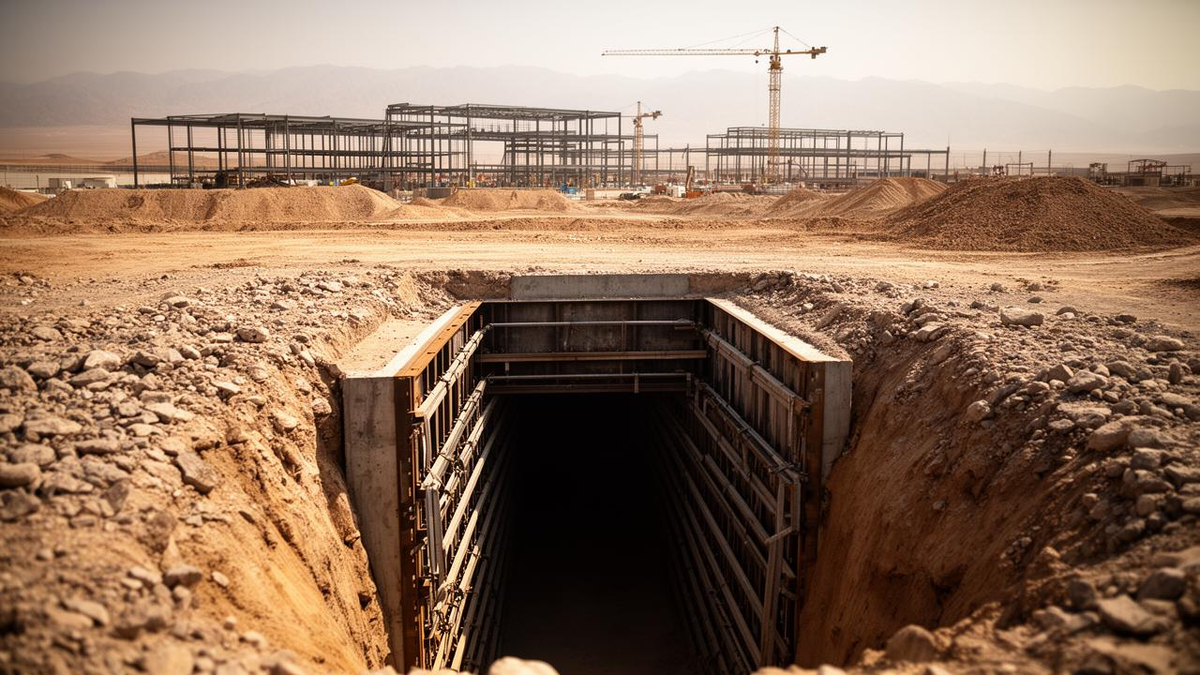
The Middle East conflict is fundamentally reshaping the United Arab Emirates’ (UAE) infrastructure investment strategy. The country is moving away from concentrating massive facilities in single locations toward distributing them across multiple regions, while pushing urban transportation and logistics underground. Analysts note that the core value proposition of Middle East infrastructure is shifting from efficiency to survivability amid missile and drone threats.
Larry Fink, CEO of BlackRock, the world’s largest asset manager, predicted that “over the next decade, much of the Gulf Cooperation Council (GCC) region’s infrastructure will need to move underground to avoid drone attacks.”
Musk’s Underground Tunnels Expand Across the UAE
The Boring Company, the tunnel venture founded by Elon Musk, has secured $3 billion in Series D funding, according to CNBC and other outlets reporting on the 13th (local time). The UAE and related investment institutions led the funding round, which valued the company at $23 billion. Participants included Sequoia Capital, Andreessen Horowitz, and Temasek.
The capital will be deployed to build more than 150 kilometers of underground tunnels for autonomous vehicles across the UAE. The Boring Company has already signed a contract with Dubai’s Roads and Transport Authority for the “Dubai Loop” project. The concept involves creating dedicated underground transit corridors in high-density urban areas—combining electric vehicles with future autonomous driving technology—rather than continuing to widen surface roads.
Musk founded The Boring Company in 2017 to solve traffic congestion, but outside of Las Vegas, the company’s commercial progress has been slow. The UAE project now gives it a foothold in the Middle East’s urban infrastructure market. Observers say the UAE’s investment in Musk’s underground tunnels serves a dual purpose: relieving saturated transportation infrastructure while also providing a defensive capability against external attacks.
Massive AI Campus: From Concentration to Distribution
The UAE’s core AI infrastructure is also pivoting from concentration to distribution. According to Reuters, the UAE is reconsidering the design of a 5-gigawatt (GW) UAE-US AI campus originally planned for a single site in Abu Dhabi. The initial plan called for concentrating data centers on a roughly 26-square-kilometer site, but distributing facilities across multiple emirates is now the leading option.
The UAE-US AI campus is led by G42, the UAE’s AI company, with participation from American technology firms including Nvidia, OpenAI, and Oracle. The first phase—the $30 billion Stargate UAE—will proceed as scheduled, but the second phase onward will be spread across multiple locations.
According to sources, UAE authorities began reviewing the plan shortly after Iran launched missile and drone attacks against Gulf states hosting US military forces, in retaliation for American and Israeli strikes on Iran. Sources interviewed by Reuters included US government officials, European diplomatic sources, and industry executives.
Iranian Attacks Triggered the Design Change
The reason for absorbing the enormous cost of a design overhaul is Iran’s attacks. In March, Iranian missile and drone strikes damaged two Amazon Web Services (AWS) data centers in the UAE and one facility in Bahrain. AWS’s regional cloud computing services continue to experience disruptions.
In April, Iran’s military released a video warning that Stargate UAE, the massive AI infrastructure project, is a potential attack target. The video included a map marking the location where the facility is reportedly being built, with the caption: “Nothing can hide from our eyes.”
Two sources confirmed that the construction site is located near Al Dhafra Air Base. The fact that this location was chosen for construction had not previously been disclosed. Al Dhafra Air Base, located on the outskirts of Abu Dhabi, hosts US military personnel and has been targeted in the current conflict.
The UAE is considering deploying air defense systems at data centers, moving some facilities underground, and building facilities that process sensitive data—such as military intelligence—inside mountainous terrain. UK security firm ISS estimated that reinforcing data center barriers and server protection facilities would increase construction costs by approximately 5-7%.
US Capital Sees Investment Opportunity
Quick-moving American investors are treating the Middle East infrastructure crisis as an investment opportunity. At the Milken Conference in May, Larry Fink said there would be “massive investment opportunities in artificial intelligence in the Middle East,” adding that “a $3,000 drone can carry out terrorism not just in the Middle East but in the United States as well, so all infrastructure must be re-examined on the assumption of attack.”
The UAE’s joint initiative with American technology companies was announced during President Donald Trump’s visit to the UAE last year. It has become central to the UAE’s strategy of moving beyond oil dependence to become a global AI powerhouse, led by government-affiliated G42.
In exchange for access to American advanced technologies, including Nvidia’s AI semiconductors, the UAE agreed to scale back its AI-related ties with China and invest in data center projects under the “Stargate” initiative in the United States.
It remains unclear how much the plan changes will affect construction costs and timelines, or how far UAE authorities have progressed in developing a new comprehensive plan.