
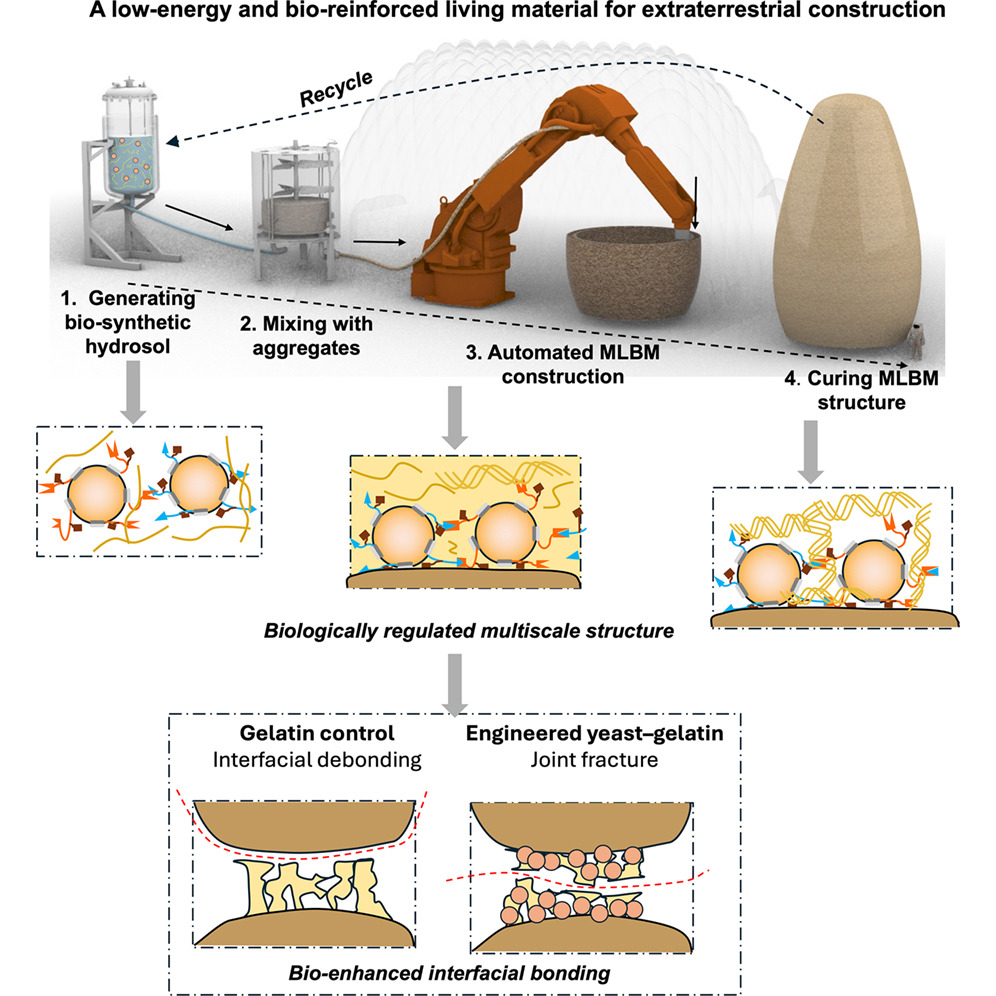
Engineers in Hong Kong have created a 3D printable building material for Mars that uses the planet’s own soil, held together by yeast engineered to behave like mussel glue. The material, developed at the Hong Kong University of Science and Technology (HKUST) under civil engineer Jishen Qiu, has passed compression tests at strength levels comparable to lightweight concrete, a threshold researchers say makes it viable for multi-storey, fully recyclable structures on the Red Planet. The findings were published in the journal Chem Circularity.
A three-ingredient formula for an alien building site
The compound rests on three components, each chosen to solve a different problem of building far from Earth. The bulk of the material is Martian regolith, the loose layer of dust, sand, pebbles and rock fragments that blankets the planet’s surface, which supplies volume and mass without needing to be shipped from Earth.
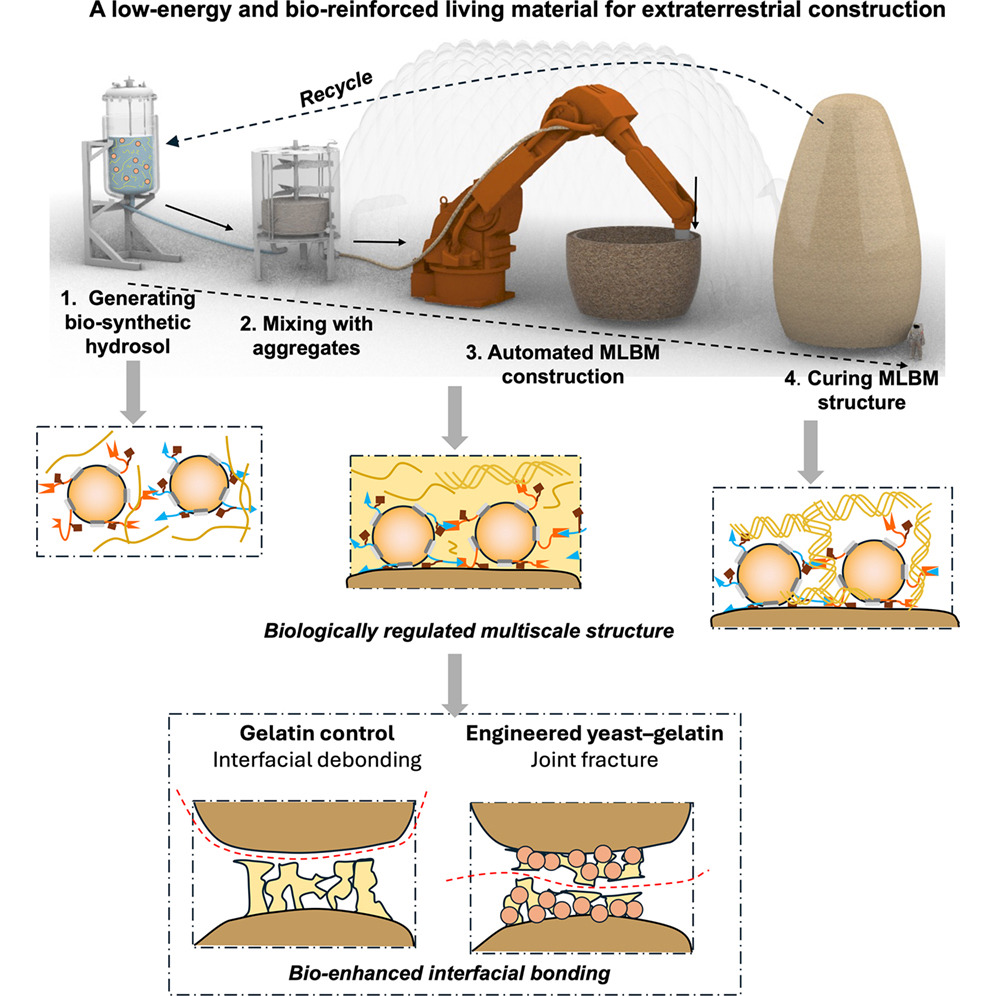 Conceptual and laboratory fabrication of MLBM. Image via HKUST.
Binding that regolith together is a specially engineered strain of yeast, modified to produce adhesive proteins modelled on the natural glue that mussels use to fasten themselves to rocks. Gelatine completes the mix, acting simultaneously as a structural binder and as a nutrient source to keep the yeast active during processing.
The team also turned one of Mars’ biggest obstacles, its extreme cold, into an asset. Rather than fighting the low temperatures, the HKUST process uses them as a natural freeze-dryer. Printing takes place at low temperature and reduced atmospheric pressure, conditions that cause ice within the mixture to sublimate directly into vapour instead of melting. That sublimation leaves behind a solid, lightweight foam, while avoiding the energy cost of melting minerals in a printer. When tested under simulated conditions, the resulting material matched the compressive strength of lightweight concrete, giving the researchers a benchmark for what multi-level Martian habitats built this way could withstand.
The approach is not without open questions. The researchers themselves flag two main risks: whether the engineered micro-organisms can actually survive Mars’ harsh environment over time, and the extent to which the whole system still depends on materials and know-how sent from Earth rather than being fully self-sufficient once on-site.
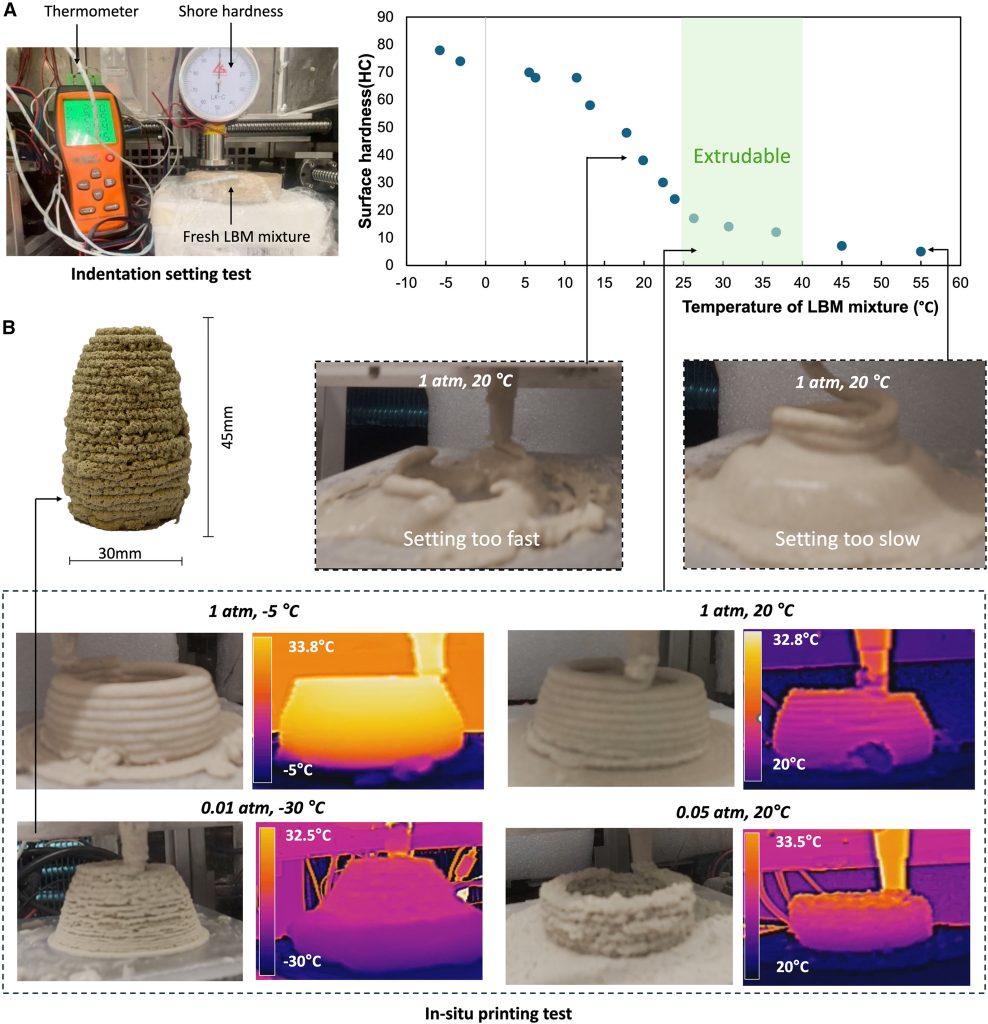 Printability tests of MLBM under simulated Mars-like cold/low-pressure conditions. Image via HKUST.
Building Off-World Without Shipping From Earth
The core gap Qiu’s team is closing is dependence on materials sent from another planet. Every kilogram of construction material launched to Mars carries an enormous cost, so the entire logic of the yeast-regolith formula is to turn that constraint into the design brief: build with what’s already there, use energy sources native to the destination and keep the system biological enough to self-replicate rather than requiring resupply.
That same strategy, using local, low-energy, waste-derived materials instead of imported ones, is already playing out in terrestrial construction. Trinity College Dublin engineers 3D printed what they describe as Ireland’s first cement-free geopolymer, a reddish-brown material built largely from industrial waste that skips Portland cement entirely and, by the team’s early estimate, cuts embodied carbon substantially compared with standard concrete. The parallel to HKUST’s approach is direct: both replace an energy-intensive, imported input with something abundant and already on-site.
A closer analogue is ICON’s Mars Dune Alpha, a 1,700-square-foot habitat 3D printed for NASA‘s CHAPEA analogue missions using ICON’s Vulcan printer. Though built on Earth rather than from actual Martian soil, the structure was designed to replicate the physical and psychological experience of living inside a Mars base, and it’s now part of the same NASA infrastructure push, Project Olympus, feeding lessons back into how real off-world habitats might eventually be printed.
Whether the destination is Mars or Ireland, the direction is the same: construction that manufactures its own material locally, cutting the line back to the factory, or the launch pad.
3D Printing Industry is inviting speakers for its 2026 Additive Manufacturing Applications (AMA) series, covering Energy, Healthcare, Automotive and Mobility, Aerospace, Space and Defense, and Software. Each online event focuses on real production deployments, qualification, and supply chain integration. Practitioners interested in contributing can complete the call for speakers form here.
To stay up to date with the latest 3D printing news, don’t forget to subscribe to the 3D Printing Industry newsletter or follow us on LinkedIn.
Explore the full Future of 3D Printing and Executive Survey series from 3D Printing Industry, featuring perspectives from CEOs, engineers, and industry leaders on the industrialization of additive manufacturing, 3D printing industry trends 2026, qualification, supply chains, and additive manufacturing industry analysis.
Featured image shows Conceptual and laboratory fabrication of MLBM. Image via HKUST.