
Dear readers, faithful companions of the lantern and the basketball,
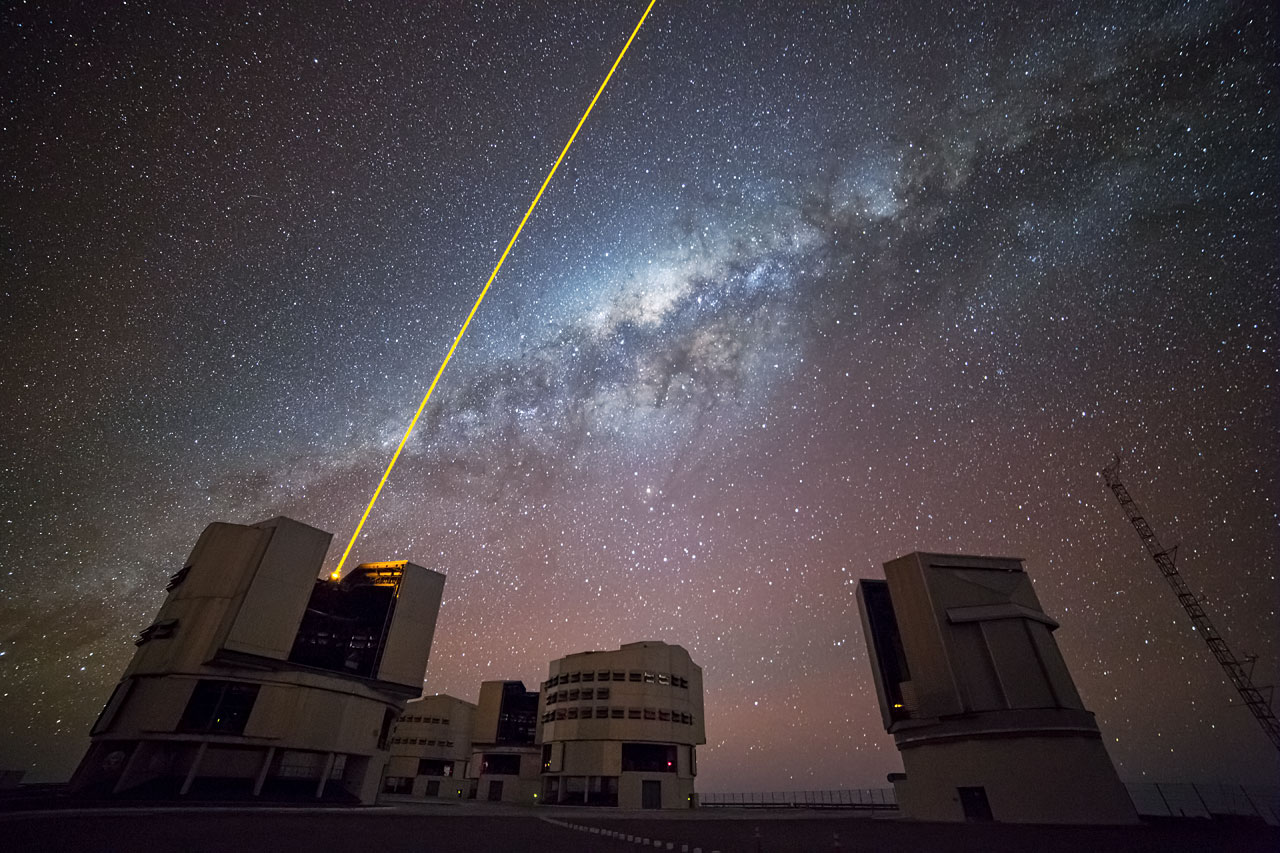
There are places where the sky resembles no other. Places where the air is so dry, so pure, so transparent that the stars seem to brush against you. Places where the Milky Way is no longer a distant river, but a flood of light that envelops you. One of these places lies in Chile, on an austere mountain overlooking the Atacama Desert, and it is called Cerro Paranal.
 J.L. DAUVERGNE/Ciel et Espace/J.L. Dauvergne & G. Hüdepohl (a
There, the Very Large Telescope keeps watch — the VLT, one of the greatest eyes humanity has ever opened upon the cosmos. And it is there that I return, two or three times a year, for intense working stays of three weeks.
But before I speak to you of giant mirrors and interferometry, let me tell you what this place means to me. For Paranal is not only an observatory. It is also a place where, sometimes, my family joins me. When the schedule allows, Jocelyne comes with me. Sometimes the children too, or only some of them. They stay in Antofagasta, the coastal city on the Pacific, and each morning, after our nights of work, for we work at night, that is the astronomer’s lot, I go down to join them. The journey between Paranal and Antofagasta is not very long, a road that winds between the ocean and the desert, and each bend brings me closer to them.
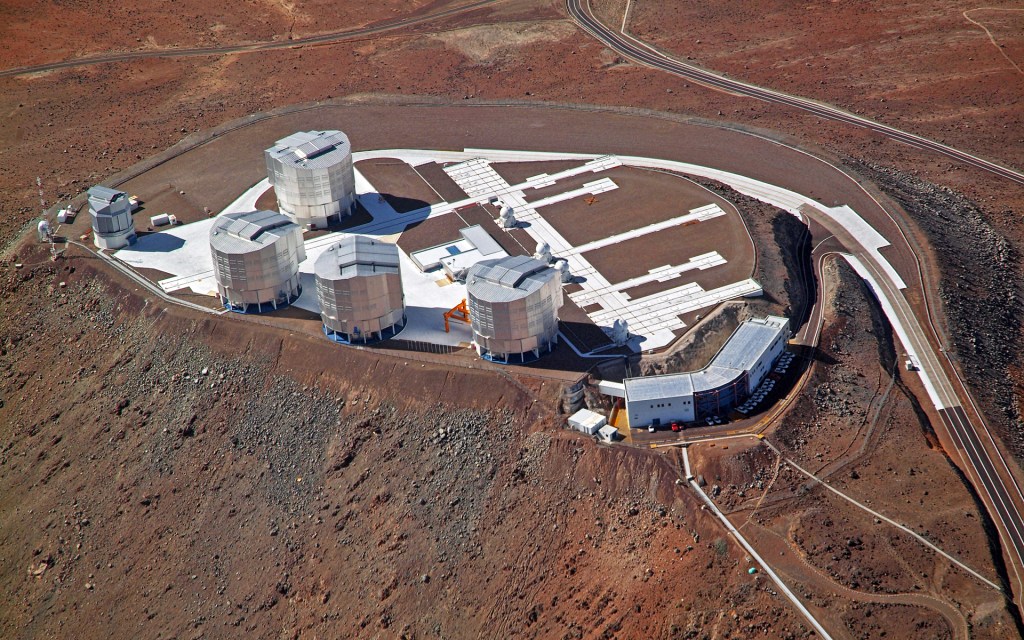
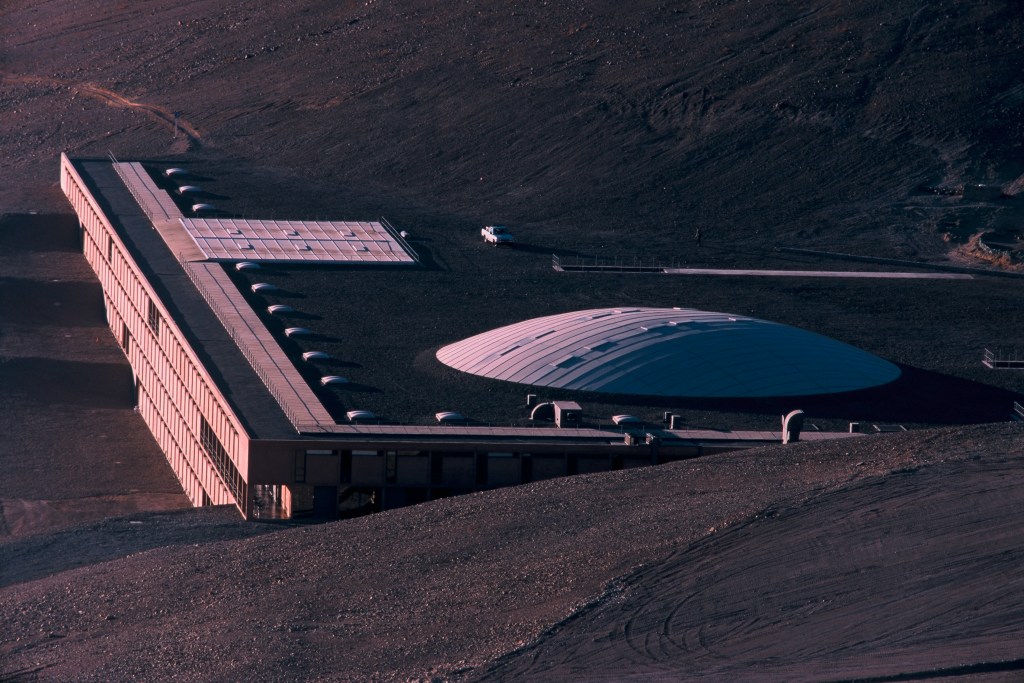
When the children are not there, or when they are at school, Jocelyne stays with me. We sleep then in a place that has no equal in the world: the Residencia. It is a hotel, but a hotel unlike any other. It is not open to the public. It belongs to ESO, the European Southern Observatory, and it is reserved for the astronomers, engineers and technicians who work on the mountain. It is nestled in a natural depression, just a few kilometres from the summit where the four giant telescopes of the VLT stand.
 ESO
The Residencia is a miracle of architecture and discretion. Designed by the German architects Auer & Weber, it was conceived to blend into the landscape, to avoid disturbing the sacred darkness of the desert. From the outside, one sees almost nothing: a heavy door, without inscription, at the foot of a gentle ramp.
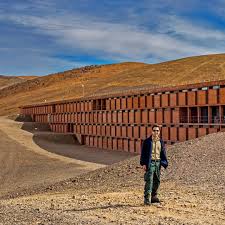 Photo privée
The rest is buried, or nearly so. But as soon as one crosses the threshold, one enters another world. A central atrium, beneath a dome thirty-five metres across, shelters a lush tropical garden, with trees, plants, and a swimming pool of dazzling blue.
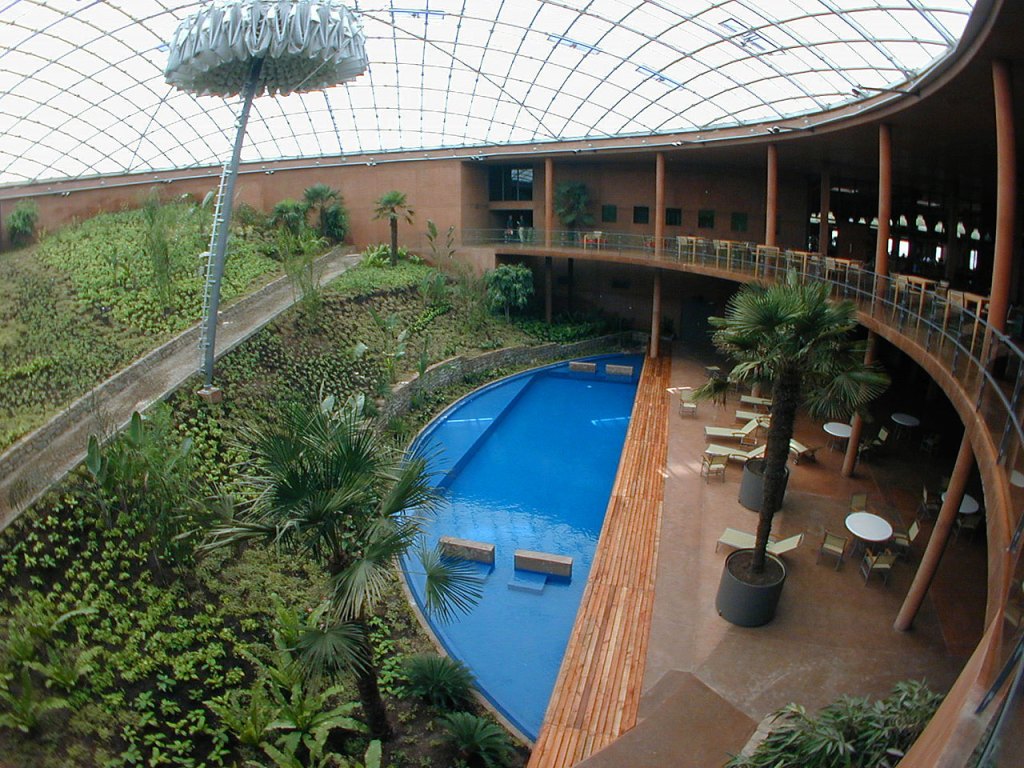 ESO/M.Tarenghi
After the glacial nights spent on the mountain, where the air is dry and the temperature sometimes falls below zero, to find again that vegetal moisture, that warmth, that life, is like returning to the surface after a dive. One breathes. One relaxes. One becomes human again.
The Residencia has its constraints, of course. To preserve darkness, the bedroom windows are tiny, and automatic shutters close at dusk. Outside, at night, cars must switch off their main headlights, and one moves only with a torch pointed at the ground. Alcohol is forbidden there, because of the altitude and the risk of dehydration. But these constraints are the price of purity. They remind us that every drop of nocturnal light is a treasure to be protected.
And then, there are those moments that belong to us alone. In the early evening, before I go up to take my shift, Jocelyne and I slip away to the observation platform open to visitors, at the very top of Cerro Paranal.
 Photo privée 2025
We nestle against each other, as when, as children, we contemplated the stars lying in the grass. The sky, at that altitude, is of an absolute blackness, a total transparency.
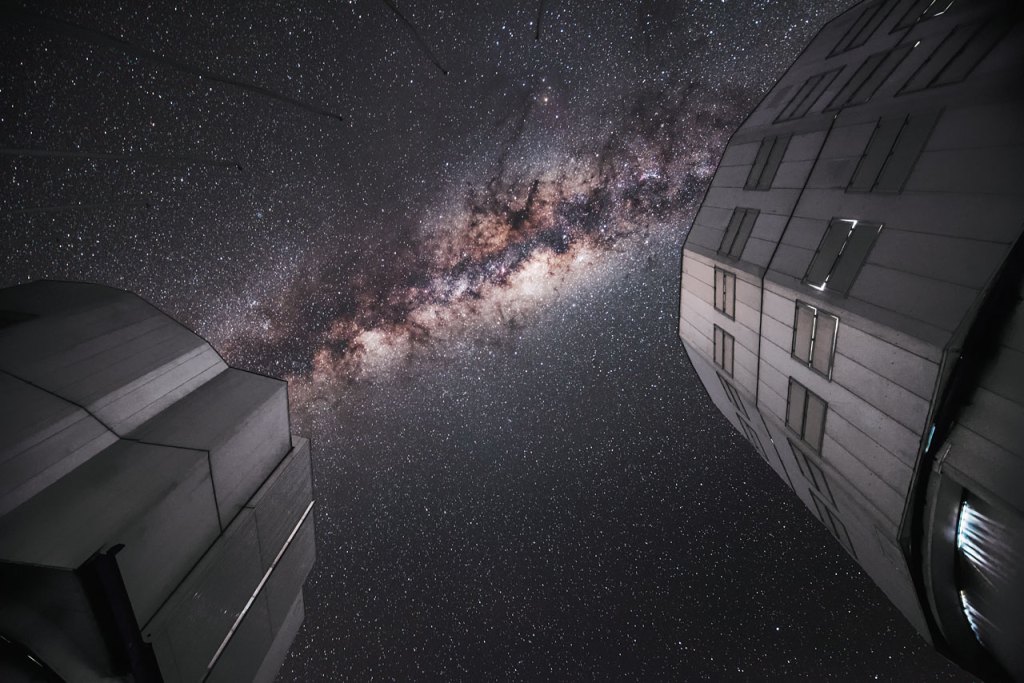 Alberto Ghizzi Panizza/ESO/A. Ghizzi Panizza (www.alber
The Milky Way is not a milky band: it is an architecture. One distinguishes nebulae, clusters, stars by the thousand, as if someone had tipped a sack of diamonds onto black velvet. Sometimes we do not speak. There is nothing to say. The silence is full. It is in those moments, suspended between two nights of work, that I measure my fortune. Not of being an astronomer, but of being there, with her, beneath this sky that we have shared since childhood.
But let us return to our subject, for the VLT, too, has a history, and it deserves to be told.
1. A Giant in the Desert
The Very Large Telescope is not a single telescope. It is a family. Four main telescopes, the Unit Telescopes, each equipped with a primary mirror 8.2 metres in diameter. Four movable auxiliary telescopes of 1.8 metres, which can be moved along rails. And a set of instruments, some twenty in total, which transform the collected light into data, images, spectra. All of it perched at an altitude of 2,635 metres, on a site chosen for its exceptional sky: humidity often below 10%, almost no cloud cover, remarkable atmospheric stability, and one of the darkest skies on the planet.
The history of the VLT begins in the 1980s. The project took shape in December 1987, and the first light was obtained on the night of 25-26 May 1998, with the first telescope, named Antu. The other three followed: Kueyen, Melipal and Yepun. These names are Mapuche words, the language of the indigenous people of Chile, and they designate respectively the Sun, the Moon, the Southern Cross and Venus. A way of paying homage to the land that hosts these giants.
Since then, the VLT has never ceased to produce scientific results. In 2007, around 500 peer-reviewed papers using its data were published. Since the beginning of science operations in April 1999, more than 2,200 papers have appeared, an average of one paper published every working day. The VLT has contributed to every field of astronomy: the nature of dark matter and dark energy, the extreme physics of gamma-ray bursts and supernovae, the formation and evolution of galaxies, exoplanets, supermassive black holes, and much more. Its power and reliability make it one of the most productive instruments in the history of astronomy.
2. The Art of Making Light Speak: Interferometry
But the VLT does not content itself with observing the sky with four separate eyes. It can also make them work together. This is called interferometry, and it is one of the most astounding technical feats of the observatory.
The idea is simple in principle, dizzying in execution. Instead of using a single large mirror, one uses several separate telescopes, and combines their light. The resolution obtained is no longer that of a single mirror, but that of a virtual mirror whose diameter would equal the distance between the most widely separated telescopes. With the VLTI, the VLT Interferometer, this distance can reach more than 100 metres, giving a resolution equivalent to that of a telescope over 100 metres in diameter. It is as if one passed from a simple pair of binoculars to a giant eye, capable of distinguishing incredible detail.
But for this magic to work, diabolical precision is required. The light collected by each telescope must arrive exactly in phase at the combination point. Now, since the telescopes are separated by considerable distances, the paths travelled by the light are different. The light from an object slightly offset from the zenith does not arrive at exactly the same moment in each telescope.
This is where the delay lines come in. Beneath the mountain, in a labyrinth of tunnels more than 160 metres long, seventeen small mirrors move silently along rails. They adjust the length of the optical path for each telescope. By moving these mirrors forward or backward, one delays or advances the light of one telescope relative to another, so that all beams arrive perfectly synchronised. “Everything must be positioned to the nearest micron,” explains astronomer Olivier Hainaut, who works on the interferometer. A micron is a thousandth of a millimetre. It is the thickness of a hair. And this precision must be maintained over tens of metres, in a tunnel where the slightest air turbulence can throw everything off.
The ESO engineers even had to account for the curvature of the Earth. To lay the rails of the delay lines, they used a water level as a reference. But in the longest tunnels, the water level is not perfectly flat: it follows the curvature of the planet. “We use the water level as a reference, then we build the delay lines correcting for the curvature of the Earth,” says Hainaut. It is geodesy at the micron scale, a dance of incredible precision.
The result lives up to the effort. By combining the light of three or four telescopes, the VLTI can achieve a resolution equivalent to that of a telescope 200 metres in diameter. This is how one can see details on the surface of distant stars, or distinguish the internal structure of planet-forming disks around young stars. One no longer contents oneself with seeing points of light: one begins to see shapes.
3. Maintaining the Giants: When Mirrors Take the Air
However perfect they may be, the mirrors of the VLT are not eternal. Each primary mirror is a disk of Zerodur, a glass-ceramic of exceptional purity, polished for two years in the workshops of the REOSC company near Paris, before being transported by ship to Chile, then hoisted to the summit of Cerro Paranal. It weighs 22 tonnes, and its surface is so smooth that if it were enlarged to the dimensions of Europe, the irregularities would not exceed a few centimetres.
But the desert is merciless. Dust accumulates, and the thin layer of aluminium coating the mirror — a few tens of nanometres thick, indispensable for reflecting light — eventually oxidises and loses its lustre. Every eighteen months or so, a maintenance ritual worthy of a surgical operation must be performed.
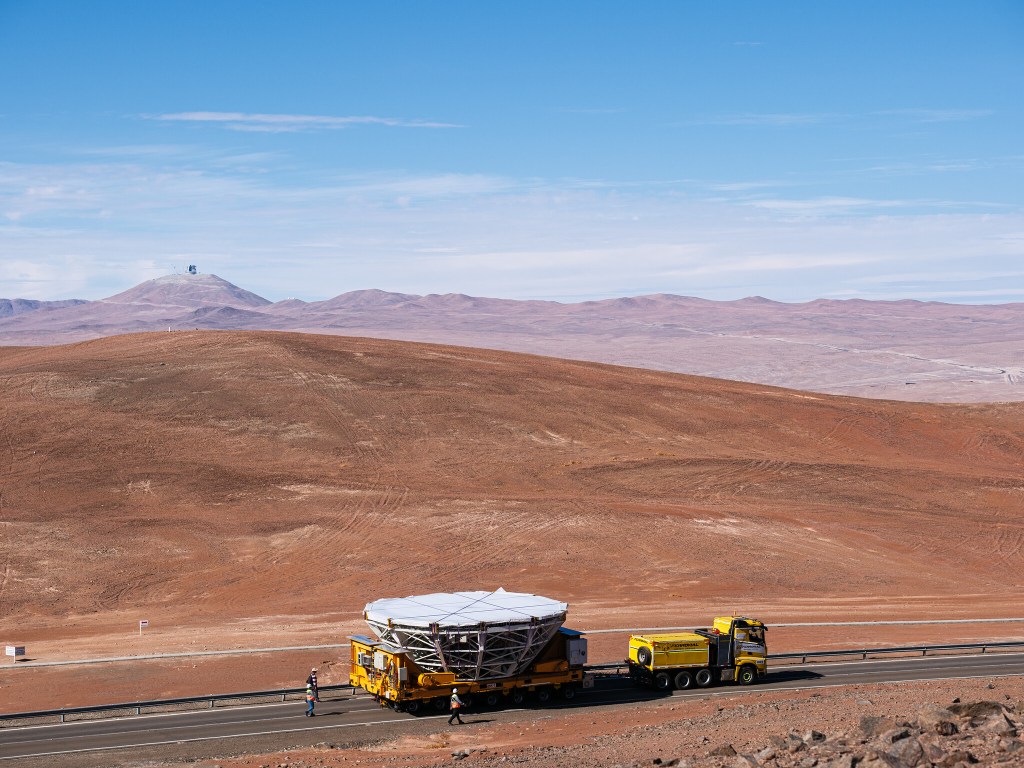 Luca Sbordone/L. Sbordone/ESO
It all begins with the descent of the mirror. The cell that supports it, with its 22 tonnes, is delicately detached from the telescope, wrapped in a protective cover, then placed on a chariot specially designed for the occasion. This chariot then begins a slow descent of the mountain, along a winding road, to the mirror maintenance building, the Mirror Maintenance Building, located below, at the base camp. There, the mirror is unwrapped, washed, then plunged into an acid bath that dissolves the old aluminium layer. It is then carefully rinsed, dried, and introduced into a giant vacuum chamber, where a new layer of aluminium is deposited by sputtering, a technique that consists of tearing aluminium atoms from a target and letting them deposit uniformly on the mirror’s surface. The layer obtained is so thin that it weighs only a few grams, but it is essential: without it, the mirror would not reflect light.
The complete operation lasts about eight days, from dismantling to reassembly. It is a period of stress for the whole team, for the mirror is the vital organ of the telescope. But it is also an opportunity to check every part, every connection, every mechanism. And when the mirror finally rises again, gleaming, towards its telescope, it is as if one has brought a giant back to life. The VLT then resumes its vigil, sharper than ever.
4. An Eye Larger Than All Others
To measure the power of the VLT, one need only compare it to its predecessors. Take Newton’s telescope, that small three-centimetre mirror he polished by hand in the seventeenth century. The VLT, with its four 8.2-metre mirrors, has a total collecting area equivalent to that of a mirror over 16 metres in diameter. That is more than 200 times the area of the 5-metre Hale telescope at Mount Palomar, which was the largest in the world for decades. In interferometric mode, the VLTI achieves a resolution equivalent to that of a 200-metre telescope. No ground-based optical instrument has ever been so powerful.
Imagine the difference. Newton’s telescope could distinguish the rings of Saturn, but barely. The Hale, with its 5 metres, allowed Hubble to discover that the universe was expanding. The VLT, for its part, can track stars orbiting the supermassive black hole at the centre of the Milky Way, 27,000 light-years away, with a precision equivalent to seeing a basketball on the Moon. It can analyse the atmosphere of an exoplanet, measure the chemical composition of a galaxy born shortly after the Big Bang, or detect the traces left by the first stars. It is a dizzying leap in our ability to read the sky.
And yet, this power is not used to dominate, but to understand. Every time the VLT points toward a star, it is a question we ask the universe. And every time, the answer is richer, more complex, more beautiful than what we had imagined.
5. The Watchman’s Lesson
Dear readers, the VLT is far more than a machine. It is a place of memory, a place of encounters, a place of relentless work and silent contemplation. It is there that I spend nights listening to the light of the stars, and mornings going back down to those I love. It is there that Jocelyne and I nestle beneath the Milky Way, like two children lost in a waking dream. It is there that science and love meet, without ever merging.
I set down my lantern. It flickers gently, like a star reflected in an 8.2-metre mirror. The basketball is in its place, and I think of those four giants of glass and steel, perched on their mountain, keeping watch over the sky for more than twenty years. They have seen supernovae, exoplanets, black holes, galaxies at the edges of time. And they will continue to see, long after us, as long as the light of the stars finds the path to their mirrors.
The next time you lift your eyes to the southern sky, remember: down there, in the Atacama Desert, four giant eyes scan the universe. And in one of them, perhaps, still shines the light of a star that went out millions of years ago. That is the magic of the VLT. It does not look at the present. It listens to the past. And it tells us about it.
François
The Most beautiful Nebulae of UniversesThe Most Beautiful Galaxies:Various StoryA Prayer for Mercy and JusticeEpisode 1: The Crab NebulaEpisode 1, The Milky Way, Our Island of LightOnce upon a time: The Birth of a StarBlack Holes, Sagittarius A*, Multiverses and Time Travel: The Truth Behind the MythEpisode 2: The Eagle Nebula and The Pillars of CreationEpisode 2. Andromeda, The Great Sister Coming Toward UsThe Mirage of MarsIf the Yankee Weren’t thereEpisode 3 : The Carina NebulaFrascati neat Roma, Death from the SkyThe Grand Tour and the Three-Body Problem — Journey to NeptuneEpisode 4: The Helix NebulaDefending Earth Against Asteroids and Fascists, When Ignorance Has Its Finger on the Nuclear ButtonHistory of Astronomy and Obscurantism Ancient and ModernEpisode 5: The Horsehead NebulaOnce Upon a Time: The Death of a StarThe Idiotic Trumpian War on ScienceEpisode 6: The Veil NebulaThe size of The UniverseRenewable energy, The Sun and Nuclear FusionEpisode 7, The Necklace NebulaLetter to a Climate SkepticOf Stars and Bombs: Why Trump’s Fascism Threatens My Profession, My Employer, and My CountryClimate Skeptics: Letter to ObsidiaThe Time of CreationThe Lantern and the Ruler: How we Measured the UniverseWhy the Universe Cannot Be an AccidentExoplanetThe Lantern at the Edge of Infinity, Gravitational Lenses, Dark Energy and the Mystery of ExpansionCold: A Symptom of Global WarmingBlaming Biden? Enough is Enough!When the Universe opened hits Eyes
Climate, two hypotheses, two futuresThe Speed of Light: Chasing a Ghost Across the CenturiesThe Tunnel of LightLe son, messager de l’airLes Neutrinos: The Ghosts of the Sun, The Great Neutrino Mystery