

Iran-backed Houthi rebels said they attacked “sensitive” sites in Riyadh, Saudi Arabia’s capital, as well as an Aramco facility in Yanbu, a Saudi port city on the Red Sea.
 Close
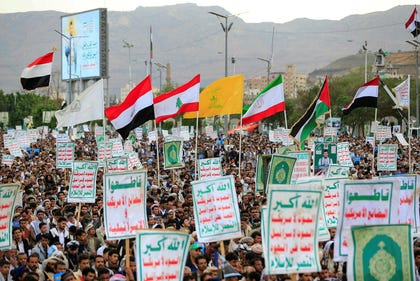
Supporters of the Houthi authorities hold flags during a protest against the Saudi intervention in Yemen and against Saudi Arabia’s recent accusation that the Houthis fired at the holy city of Mecca, in Sanaa on Saturday. Credit: AFP/MOHAMMED HUWAIS
Supporters of the Houthi authorities hold flags during a protest against the Saudi intervention in Yemen and against Saudi Arabia’s recent accusation that the Houthis fired at the holy city of Mecca, in Sanaa on Saturday. Credit: AFP/MOHAMMED HUWAIS
The Houthis added that they will continue targeting Saudi military build-ups until Riyadh ends its blockade on Yemen.
Turkey’s foreign minister, addressing the Saudi-Houthi conflict, said it is unacceptable for Saudi Arabia to be made part of the U.S.-Iran war, and that it has no desire to join the conflict.
The Turkish minister, Hakan Fidan, also said that proposals have been conveyed to all sides to end the fighting. He added that Saudi Arabia may have military needs, and that Turkey will look into it as part of a trilateral defense pact together with Pakistan.
A spokesperson for Iran’s Foreign Ministry told Iranian state television that Pakistan’s interior minister will visit the country to discuss bilateral ties. The spokesperson added that he was unaware of any U.S. message.
Earlier, Iran’s top security official said in an interview with Al Jazeera that Qatar had conveyed Iran’s conditions to the United States to end the war and is awaiting a response from the Trump administration, as talks continue between Tehran and mediators Qatar and Pakistan,
Tehran’s conditions include ending the war on all fronts, unfreezing Iranian funds and ending the U.S. naval blockade, the official said. According to him, Iran is also seeking an end to Saudi Arabia’s with the Houthis in Yemen.