
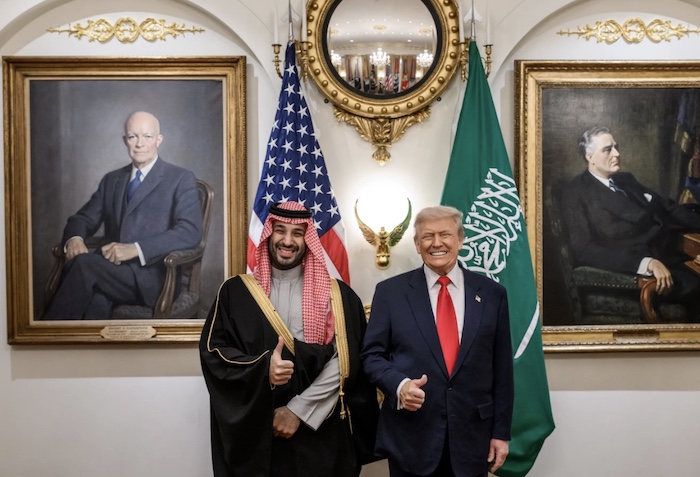
Israel is concerned about the possible sale of 48 F-35 fighter jets to Saudi Arabia. Israel can seek to delay and limit the deal with Saudi Arabia, while taking into account the Trump administration’s various interests in the matter. Even if the deal goes ahead, including in full, a number of factors could help Israel address this challenge.
The U.S. State Department has announced a deal to sell 48 F-35s to Saudi Arabia. Israel is concerned about the move.
Like previous administrations, the Trump administration seeks to sell American weapons systems to the Middle East, both because of the profits involved — $25 billion in the case of the F-35 sale, along with additional weapons systems and military equipment — and because the administration wants Saudi Arabia to invest hundreds of billions of dollars in the United States. Saudi Arabia is also important to Washington on issues related to oil, including production levels and prices.
The F-35 sale is part of the United States’ broader struggle and competition with other powers, particularly Russia and China, with all that entails. The United States does not want to strengthen Russia’s or China’s foothold in Saudi Arabia if either country were to sell advanced fighter jets to Riyadh.
The Trump administration seeks Saudi support on diplomatic and military issues, including in the ongoing confrontation with Iran.
The Trump administration also wants to compensate Saudi Arabia for its refusal, at this point, to launch a campaign against the Houthis.
Given these and other American considerations, to what extent can and should Israel invest in persuading the Trump administration to abandon, or at least limit, the sale of F-35s to Saudi Arabia? And what might the Trump administration demand from Israel in return?
Among other considerations, Israel should take into account, in opposing the F-35 sale to Saudi Arabia, the possibility of reaching normalization with Saudi Arabia with U.S. assistance, as well as other issues, such as American assistance to Saudi Arabia in the nuclear field.
Israel can mobilize its supporters in the United States to take action regarding the F-35 sale to Saudi Arabia.
There are concerns in the United States about the leakage of American knowledge regarding the F-35 from Saudi Arabia to China and Russia. Previous deals to sell F-35s to Turkey and the United Arab Emirates failed in part because of this concern. Israel can wait and see whether the same will happen this time, or take a more proactive approach and emphasize the issue.
In the past, Israel was warned by the United States over Chinese involvement in Israel. Israel took steps in response and should emphasize to its American patron that information from American weapons systems in its possession will not leak to China — unlike the situation with other countries.
Israel can seek to limit the F-35 sale to Saudi Arabia, including within the framework of the formal U.S. commitment to maintaining Israel’s qualitative military edge.
Israel should learn lessons from similar moves in the past involving Saudi Arabia, such as the sale of AWACS aircraft and F-15s to Saudi Arabia at the time, while taking into account the differences between those cases.
Following the upcoming U.S. elections, if the Democratic Party gains a majority in the House of Representatives, and particularly if it is a substantial majority, it will have greater leverage. Its members may oppose the F-35 sale to Saudi Arabia, not because of Israel but as another step aimed at challenging Trump, as well as over civil-rights violations in Saudi Arabia. Israel will presumably seek to encourage them in this regard, but it will need to be careful not to anger the Trump administration.
Israel can therefore try various ways of dealing with the F-35 sale to Saudi Arabia, but it may not succeed. Alternatively, it may decide in advance to give up at least some of its demands in exchange for receiving various advanced weapons systems and military equipment, including systems that the United States has so far not approved for transfer to Israel.
If Saudi Arabia ultimately receives the F-35, the Israeli Air Force will still retain a significant advantage over its Saudi counterpart. The same is currently true regarding the F-15s operated by Israel and Saudi Arabia.
The Israeli Air Force integrated the F-35 into its operations as early as 2016. Israel has therefore accumulated enormous experience with the aircraft, particularly during the past two years. Saudi Arabia has no comparable experience.
Numbers also matter. The Israeli Air Force is expected to receive up to 75 F-35s. It currently has almost two-thirds of that number. It will take Saudi Arabia considerable time to build up a fleet of similar size, especially since it is not expected to receive its first F-35s for several years, if the deal goes ahead.
Despite the F-35’s high level of sophistication, its effective operation still depends on aircrews, ground crews, support teams and various other elements. In these areas, the Israeli Air Force is far more experienced than its Saudi counterpart.
Israel previously came to terms with the attempt — which ultimately did not materialize — to sell F-35s to the United Arab Emirates. There are certain similarities here with the potential sale of F-35s to Saudi Arabia. Despite the differences between Israel and Saudi Arabia, the two countries, as is well known, have cooperation and shared interests in various areas, including security.
As was the case with the UAE, if a serious crisis were to emerge between Saudi Arabia and the United States — and certainly if an anti-American ruler were to come to power in Saudi Arabia — Washington could cut off its support for the F-35. Without that support, Saudi Arabia would face major difficulties and might even be unable to operate the aircraft.
Israel could propose that instead of focusing on acquiring F-35s, Saudi Arabia strengthen its air defenses to address missile and drone attacks against the kingdom. Israel, in coordination with the United States, is in contact with Saudi Arabia on this issue.
It would be preferable for Israel if Saudi Arabia invested in its naval capabilities, helping it confront Iran and the Houthis in general, and in the struggle over the Strait of Hormuz and Bab el-Mandeb in particular. Any Arab military buildup may concern Israel, including at sea, but this would be preferable to an expansion of Saudi Arabia’s air capabilities.
The sale of F-35s to Saudi Arabia could help it defend itself against Iran and, as a result, make it more willing to take risks in confronting Iran. So far, however, despite its modern air force, Saudi Arabia has been hesitant to do so.
Saudi Arabia wants the F-35 deal despite — and partly because of — its defense agreement with Turkey and Pakistan, the so-called Mecca Pact, or Mecca Joint Defense Agreement. That agreement has recently suffered a setback. Saudi Arabia was attacked without Turkey or Pakistan actually responding. Nevertheless, the Mecca Pact could become more operationally meaningful in the future. Given the strained relationship between Israel and Turkey, which itself may receive F-35s, closer ties between Turkey and Saudi Arabia, particularly if both countries operate F-35s, would concern Israel.
Saudi Arabia would be able to deploy F-35s at Tabuk airbase, putting them relatively close to Israel — approximately 300 kilometers away. This is a familiar concern given the fighter aircraft Saudi Arabia already operates.
If the aircraft ever needed to be destroyed, like any aircraft caught on the ground, the F-35 would depend on maximum protection, including air defenses and other measures.
In summary, Israel can seek to cancel, or at least delay and limit, the sale of F-35s to Saudi Arabia. In any case, it should take into account from the outset the wide range of factors affecting its relationship with the United States. Even if the deal goes ahead, the Israeli Air Force will still retain significant advantages over its Saudi counterpart.