
A new recipe for building materials that can be used on Mars hardens in the cold, creating bricks can be reused four times.
Engineers who design building methods for Mars habitats mostly plan to cook the ground first. Heat crushed rock above 1,830°F (1,000°C) and it fuses into blocks strong enough to stack, but a furnace that size needs power nobody will have out there.
So a team in Hong Kong made its building blocks from sand, gelatin and living yeast instead, and let the extreme cold on Mars do the hardening.
The idea came from a snack. “My inspiration came from freeze-dried fruits that become harder,” said Jishen Qiu, who is a civil engineer at the Hong Kong University of Science and Technology (HKUST). He led the work with colleagues at the Hong Kong Polytechnic University.
In an interview with Earth.com, Qiu questioned whether an advantage could be gained from the fact that materials go hard when frozen.
“If we can fine-tune the ‘freezing’ process and the “drying (vacuum)” process separately, we can make mechanically efficient microstructure in the material,” Qiu explained.
Biology has been drafted into off-world building before, from NASA-funded plans to grow homes out of fungus to algae bioplastic shells and ice domes.
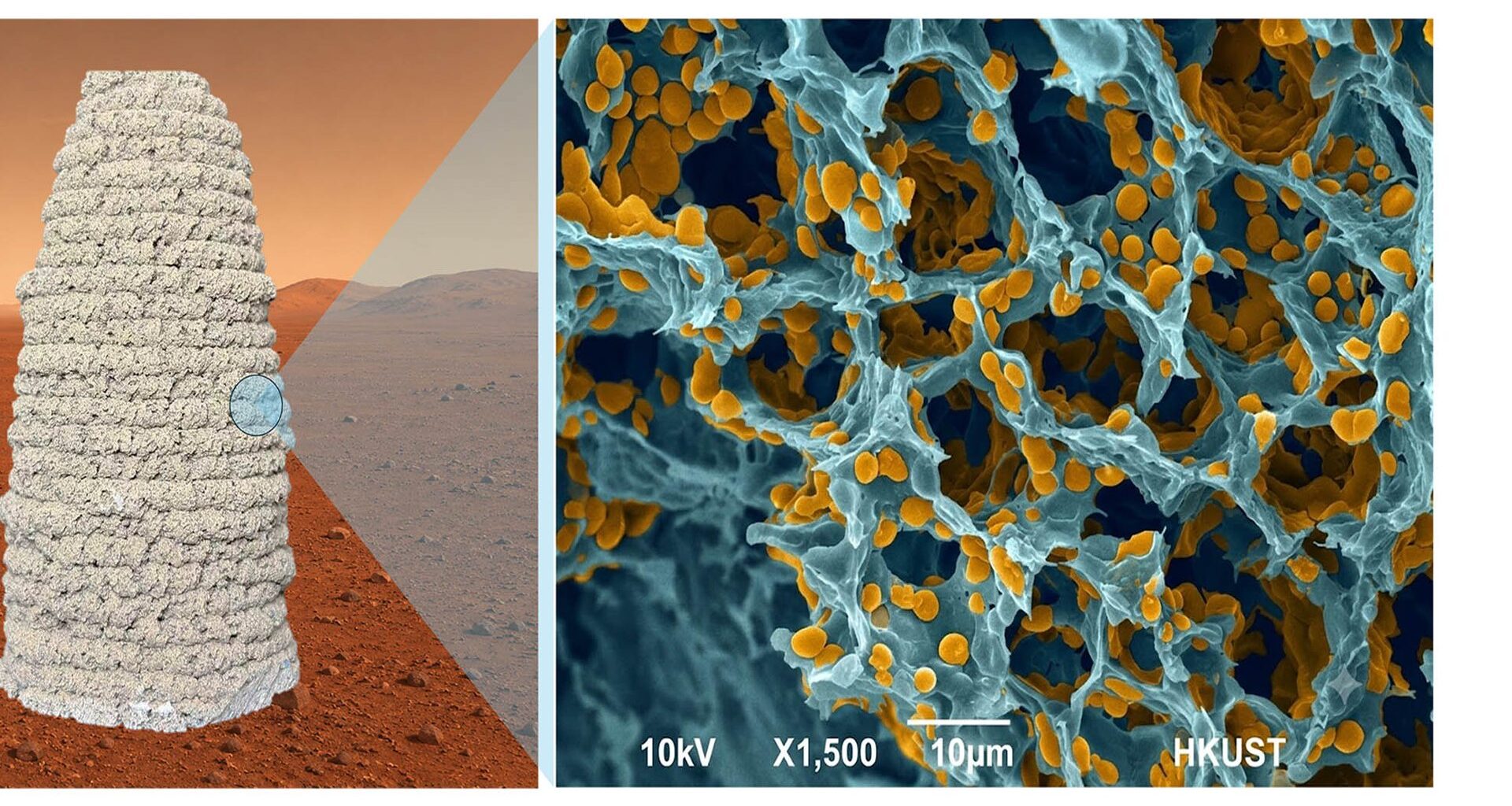
What this team has printed so far is a tower about an inch tall, made inside a chamber in Hong Kong.
Martian cold does the hardening
The mixture starts wet. Sand supplies the bulk, and a warm, watery glue of gelatin and yeast cells coats the grains and bridges the gaps.
Then the chamber takes over. At -67°F (-55°C) and roughly a ten-thousandth of Earth’s air pressure, the water freezes and then passes straight from ice to vapor without melting. That’s freeze-drying, the process behind the fruit that Qiu was thinking of.
What’s left is a stiff, porous gelatin scaffold with the yeast set into its walls and the sand locked in place. Those holes aren’t a flaw. They’re most of the reason the stuff weighs so little for the load it carries.
Printing takes a narrow temperature window. Gelatin begins to set below roughly 100°F (38°C), so the mix leaves the nozzle at 99°F (37°C). Cooler and it gels before it lands; warmer and the shape slumps.
The team ran its tower 1 inch (25 mm) tall and 0.6 inches (15 mm) wide at -22°F (-30°C) and 0.01 atmospheres. NASA puts the Martian surface at about 0.006 atmospheres and between -112°F and 68°F (-80°C and 20°C).
Engineered yeast strengthened the glue
The yeast is the ordinary kind that raises bread, Saccharomyces cerevisiae. The team added genes so each cell grows a coat of sticky proteins on its surface, including the ones mussels use to hold onto wet rock.
That coating changed what the glue could do. Against the same recipe with no cells in it, the best yeast version carried 170 percent more load in compression.
A second test showed where the gain came from. The researchers joined two glass beads with a single dab of glue and pulled them apart.
Gelatin-only joints peeled cleanly off the bead, while joints holding engineered cells tore through the middle, which means the grip on the sand had become stronger than the glue itself.
The cells also reshaped the holes. Gelatin alone froze into voids spanning three orders of magnitude, and the engineered version clustered them around 5 micrometers and linked them evenly.
Neither ingredient does much alone. Yeast without gelatin held together but stayed weak. The winning recipe put biological solids at a quarter of the mix.
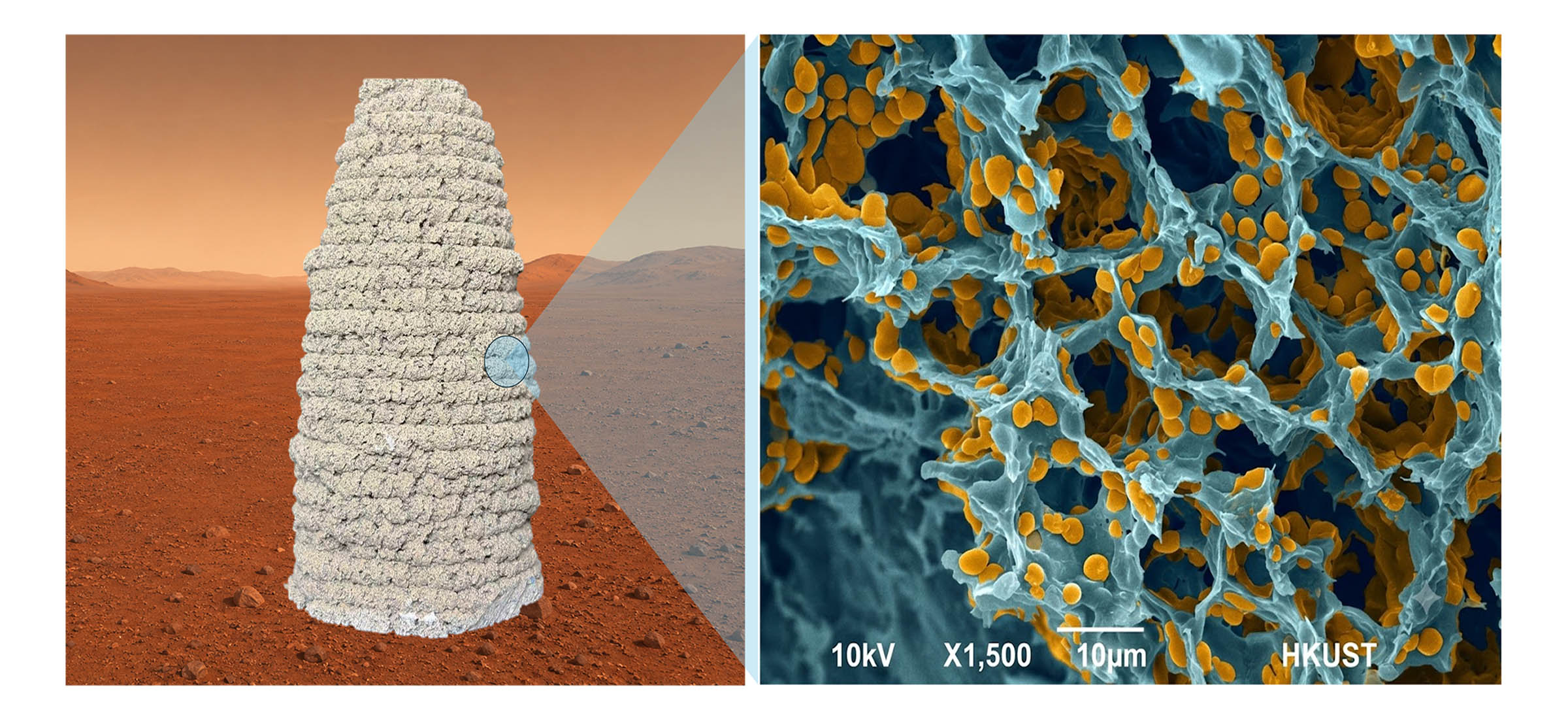 Living building material can be 3D printed under simulated Martian conditions at –30°C and 0.01 atm (left). A microscopic view reveals the material’s porous structure with polymers and engineered yeast highlighted in yellow (right). Credit: Ning Liu. Click image to enlarge.Strength matched low-grade concrete
The hardened material reached a mean compressive strength of about 1,740 pounds per square inch (12 megapascals), which puts it alongside low-grade concrete.
In bending it reached roughly 870 pounds per square inch (6 megapascals), up to twice what a lightweight concrete of the same density manages.
Qiu is blunt about what that buys. “So this is actually strong enough to build a one- or two-story building on Earth whose gravity is three times that of Mars,” he said. “So, you can probably easily build a multistory building on Mars with the material.”
The energy number is the one the authors care about. A cubic meter takes an estimated 0.02 to 0.12 gigajoules. That’s tens of times less than heating rock until it fuses, the route that most schemes take, including several drawn up for NASA’s 3D-Printed Habitat Challenge.
Mars gets about 200 watts of sunlight per square meter. On the team’s arithmetic, a solar array that would need several days to sinter that much rock could turn out the same volume of this material in under an hour.
That comparison covers processing energy only, on both sides. It leaves out excavation, bioreactors, pumps and robots. It would also take about 44 pounds (20 kilograms) of ingredients to be shipped from Earth.
Bricks were recycled four times
Crush a tested brick, warm the gelatin until it dissolves, and the whole mess can be mixed and frozen again. The team ran that loop four times.
Fourth-generation bricks came out at 1,710 pounds per square inch (11.8 megapascals), close to the stiffness of the originals, and the yeast inside them was still alive.
“As long as there’s one yeast that’s still alive, you can grow them again,” Qiu said.
Melted rock can’t do that. A failed wall made by sintering stays a failed wall, while this one goes back in the mixer at a mild temperature.
Builders here are after the same trick with other biological glues, including a seaweed binder that turns loose soil into printable walls.
Can the yeast survive Mars?
No one knows, and Qiu named it as the next thing to find out. He told Earth.com the question is “how well the current microbe would resist (or survive) cosmic radiation,” and, if not well, then which other microbes could take its place.
Martian ground is its own problem. The salts in it are harsh enough to kill hardy microbes from Earth, and these tests used plain inert sand rather than anything resembling regolith.
The recipe leans on Earth too. Its best version uses gelatin made from pig skin, and the cells eat nutrients brought along with them. A gelatin-free mix held the sand together but came out weaker.
The authors wrote the rest of the list themselves. No one has measured how this material handles direct pulling, whether it holds air, or what years of Martian weather do to it. Every structure so far is smaller than a wine cork.
Scaling up needs a room that nobody has built. Qiu told Earth.com the team wants “a bigger testing bed, with reduced gravitational acceleration,” because lower gravity may change how a printed wall behaves on the way up.
Until that room exists, the strongest claim for building a house on Mars made of yeast is that it worked at the size of a thimble.
The full study was published in the journal Chem Circularity.
—–
Like what you read? Subscribe to our newsletter for engaging articles, exclusive content, and the latest updates.
Check us out on EarthSnap, a free app brought to you by Eric Ralls and Earth.com.
—–