
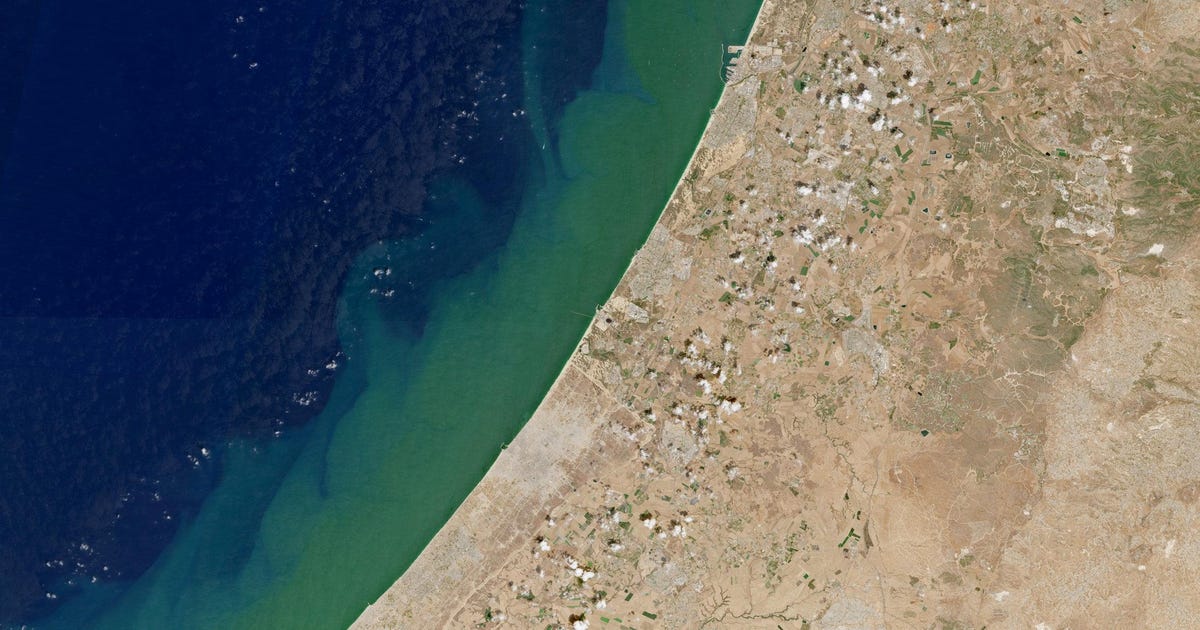
This summer, Israel hasn’t been baked by unusual heat, but the Mediterranean Sea has. As the warming of the water accelerated, the country’s biggest-ever algae bloom wracked the central and southern coast, clogging filters in the desalination plants fed by seawater and forcing them to shut down – not for an hour or a day, but weeks.
This event continues, but all six coastal desalination plants are at least partially back online, under close supervision, the Water Authority told Haaretz on Thursday. Meanwhile, households and farms have been told to skimp on water, and economists warn that food prices will rise. In Tel Aviv, the beaches temporarily shut off freshwater showers for swimmers who dared to brave the greening sea.
Israelis had been told that the desalination plants divorce us from Mother Nature. Suddenly, Mother Nature is back.
 Close
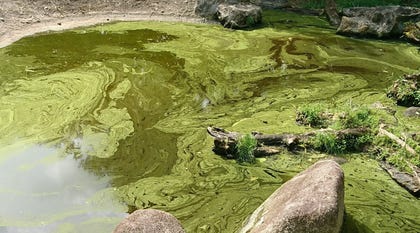
Blue-green algae, also called cyanobacteria. Climate change is warming the Mediterranean faster than the oceans. Credit: Cheng Wei/Shutterstock
Blue-green algae, also called cyanobacteria. Climate change is warming the Mediterranean faster than the oceans. Credit: Cheng Wei/Shutterstock
What is a bloom? An explosive increase in a single microorganism that may change the aqua water to yellow, green, red or brown. Blooms also stink as dead cells rot. These masses, having killed off other life forms around them, persist until for whatever reason the bloom itself collapses.
How is it that Israel, seemingly out of nowhere, developed such a disastrous infestation of cyanobacteria along most of its shore, shattering the complacency so utterly that some have dubbed the bloom the country’s “October 7 for water”?
Related Articles
It didn’t happen out of nowhere. Climate change is warming the Mediterranean faster than the oceans, a new study published by the American Geophysical Union confirmed this week.
The Mediterranean coasts are also perennially polluted with sewage and fertilizer runoff. Filth and warmth are exactly what cyanobacteria love, and both are intensifying in the Mediterranean every year. Hence a major algae event was foreseeable, though, like collapsing glaciers in Nepal, it was impossible to predict the tipping point.
Yet when that point materialized late last month and coastal waters turned from blue to green from the Nile Delta to Hadera near Haifa, the shock was genuine.
 Close
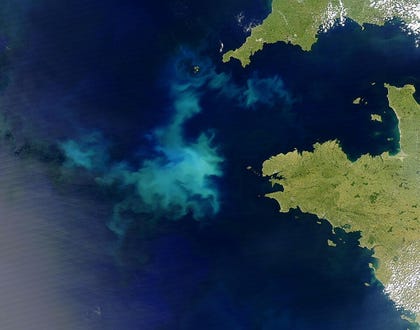
Algae blooming off the coasts of England and France. Credit: Jacques Descloitres, MODIS Rapid Response Team, NASA/GSFC
Algae blooming off the coasts of England and France. Credit: Jacques Descloitres, MODIS Rapid Response Team, NASA/GSFC
“The extent of this natural phenomenon was definitely unexpected,” the Water Authority said when asked about foresight. “Nothing like it had been seen in the last 30 years, since monitoring began. According to the Israel Oceanographic and Limnological Research Institute, no bloom of such intensity had ever been observed.”
Then “all hell broke loose,” says Eyal Harel, co-founder and CEO of BlueGreen Water Technologies, a company that treats algae blooms. The authorities tapped it for its expertise, on top of the Oceanographic Institute’s advice.
“It was going to happen sooner or later, and now it has happened,” Harel says. “Blaming the bloom on Gaza is nonsense. So is blaming floods in Egypt that didn’t happen.”
Could Israel have prepared for this dark day? Yes, but it didn’t, not in any pragmatic way. What did the experts know? That catastrophic blooms in the Mediterranean were a matter of time.
The scale of the current bout may have come as a shock, but all one had to do was glance north in the Mediterranean, where disastrous blooms have repeatedly afflicted Marmara in Turkey and the Adriatic Sea.
 Close
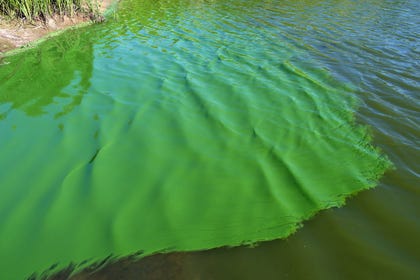
Algae flourishing in Lower Saxony, Germany. Sometimes blooms succeed one another, and a benign species may be replaced by a toxic one. Credit: Christian Fischer/Wikimedia Commons
Algae flourishing in Lower Saxony, Germany. Sometimes blooms succeed one another, and a benign species may be replaced by a toxic one. Credit: Christian Fischer/Wikimedia Commons
Also, Israel experienced incidents of contamination between 2007 and 2023 that caused short production halts at isolated desalination plants, ranging from a few hours to a few days, the Water Authority says. But these shutdowns weren’t from algae but from sand suspended in the water because of storms and runoff in streams.
For five of Israel’s six plants, which supply 80 percent of the water for urban and household use, to shut down from a single event is unprecedented. The plants were spared irreparable damage, but they have to replace their filters and have been advised by BlueGreen to stock up on more.
‘The bloom that hit Israel this year is, without question, of biblical proportions. Israel faced it for the first time, but it won’t be the last and probably won’t be the worst.’
Eyal Harel, co-founder and CEO of BlueGreen Water Technologies
Once a body of water has become infected, recurrence under the right conditions is inevitable, Harel says, and this isn’t exclusively an Israeli problem.
Around the world, cyanobacteria are thriving on pollution and warming in both saltwater and freshwater. Scum graces bodies of water from the Lincoln Memorial Reflecting Pool to North America’s Great Lakes to African reservoirs to the oceans.
But doesn’t Israel have monitoring systems? Yes, but forecasting an ecological tipping point is like beating the stock market.
 Close
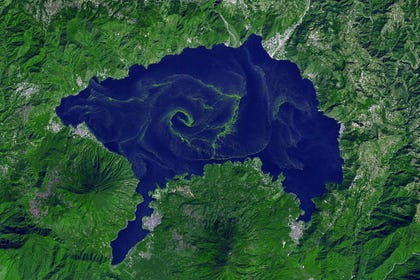
Algae at Lake Atitlán in Guatemala. Credit: NASA Earth Observatory/Jesse Allen/Wikimedia Commons
Algae at Lake Atitlán in Guatemala. Credit: NASA Earth Observatory/Jesse Allen/Wikimedia Commons
“Honestly, nobody saw it coming, not to the extent we’re seeing,” Harel says, qualifying that the sea is a fast-changing, chaotic environment that is very hard to model and predict.
“We’re in a unique situation. An El Niño year is bad but this year is a super El Niño year and that’s worse. It adds another angle of complexity.”
Parsing ‘all hell’
This has been a year of record-breaking weather around the world as humankind declines to seriously abate climate change and pollution keeps pouring into our warming sea. The Nile, which flows into the Mediterranean, is the sewage line for much of Africa, Harel says, and more raw sewage is gushing into the sea from Gaza. Other creatures suffer from this unlovely stew, and declines in biodiversity just improve the conditions for an algae conquest.
Once blooms begin, they intensify year by year until the kind of collapse that happened late last month. “What does all hell mean? A breakdown in biodiversity. By definition, a bloom is a biodiversity problem,” Harel says.
In nature, the different species keep each other at bay. When diversity breaks down, the strongest algae outcompete everything else and take over the environment. They’re scoring against an empty goal.”
Once a body of water has become infected, recurrence under the right conditions is inevitable, Harel says, and this isn’t exclusively an Israeli problem.
Having not forecast the bloom, experts are wary about predicting when it will ebb, but the autumn is plausible because of changing currents and chill.
“Regression doesn’t mean the cyanobacteria die. When it gets colder, some will be unhappy and some will die, but we’ll remain with a massive inoculum [dose] of cyanobacteria sitting and waiting for the conditions to improve,” Harel says.
“That’s why we see conditions deteriorating from year to year. This isn’t a once-in-a-century event. Blooms along Israel’s coast in the summer are going to be the new normal.”
 Close
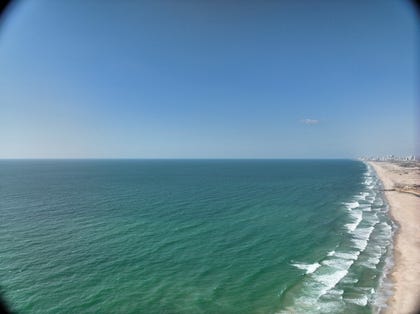
The Israeli coast off Ashkelon. Israel will apparently need more facilities, with each costing billions of shekels to build. Credit: Roy Jaijel/Israel Oceanographic and Limnological Research Institute
The Israeli coast off Ashkelon. Israel will apparently need more facilities, with each costing billions of shekels to build. Credit: Roy Jaijel/Israel Oceanographic and Limnological Research InstituteIsrael has been lucky
Desalination in Israel is a private enterprise that sells the water to the government, though some observers are wondering if the plants should be nationalized. Either way, when the plants shut down, Israel resorted to its traditional sources: the freshwater Sea of Galilee and the aquifers, both of which are perpetually overexploited, which is why Israel built desalination plants in the first place.
But Israel has been lucky, Harel says. Some blooms emit toxins, some don’t – the current mega-manifestation is by a nontoxic variant of bacteria called Synechococcus. So far. Sometimes blooms succeed one another, and a benign species may be replaced by a toxic one.
“That would have been a real drama,” Harel says. “Dealing with the problem is hard enough today. Imagine if it were toxic.”
BlueGreen doesn’t have enough material in stock to make a dent in a bloom stretching about 500 kilometers. The most it can do this year is achieve proof of concept for its technology – in the chaos of the open sea.
The government tapped BlueGreen Water Technologies because of its unique methodology to kill blooms, albeit used mainly in freshwater lakes. But the company has begun to work in oceans and seas and is starting to get results, including in the United States and Italy.
Crucially, while BlueGreen hardly has a monopoly on analyzing satellite photography, it has unique insight into stains in the sea, using a multidisciplinary approach to identify biological conditions from space and direct the response accordingly, Harel says.
The company was called into action a few days after the slime headed north from the Nile – again, this has been happening for years, though until now on a smaller scale. BlueGreen was called in as the desalination plants went offline one after another.
“We looked at the images. Holy cow,” Harel says. “We realized we were facing an event of historic proportions with catastrophic implications for Israel’s water economy, and nobody had an idea what to do. We didn’t either, but unlike most, we had a lot of experience with blooms.”
 Close
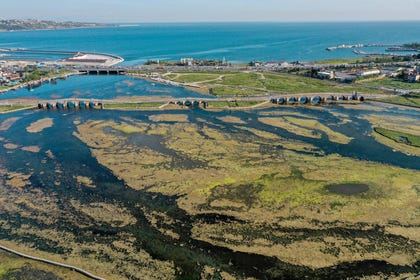
Lake Buyukcekmece in Istanbul covered with algae in May 2022. Disastrous blooms have repeatedly afflicted Marmara in Turkey and the Adriatic Sea. Credit: Muhammed Enes Yildirim/Anadolu via AFP
Lake Buyukcekmece in Istanbul covered with algae in May 2022. Disastrous blooms have repeatedly afflicted Marmara in Turkey and the Adriatic Sea. Credit: Muhammed Enes Yildirim/Anadolu via AFP
But BlueGreen can’t fix this crisis this year. Even if its technology will work in the sea, it doesn’t have enough material in stock to make a dent in a bloom stretching about 500 kilometers (310 miles) and 20 kilometers wide at its narrowest point. The most the company can do this year is achieve proof of concept for its technology, not in a placid lake but in the chaos of the open sea.
Which concept? Israel can’t stop pollution from pouring into its coast from Egypt, and it can’t prevent sewage disposal into the sea in Gaza. So, next time, BlueGreen aims to attack the miscreant microbes off the coast at the Gaza-Israel border, striving for a 24/7 firewall.
Fear of copper
Meanwhile, the media seems to have conflated experimental chemical treatments by BlueGreen and copper-based generic algicides.
The company has three products to tackle blooms: Oxy, which kills algae cells and breaks down into water and oxygen; Blue, which uses copper sulfate to disrupt photosynthesis; and Dew, an aluminium sulfate-based coagulant that makes algae cells clump together, enabling their removal. The optimal product depends on the location and the bug.
“Some people say you shouldn’t toss copper into nature, which is all very well when you don’t have a bloom,” Harel says. “What some people fail to understand is that when assessing the environmental impact of intervention, your baseline isn’t clean water, it’s the current situation and what happens if nothing is done.”
Copper in generic algicides just sinks to the bottom, hurting life below while the algae floats to the top. Conversely, the company’s formulation is a slow-release dose in the upper layer of the water, which is where the blooms are, Harel says. Either way, Israel and all its friendly neighbors combined wouldn’t have enough generic copper to bleach this bloom.
Of course, no chemicals is better than chemicals, but what are the options? “I know from experience that everybody hates copper and loves hydrogen peroxide [the Oxy product],” Harel says. “That’s because copper stays in the environment while hydrogen peroxide breaks down into water and oxygen, so it’s considered more environmental.”
 Close
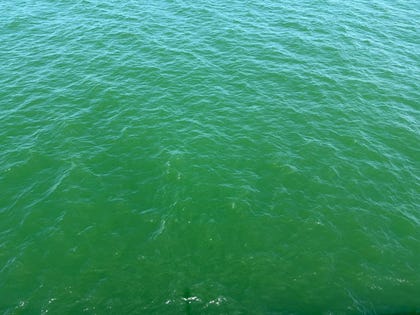
The green sea off Israel’s coast. Israel has been lucky. Some blooms emit toxins, some don’t – the current mega-manifestation is by a nontoxic variant of bacteria. Credit: Osher Rafaeli
The green sea off Israel’s coast. Israel has been lucky. Some blooms emit toxins, some don’t – the current mega-manifestation is by a nontoxic variant of bacteria. Credit: Osher Rafaeli
So the company decided to throw everything into the mix, not because it was right, but because it was that or nothing.
When BlueGreen moved to test its technology, it began with the copper product because it works faster. “We wanted to deliver a blow that reduces the quantity of bacteria in the water immediately, at the border with Gaza,” Harel says.
“Then we used the aluminum product to sink the biomass, then longer-term treatment with Oxy, which creates sublethal oxidative stress that in turn triggers a deadly chain reaction in the cyanobacteria.”
The result: “We made a dent,” Harel says. But that was the most BlueGreen could achieve this year, and after a brief drop in algae-caused turbidity, the bloom just got worse.
Note that the company couldn’t just fly crop dusters over the Mediterranean and drop chemicals. The first hours of the crisis were devoted to discussions with officials from various ministries to obtain permits for the plan as well as chemicals and funding.
The Water Authority adds that it obtained permits from the Environmental Protection Ministry for all materials dumped into the sea, adding, “Experts are currently analyzing the results of the trial. As of now, this was a one-time experiment, and the same method is not being continued at this time until a full analysis of the trial’s impact on the phenomenon is available.”
One headline blared that “27 times” the permitted dose of chemicals had been dropped onto the bloom, but the government says it was actually equivalent to a small fraction of the conservative dose permitted in drinking water.
 Close
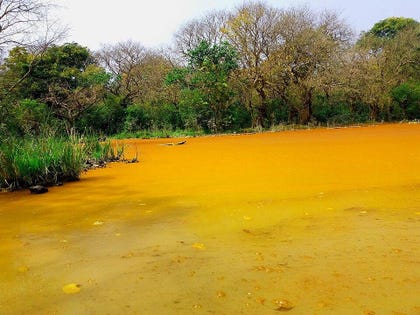
Algae in Bangladesh. Sometimes it isn’t really green at all. Credit: Nijhum Paul/Wikimedia Commons
Algae in Bangladesh. Sometimes it isn’t really green at all. Credit: Nijhum Paul/Wikimedia Commons
What would have happened if no copper had been dropped and nothing had been done? Exactly what did happen, because the company was testing its technology on the bloom, not treating it effectively. The desalination plants had to close and are starting to reopen.
What next? The Water Authority says a plan is on tap to expand the existing facilities – for example, in Ashkelon in the south – to increase system redundancy and to simply have more facilities. The authority has also appointed a team to study the event and draw conclusions.
Israel will apparently need more facilities, with each costing billions of shekels to build. “As part of its long-term preparations for climate change, the Water Authority projects that by 2050 there will be a decrease of about 15 percent in the [replenishing] recharge of water sources due to climate change, as well as reduced precipitation and increased evaporation,” the authority told Haaretz.
Just jump in
So, theoretically, armed with the lessons learned, if the waters are monitored, if a bloom is spotted in time, if enough materials are stockpiled and used in the right places, maybe the catastrophic shutdown of the desalination plants on which Israel increasingly depends in this era of climate change and desertification can be averted.
This is the new normal. Year to year Israel will experience ever greener waters on the Mediterranean coast because, plausibly, the kind of effluxes – outflows – from Egypt and Gaza that Israel has experienced aren’t about to change. Or we could get another variant – maybe red this time.
Are there no alternatives to chemicals, reeking blooms and dead aquatic zones? There may be, for Israel’s water, but not for the beaches and the biodiversity. One suggestion involves negotiations with Egypt to treat the Nile efflux.
Another is to build intake pipes long enough to reach clean seawater. The Water Authority says this option is being considered, but the pipes would have to extend many kilometers, and blooms aren’t a constant in time or space.
Yet another possibility is that when necessary, instead of feeding the infected water directly into the desalination plants, it can be directed to giant reservoirs, which would have to be built. The algae in the pools could be eradicated without pouring any chemicals into the sea, and seawater now devoid of slimy microalgae could be desalinated.
For the next time, which will come, BlueGreen suggests creating the firewall to dramatically reduce the numbers of microbes, allowing other species to survive and compete. You have to catch the bloom as it begins and maintain the firewall 24/7. That may be horribly expensive in money and chemicals, “but anything short of a blitz of treatment is meaningless,” Harel says.
At this point in the state of technology, biology, geology and the way we live, Israel’s desalination plants have a better chance of being saved than the beaches.
The issue under discussion is how to keep the plants online in the case of algae explosions, which are starting to appear around the world in the winter because our species has absolutely changed the planet.
“The bloom that hit Israel this year is, without question, of biblical proportions. Israel faced it for the first time, but it won’t be the last and probably won’t be the worst,” Harel says.
“We were called in and came running within hours with whatever we had: the little that was in the warehouse, a lot of curiosity, and more hands-on experience with blooms than just about anybody else – but none of it in a setup like this, the open sea rather than a lake. We set ourselves modest targets and pretty much met them.”
Unfortunately, “some people wanted magic, and fast. All we had to offer was science, and the patience to observe and learn so that next time we can come better prepared.”
In the end, imagine a summer with empty beaches and no fishing because the sea is too toxic to enter – that’s just another Tuesday in many parts of the world. No solutions beyond prayers have been proposed at this point for beachgoers facing miles upon miles of greening sea.