
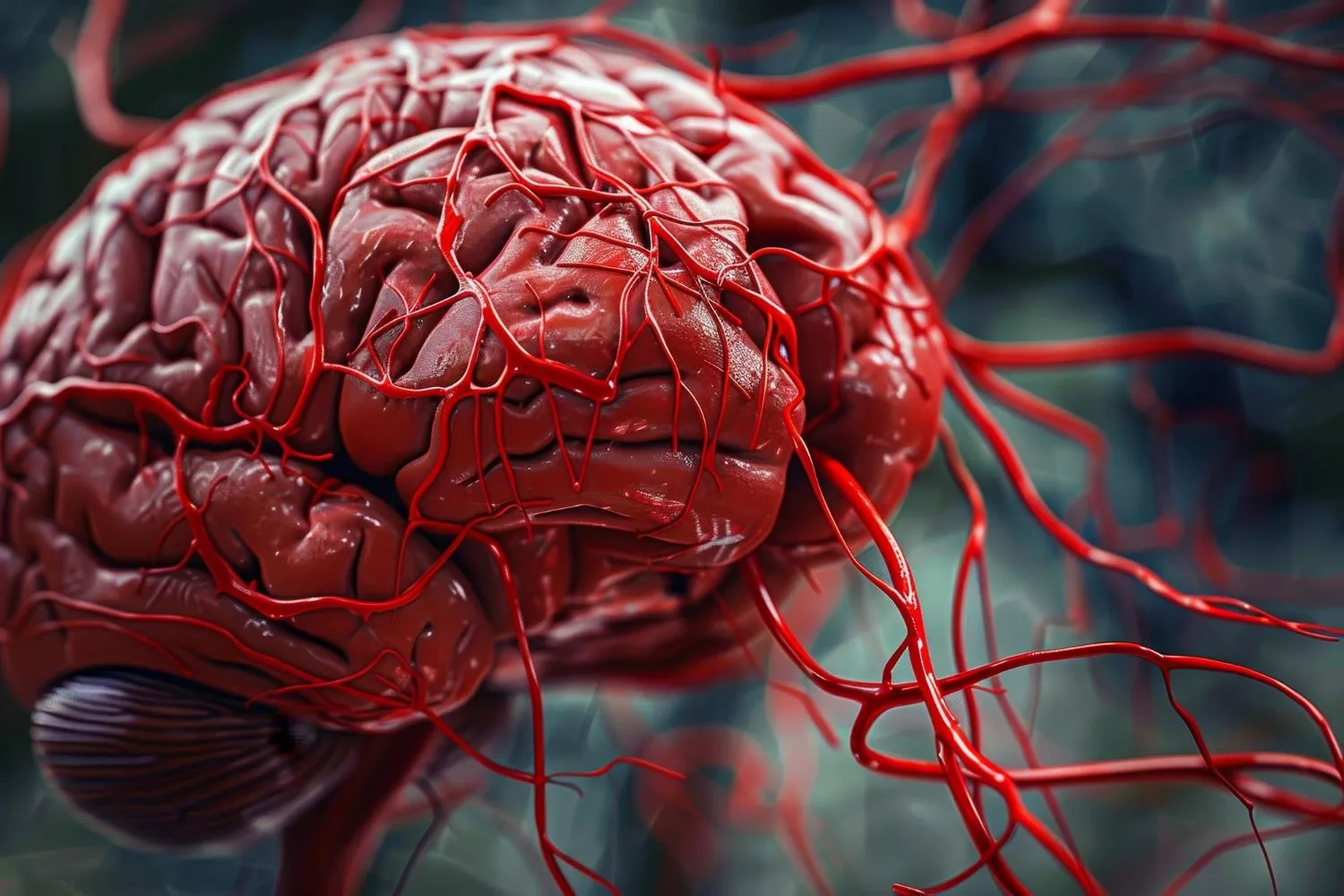
We often think of the brain as a fortress, sealed inside the skull and protected from the chaos of the body’s movements. But new research suggests that the brain’s circulation is far more connected to the rest of the body than scientists realized.
A study led by researchers at Michigan State University (MSU) and Penn State, published in the Proceedings of the National Academy of Sciences, shows that engaging the core muscles through exercise, movement, or even something as simple as coughing can trigger ultrafast changes in blood flow inside the brain.
When abdominal muscles contract, they increase pressure in blood vessels connected to the brain through the spinal column. The researchers found that this pressure causes major veins in the brain to constrict rapidly, momentarily boosting blood flow.
“The brain may be protected inside the skull, but it is not isolated from the mechanical forces generated by the rest of the body,” said Qingguang Zhang, assistant professor of physiology at MSU and first author of the paper.
Active lifestyles are associated with youthful brain structure
“We were surprised by how rapidly and consistently the veins responded to movement. The brain is often studied as though its circulation is regulated independently of the rest of the body. Our findings show that mechanical signals generated by the body can have immediate consequences for the circulation inside the skull.”
In the past, researchers were mostly concerned with the role of arteries and capillaries in controlling blood flow. Arteries carry oxygenated blood to tissues, while capillaries allow the transfer of nutrients and removal of waste products from those same tissues. It has long been thought that veins have very little, if any, control over blood flow, and that they simply deliver blood back to the heart.
But the team observed something unexpected: extraordinarily fast constrictions of the superior sagittal sinus and bridging veins, large veins that drain blood from the brain. These constrictions occurred within a tenth of a second in response to abdominal muscle use, much faster than arterial changes.
“Veins are not simply passive pipes,” Zhang explained. “Our results highlight the other side of circulation. What happens to blood as it leaves the brain can be just as dynamic and physiologically important.”
Exercise helps neurons to grow, study
The study, conducted in mice, revealed that even ordinary behaviors, walking, breathing, and coughing, can alter pressures throughout the body and influence brain blood flow. The researchers believe the same mechanisms apply to humans, given the similarity of physiological structures.
Lead researcher Patrick Drew, professor of biology, engineering science and mechanics, neurosurgery, and biomedical engineering at Penn State, compared the system to a city’s water supply:
“A city’s water system has to be able to accommodate different use needs of an apartment building or a single-family home, or even a full stadium on gameday. Blood flow in the body must be precisely controlled because different organs need different amounts of blood at different times.”
The findings could help explain why exercise benefits brain health; movement itself may directly regulate circulation. They may also shed light on why headaches and migraines worsen with movement, since pain receptors in the dura (the membrane surrounding the brain where these veins are located) could be influenced by rapid shifts in blood flow.
Regular exercise may reduce risk of brain haemorrhage
“We are interested in understanding the fundamental mechanisms that control the flow of blood in our brains,” Drew said. “Like a good mechanic must understand how a car works to diagnose and fix a problem with its engine, we want to understand blood flow in the brain so in the future it will be easier to recognize issues and potentially develop treatments and cures.”
This study examines the brain as part of the overall physical body system, rather than being considered as a separate organ. In addition to chemical signaling that takes place locally within the brain, there are other physical mechanisms that can generate mechanical forces (e.g., blood pressure) which then influence blood flow in the brain.
Journal Reference:
Qingguang Zhang, C. Spencer Garborg, Noah Frank, and Patrick J. Drew. Ultrafast venous and sagittal sinus constrictions in the brain driven by abdominal pressure. Proceedings of the National Academy of Sciences. DOI: 10.1073/pnas.2604172123