
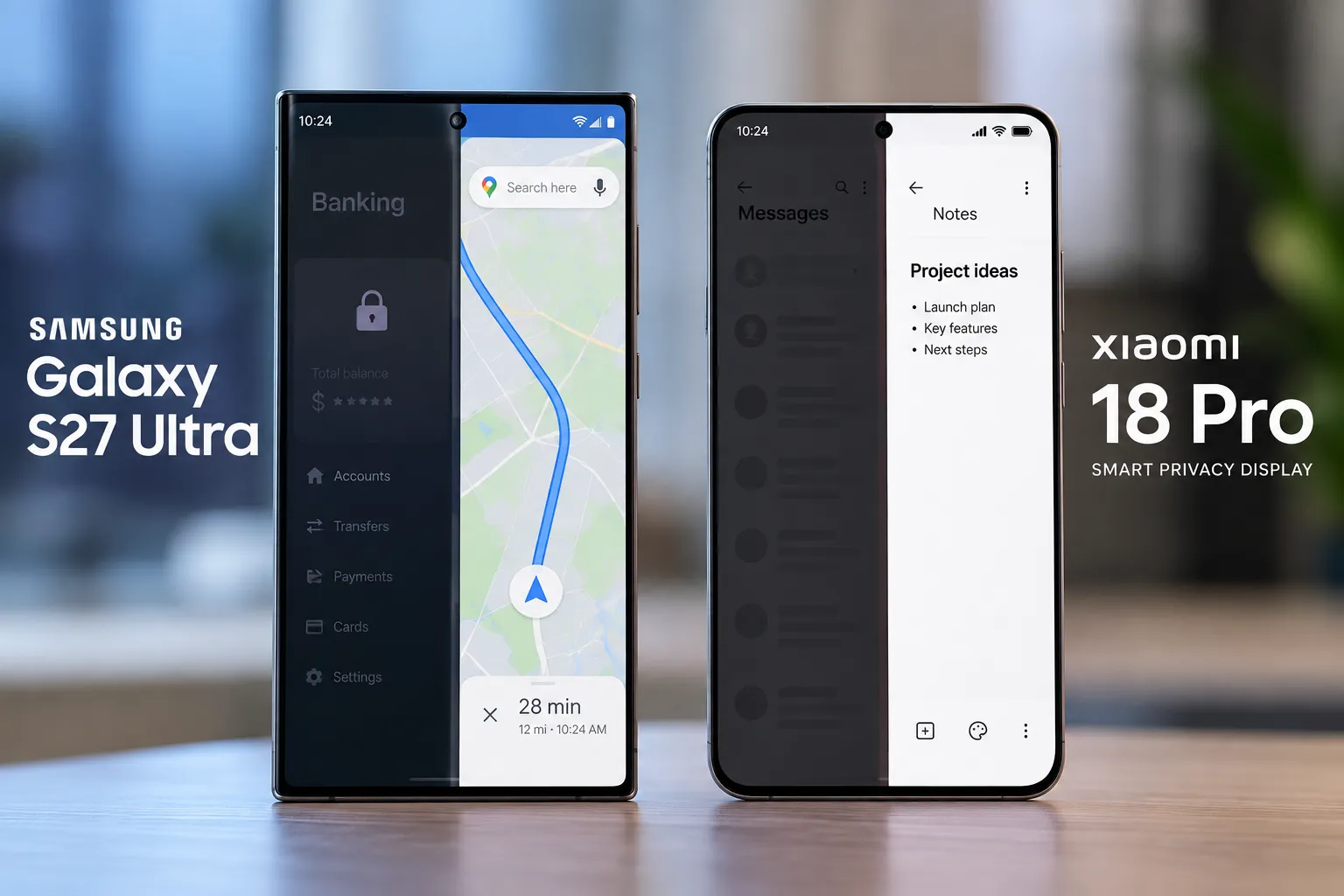
Leaker Ice Universe says Samsung is preparing a split-screen Privacy Display upgrade for the Galaxy S27 Ultra that would dim only one app window in split-screen mode, even as that window gets resized.
Samsung hasn’t announced the Galaxy S27 Ultra or confirmed the feature. The report follows Xiaomi’s launch of the 18 Pro and 18 Pro Max in China, which expands hardware-level privacy protection into notifications, floating windows, and split-screen views.
Android Authority’s report traces the Galaxy S27 Ultra claim to a single Ice Universe post. That makes the split-screen behavior a leak rather than a confirmed Samsung feature.
Here’s what Samsung’s Privacy Display does today, what Xiaomi has already shipped, and how much the Galaxy S27 Ultra rumor actually establishes.
What Samsung’s Privacy Display does right now
The Galaxy S26 Ultra already lets owners activate Privacy Display for specific apps, notifications, and sensitive actions such as entering a PIN, pattern, or password.
Samsung also provides two levels of protection. Partial Screen Privacy can restrict visibility of notification pop-ups while leaving the rest of the screen visible, while Maximum Privacy Protection further narrows the viewing angle and dims the screen.
Samsung’s current support page says the feature uses its hardware-integrated Flex Magic Pixel technology to control light emission and reduce readability from side angles.
Samsung also warns that Maximum Privacy Protection can slightly blur the display or alter colors.
The company’s earlier launch material carries a broader caveat: Privacy Display limits peripheral visibility but does not guarantee that all information becomes completely invisible in every environment. Viewing angle and screen brightness can still affect what someone nearby can make out.
That baseline matters because Samsung already supports more than full-screen dimming.
One UI 9 also expanded Privacy Display behavior for picture-in-picture windows. In testing during the One UI 9 beta, a protected app could continue receiving Privacy Display treatment after shrinking into a PiP window while the rest of the screen remained normally visible. Samsung began rolling out stable One UI 9 to the Galaxy S26 series in September.
What Samsung has not publicly documented is the specific Xiaomi-style behavior described in the new leak: protecting one app in a two-app split-screen layout while dynamically following that app’s changing window boundary as the divider moves.
Xiaomi 18 Pro split-screen privacy protection
Xiaomi’s 18 Pro and 18 Pro Max launched in China on Sept. 23 with what the company calls Smart Privacy Display.
Like Samsung’s implementation, Xiaomi’s system is built into the display rather than relying on a removable privacy film.
Xiaomi says its panel alternates conventional wide-view pixels with narrow-angle privacy pixels. When privacy protection is enabled, the normal pixels switch off and the baffled privacy pixels remain active, reducing how much light escapes toward someone viewing from the side.
The company claims side brightness falls to roughly 1% of the front-facing level at angles beyond 60 degrees. That is a manufacturer claim rather than an independent measurement. (Android Authority)
The software controls are where Xiaomi currently goes further.
Privacy protection can be assigned to selected apps and sensitive pages and can extend to:
Notifications
Floating windows
Split-screen apps
Certain password, payment, transfer, and messaging screens
In split-screen mode, Xiaomi can protect one app while leaving the second app normally visible.
The protected area also follows the app as the split-screen divider is moved, according to the demonstration highlighted in the Galaxy S27 Ultra leak report.
That is the specific behavior Ice Universe says Samsung could add next.
Xiaomi also adds automatic privacy triggers
Xiaomi offers several ways to turn Smart Privacy Display on without manually toggling the entire screen.
Its controls include app- and page-specific rules, location-based activation, Quick Settings, voice commands, and a configurable hardware AI key.
The company has also described front-camera detection that can warn the user or trigger privacy protection when another person appears to be looking over their shoulder.
Samsung already supports automatic activation for selected apps, credentials, and notifications, but its current public support documentation does not list the same location-based or onlooker-detection controls.
That does not establish what Samsung may be testing internally. It only describes the features documented on the two systems available today.
What the Galaxy S27 Ultra leak actually claims
The Galaxy S27 Ultra rumor is narrower than Xiaomi’s full feature set.
Ice Universe claims Samsung plans to add split-screen Privacy Display behavior similar to Xiaomi’s implementation.
In practice, that would mean one app could remain protected while a second split-screen app stays normally visible, with the private region changing size along with the protected window.
Samsung has not confirmed that functionality.
Android Authority’s report cites Ice Universe as the source and includes no Samsung statement, prototype images, or independent second source specifically corroborating the resizable split-screen behavior.
There is separate reporting that Privacy Display itself may expand beyond the Ultra model in the Galaxy S27 generation. ET News, cited by Android Authority earlier this month, reported that the Galaxy S27 Pro and S27 Ultra are expected to receive the technology.
That is still reporting about unreleased hardware rather than an official Samsung product announcement.
Samsung may still have stronger side-view blocking
Ice Universe also argues that Samsung’s current Galaxy S26 Ultra has stronger raw privacy protection than Xiaomi’s system.
That claim appears to relate to the way Samsung restricts visibility from multiple directions rather than only horizontally.
Android Authority separately reported Ice Universe’s claim that Samsung’s panel uses four-way light blocking, covering the top, bottom, and sides, while Xiaomi’s implementation focuses primarily on horizontal viewing angles.
The trade-off, according to that reporting, is that Samsung’s more aggressive implementation can produce greater off-angle brightness loss and display-quality changes.
These are not standardized laboratory comparisons.
There is no independent test in the reporting reviewed here that establishes a definitive winner for privacy strength, image quality, battery use, or viewing comfort across the Galaxy S26 Ultra and Xiaomi 18 Pro series.
Treat “Samsung blocks more, Xiaomi offers more controls” as a description of the current reporting, not a settled ranking.
Galaxy S26 Ultra vs. Xiaomi 18 Pro privacy features
The current products overlap more than the original versions of their software suggested.
Galaxy S26 Ultra currently supports:
Full-screen Privacy Display
Automatic protection for selected apps
PIN, pattern, and password activation
Privacy protection for notification pop-ups
Maximum Privacy Protection
Selective picture-in-picture behavior through One UI 9
Xiaomi 18 Pro and 18 Pro Max add:
App-specific privacy rules
Sensitive-page rules
Notification protection
Floating-window protection
Split-screen protection
Dynamic resizing of a protected split-screen region
Location-based activation
Onlooker detection
Quick Settings, voice, and hardware-button controls
The clearest difference today is therefore not simply “Samsung supports apps and Xiaomi supports windows.”
Samsung already has partial-screen behavior for notifications and PiP. Xiaomi extends that concept further into resizable split-screen multitasking and adds more automation around when privacy protection activates.
Xiaomi 18 Pro global availability is still worth treating carefully
Both the Xiaomi 18 Pro and 18 Pro Max launched in China on Sept. 23.
The 18 Pro starts at 5,999 yuan, while the Pro Max starts at 6,999 yuan.
Reports indicate that Xiaomi plans international availability for at least part of the 18 Pro family, but the exact model lineup, markets, timing, and whether every Smart Privacy Display feature will carry over have not been consistently detailed.
That makes the Chinese launch the firm reference point for now.
Anyone outside China considering one specifically for Smart Privacy Display should wait for Xiaomi’s regional product pages before assuming both Pro models and every privacy feature will be available locally.
What Galaxy S26 Ultra owners can use now
Galaxy S26 Ultra owners do not need to wait for the Galaxy S27 generation to use app-specific Privacy Display.
Open:
Settings > Display > Privacy Display
From there, Samsung currently lets users choose apps that automatically activate the feature, protect PIN and password entry, shield notification pop-ups, and enable Maximum Privacy Protection.
Owners receiving One UI 9 also gain the newer PiP behavior reported during the beta cycle.
What they cannot currently enable through a documented setting is Xiaomi’s specific dynamic split-screen system, where only one side of a two-app layout remains protected and the privacy region follows the divider as it moves.
There is no hidden setting documented by Samsung that turns that on.
What to expect from the Galaxy S27 Ultra rumor
The Galaxy S27 Ultra split-screen claim is plausible in the context of Samsung’s existing Privacy Display development.
Samsung moved from full-screen protection to specific apps and notifications on the S26 Ultra, then expanded that idea to PiP behavior with One UI 9.
A dynamically resized split-screen region would be another step along the same path.
But that progression is context, not confirmation.
The only specific report that the Galaxy S27 Ultra will gain Xiaomi-style split-screen privacy currently comes from Ice Universe. Samsung has not announced the phone or the feature.
Galaxy S26 Ultra owners can use the privacy controls they already have today. Prospective Galaxy S27 Ultra buyers should wait for Samsung’s own specifications before treating dynamic split-screen protection as part of the next flagship.
And comparisons of Samsung’s and Xiaomi’s actual privacy strength should wait for independent testing of both systems under the same viewing angles, brightness levels, and lighting conditions.