
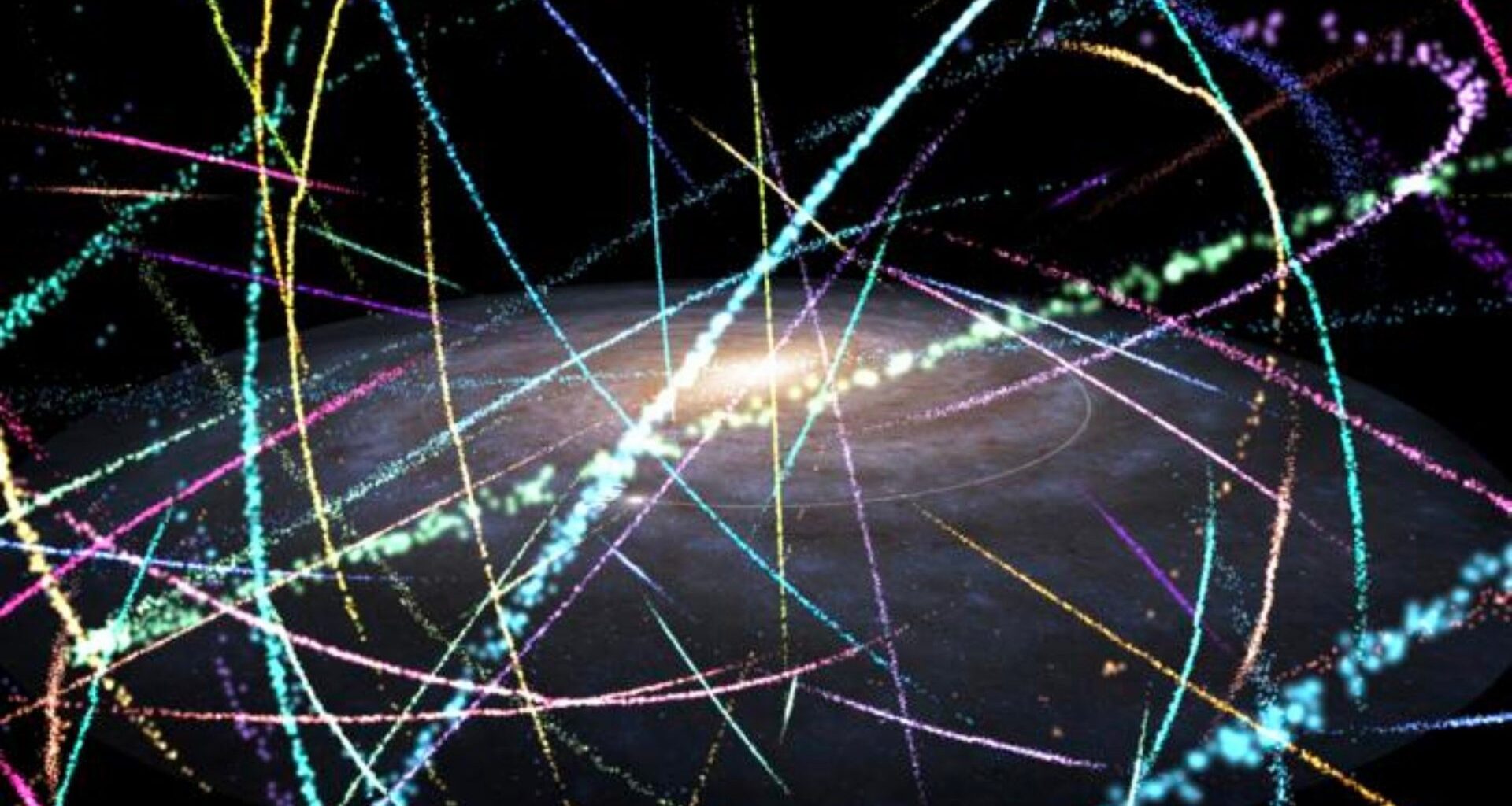
Only 70 of 15,000 simulated stellar streams stayed smooth, and the galaxy alone bent the rest with no dark matter in the model.
Torn-apart star clusters leave long, thin star streams looping around the Milky Way. For years, astronomers have read the gaps and kinks in those trails as fingerprints of dark matter.
New research suggests the galaxy produces the same features on its own. Judged on shape alone, the two causes look identical.
Arpit Arora is a postdoctoral scholar in astronomy at the University of Washington. He and his colleagues grew roughly 15,000 of these streams inside four computer models of Milky Way–scale galaxies.
The group left every clump of dark matter out on purpose.
“We found that almost all of the streams had some sort of structural variation,” Arora said. “So this idea that streams are naturally thin and smooth wasn’t really necessarily true.”
Smooth streams were the assumption
A big galaxy pulls apart any dense ball of stars that wanders too close. The stars spread out along the path that the ball was already traveling along.
The filament that remains behind can wrap a long way around the galaxy. Astronomers call these stellar streams.
Most of the ones visible from Earth are ragged. Stretches of them bend off course, and a mysterious gap can interrupt an otherwise even band.
For two decades the leading explanation has been dark matter. The stars are thought to be pulled out of line by small, invisible clumps of it that pass near a stream.
Astronomers can’t weigh a clump that gives off no light any other way. This is why star streams became the tool of choice.
“Dark matter makes up most of the mass in the universe and forms the scaffolding that galaxies grow on, but we still don’t know what it is,” said co-author Nora Shipp, a UW assistant professor of astronomy.
“The Milky Way is one of the best laboratories we have for figuring that out, and stellar streams are one of the sharpest tools inside it.”
Simulations left dark matter clumps out
The team started with four galaxies about as heavy as the Milky Way. Each one was grown from scratch in an earlier round of cosmological simulations.
One stayed fairly isolated and one built an unusually large disk. The other two had recently swallowed something big, in one case a dwarf galaxy about as massive as the Large Magellanic Cloud.
None of those galaxies keeps the same shape. The disk warps, the halo reacts to whatever fell in last, and a stream orbiting inside feels a different pull as billions of years go by.
Into that, the researchers dropped about 15,000 star clusters on orbits ranging from nearly circular to sharply stretched. They then let them come apart over five billion simulated years.
They took out the small stuff by hand, leaving no dark matter clumps or giant gas clouds in the model. Anything that turned up in a stream had to come from the galaxy itself.
Only 70 streams stayed smooth
About a quarter of the streams, 26 percent, finished with no significant features off their track. Another 34 percent were a mess. Roughly three-quarters departed in some way from a clean, narrow line.
Even the tidy ones weren’t tidy. Their width varied by about 22 percent from one segment to the next, and no stream in the sample held steadier than 10 percent.
Out of roughly 15,000, about 70 came through free of detectable wiggles at any scale. In a galaxy with nothing small in it to blame, a featureless stream is close to a fluke.
Distance mattered most. Streams with orbits that carried them within about 49,000 light-years (15 kiloparsecs) of the galactic center came out the most disturbed. The calmest ones kept to wide, nearly circular paths farther out.
“In our simulations, the host galaxies alone caused the same kinds of irregularities that we observe in real stellar streams,” Arora said.
“Now that we can predict what the host galaxy does on its own, we can start isolating the part that dark matter is responsible for.”
Feature sizes overlap with dark matter
Size is what’s awkward here. Among the smoothest streams that still showed clumping along their length, the typical smallest feature spanned about 2 degrees of sky, roughly four times the width of the full moon.
Dark matter clumps are predicted to leave gaps of 1 to 5 degrees. The galaxy and the clumps produce features of the same size, so shape alone can’t tell them apart.
The team checked that against a control, running 1,000 more streams through a model galaxy that was frozen in place and perfectly symmetric.
About 35 percent of those finished with no detectable clumping along their length, compared with about 2 percent of the smooth streams in the realistic galaxies.
Two features astronomers have argued over turned up in the simulation too. The stream called GD-1 carries a spur, and the ATLAS–Aliqa Uma stream carries a sharp kink.
Both have been read as the work of dark matter, and both have look-alikes in a catalog built with no dark matter clumps in it.
Motion may separate the two causes
The simulation is deliberately simple in places. Stars leave the clusters at a steady rate rather than in bursts, and nothing happening inside a cluster is modeled, so real streams may carry more structure than these do.
The fractions also belong to the orbits the team sampled, rather than to the real Milky Way.
What nobody has tested is whether a dark matter clump leaves a different mark in how a stream’s stars move, as opposed to how the stream looks from here. That’s the next run: the same four galaxies, with the clumps put back in.
“Sadly there’s no magic wand to reveal the structure of dark matter,” said James Davenport, a research assistant professor of astronomy at the UW.
“Streams are complex systems, but they’re still the most interesting way to study the dark matter close to home.”
In June, the Vera C. Rubin Observatory released its first images, and it should find hundreds more streams. Each one will now arrive with a prediction of how bent it ought to be with no dark matter involved at all.
The full study was published in the journal The Astrophysical Journal.
—–
Like what you read? Subscribe to our newsletter for engaging articles, exclusive content, and the latest updates.
Check us out on EarthSnap, a free app brought to you by Eric Ralls and Earth.com.
—–