
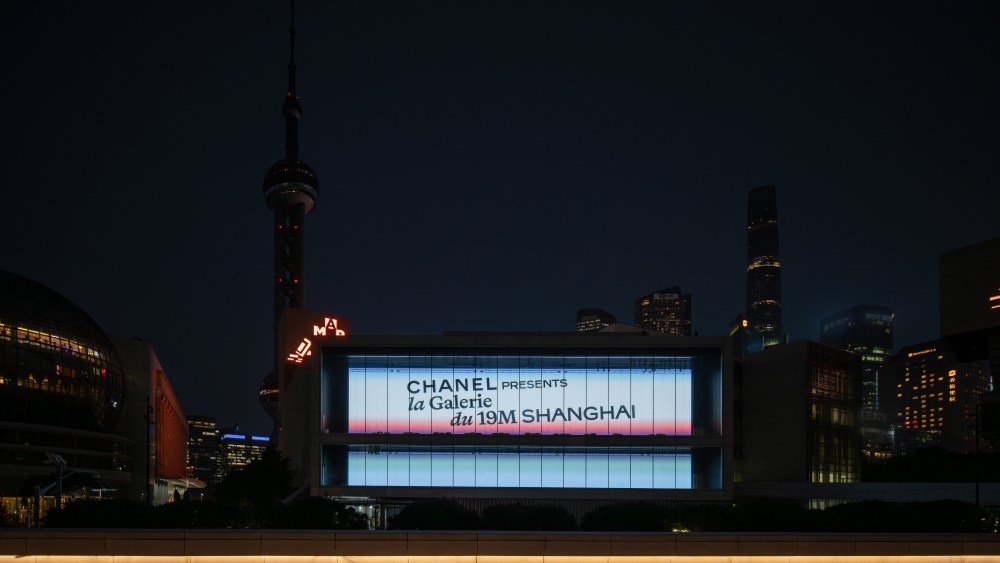
In an effort to deepen its relationship with Asia, Chanel has unveiled the latest edition of La Galerie Du 19M Shanghai project at the Museum of Art Pudong — a colossal white structure on the Huangpu River. Taking over the entire third floor, the free exhibition is its largest format to date and the Parisian luxury maison’s biggest local project of the year.
The project, now in its third iteration, after Dakar and Tokyo, brings together the storied craftsmanship of Lesage, Montex, Goossens, Lognon and more alongside more than 31 creative guests from China and France, arrives amid a renewed interest in handicrafts among young Chinese consumers — from pixel-bead crafting and pottery to a growing appreciation for traditional garment craftsmanship.
Dubbed “A Sense Of Touch,” the Shanghai edition progressively introduces the brand’s Métiers d’Art hub Le19M‘s history and evolving identity to the Chinese audience — in an intimate format.
“What I like in such an exhibition is that you don’t see any Chanel — you see what allow us to be able to create what is Chanel — it’s about the intangible. When you reach that level of brand equity, it allows us to go one step further in the intimacy of our brands,” said Bruno Pavlovsky, president of fashion and president of Chanel SAS.
“The frequency is unique — it’s about materials, and it’s about infinity — when you put artists, creative people together with craft, there’s no limit to what they can imagine. It’s transmission with materials with this level of freedom that you can feel through the exhibition — it is the result of Chinese French collaboration,” added Pavlovsky.

Inside “A Sense Of Touch.”
Courtesy of Chanel
“In the boutique, you see the result of their work — here, you understand a little bit more about the depth of what they are doing,” said Pavlovsky, adding that the brand’s China ready-to-wear business is “booming,” a fact made visible by the density of Matthieu Blazy’s new Chanel looks on the back of clients at the exhibition opening.
“We just reopened Plaza 66, which is an incredible, an incredible, Unique maison for the house with such deep proposal, I will also visit IFC, which is just nearby — there are many things happening, we continue to improve the existing network of our boutiques, but the priority of this year is the launch of our new collection,” said Pavlovsky.
Going back to the exhibition, Pavlovsky marveled at how the Parisian couture house can learn from artists in the journey towards responsibility — “If you are an artist, you have to contribute to the better, being an artist means that you are sustainable, you have to be sustainable,” added Pavlovsky, adding that Chanel’s sustainability efforts are concentrated on raw material sourcing and processing, from cotton and cashmere to silk and leather — “There is still a lot more to do, but we are seeing steady progress year after year,” he said.
Through out the exhibition — which is curated by an editorial committee of Gong Yan, Lin Tianmiao, Zhang Lei and Christelle Kocher — the sustainability message is often highlighted through the transformation of discarded and leftover materials into new works of art.
Using upcycled material from Lesage and Lesage Intérieur, Chinese artist Yin Xiuzhen’s Untitled, 2026 brings divines a goddess statue into 19 hollow sections, a nod to Le19M’s name; Ding Yi, another established Chinese painter, incorporated leftover paint flakes into a gridded Montex structure aptly named “Appearance of Crosses – Embroidery Painting”; in a deeply personal meditation on medication and disease, Lin Tianmiao combined 500 paper pill boxes she collected during treatment with flesh-toned Massaro leather in a piece called “Second Life.”
Yin Xiuzhen “Untitled, 2026” created with Lesage and Lesage Intérieurs.
Courtesy
A centenary retrospective of the Lesage maison is also included in the exhibition. The latest iteration of the show incorporates more localized elements, such as a coromandel screen, a well-documented Coco Chanel obsession, from the brand’s heritage department; an embroidery of Shanghai for the “Mademoiselle Privé” exhibition in 2019, and key looks from Blazy’s latest collections.
A coromandel screen from the brand’s heritage department.
Courtesy
The exhibition will run until November 15.
A series of talks — the first batch in early October is already booked out — and workshops for children and adults will invite the public to engage with the brand and its craft on a more visceral level.