
What is My Take on This Study and FFR-CT?
I firmly believe FFR-CT is going to become an integral part of coronary computed tomography angiography (CCTA) evaluation when needed.
This is a strong study supporting FFR-CT as a marker of prognosis, particularly when values become markedly abnormal.
However, association should not be confused with mechanism.
Lower FFR-CT inevitably reflects, at least partly, the underlying atherosclerotic burden, stenosis severity and diffuse coronary disease.
We should also consider the most important limitation of the study: Plaque burden was not available.
Does FFR-CT Offer Prognostic Value Beyond Quantitative Total Plaque Burden?
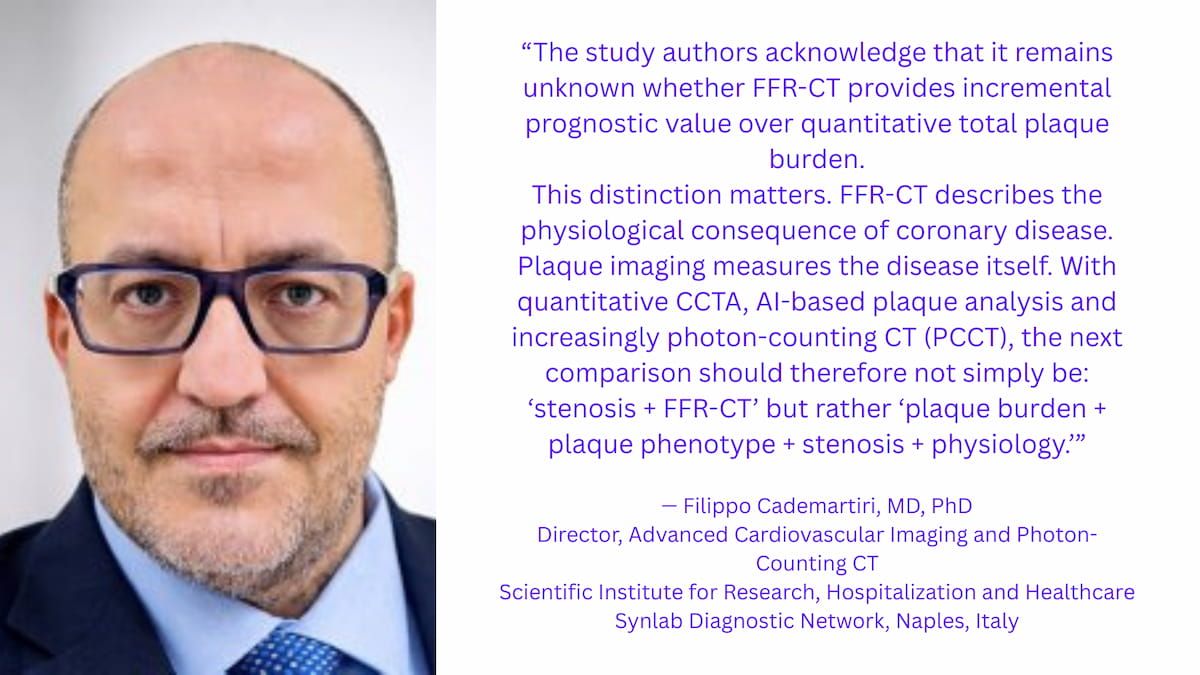
The study authors acknowledge that it remains unknown whether FFR-CT provides incremental prognostic value over quantitative total plaque burden.
This distinction matters.
FFR-CT describes the physiological consequence of coronary disease. Plaque imaging measures the disease itself.With quantitative CCTA, AI-based plaque analysis and increasingly photon-counting CT (PCCT), the next comparison should therefore not simply be: “stenosis + FFR-CT” but rather “plaque burden + plaque phenotype + stenosis + physiology.”
Only then will we understand how much independent prognostic information physiology really adds.
Dr. Cademartiri is the director of advanced cardiovascular imaging and photon-counting CT at the Scientific Institute for Research, Hospitalization, and Healthcare Synlab Diagnostic Network in Naples, Italy. He is also a consultant in advanced cardiovascular imaging at CDI/Centro Diagnostico Italiano in Milan, Italy.
(Editor’s note: This blog is adapted with permission from Dr. Cademartiri’s original LinkedIn post available at: https://www.linkedin.com/feed/update/urn:li:activity:7509196634615070720/ ).