
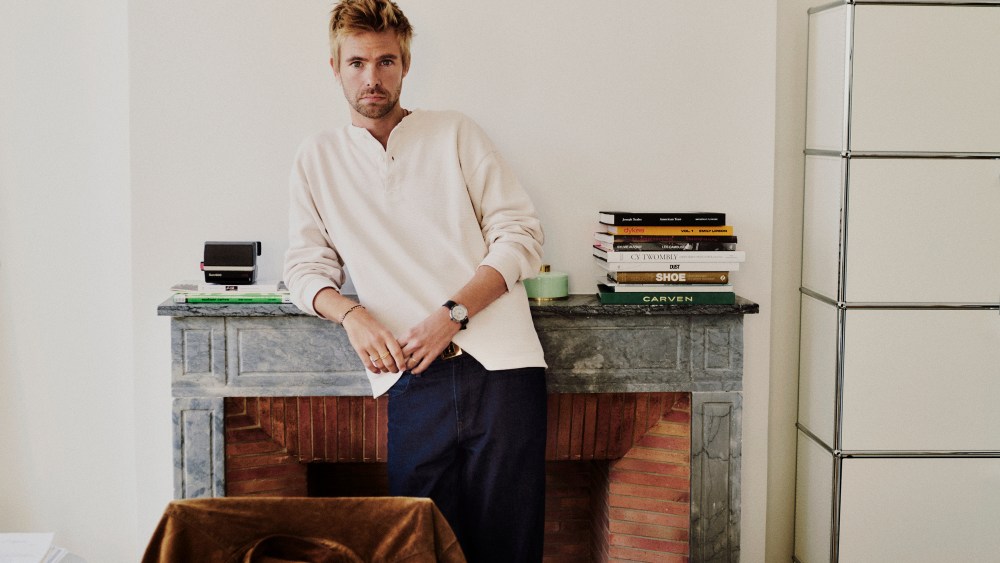
PARIS — “I’ve always done what I wanted to do. I never let myself be influenced by others, and as a result, I’ve lived a happy life because, ultimately, I have no regrets.”
So spoke Madame Carven, already a centenarian at the time, in a 2012 interview visible on YouTube.
These words stayed with Kai Nesselrath, who was appointed design director of the house bearing her name in June and will show his first collection on the runway on Thursday.
“It’s that spirit of Madame Carven that spoke to me the most — that energy of hers,” he told WWD in an exclusive preview. “This is what we call a woman that’s a doer.”
During his research for his new role, a rabbit-hole endeavor he said took him through “whatever had Carven written on it” from the house archive and libraries to Pinterest and other digital repositories, he was struck how Marie-Louise Carven-Grog, born Carmen de Tommaso, launched her house in 1945 to dress women of similar stature to her 5-foot, 1-inch self and became one of the rare women couturiers in Paris.

A preview of Carven
Mathieu Rainaud/Courtesy of Carven
But more than how she built her brand and the style she developed, what he wants to embrace in his tenure is “how she saw this everyday life and this very Parisianity,” which “played such a role for her, and really trying to bring [Carven] back to that.”
So instead of taking cues from Carven’s late-1950s and early-1960s heyday, a period that saw women stepping into the workforce in ever-increasing numbers, Nesselrath wondered what they can become now.
He is after a modern, mobile woman and intends designs that “should feel like you can live in [them],” he said. In particular, “the construction of a jacket, where you place the shoulder pad, how you move the fabric” is his way of playing with architecture.
A preview of Carven
Mathieu Rainaud/Courtesy of Carven
The discipline forms a kind of impossible conversation between the founder and her current successor. Madame Carven studied it; Nesselrath considered the discipline, although he did not pursue it.
Born and raised in Rome to German parents, Nesselrath grew up with art historians for parents and, he joked, “an overdose” of art that included promises of ice cream for one more stop on the family tours of churches.
How buildings are designed and made was an early interest, but fashion offered a quicker route from idea to object. “If you start doing architecture and you build a house, you’ll have to wait probably five years to see the result,” he said. “In fashion, if you want a jacket, you explain it, and then in about like a few days you can see a toile.”
After a year at art school Accademia di Belle Arti di Roma, he studied fashion at Polimoda in Florence, adding courses at Central Saint Martins after graduation, then moved to Paris to work in Chanel’s haute couture department. He spent just under a decade at Saint Laurent, where he focused on tailoring and structure for almost a decade.
A preview of Carven
Mathieu Rainaud/Courtesy of Carven
Carven offered a chance to take on a new kind of responsibility in a more intimate house, which he described “a little bit like a boutique hotel.”
For his first collection in the French house, owned by Icicle’s parent ICCF Group, Nesselrath took Paris as both setting and inspiration.
After living in the City of Lights for more than a decade, the designer said he was drawn to its features, which informed his palette that runs from sky blues to Seine greens, via tones inspired by its typical stone buildings. Roses and a soft orange nod to the way light catches on its facades.
“Since coming and working in Carven, I’ve developed — I wouldn’t say a passion, but an intention for green,” he added from his office overlooking the Rond-Point des Champs-Élysées where horse chestnut trees were turning russet with the first days of fall.
While silhouettes remained under wraps, Nesselrath said his Carven era moves away from the sharp shoulders of his tailoring past toward softer, rounder shapes, with details such as the triangular shape of a trenchcoat’s vent or the overall line of a coat loosely lifted from archived sketches.
Playing on the doer’s need for utility and femininity in step, he reached for cotton duck, denim and silk that telegraph the lived-in feel, continuing Madame Carven’s interest in work with practical materials, including fabrics associated with furniture and uniforms. A floral jacquard, spotted on a high-neck long dress still in progress during the preview, also expressed that balance.
A preview of Carven
Mathieu Rainaud/Courtesy of Carven
A Carven code that he will be exploring extensively is stripes, interpreted as a newly developed design of varying width and proportion in the darkest of green on white poplin, as well as the interplay of sheer fabrics, with folds and pintucks creating an effect.
He also left edges raw, for delicacy without drifting into lingerie. “I don’t want the collection to feel too perfect,” he said. “I want there to be little imperfections.”
And inspired by the doer-typical gesture of tucking a writing instrument behind the ear, Nesselrath chose a Carven-engraved pencil for the invitation. Pencil shavings, fragile and featherlike, also turned into earrings.
“It feels like a puzzle,” he said of the way the collection’s details come together. “You have all these bits, and somehow, by some sort of magic, it all makes sense.”