
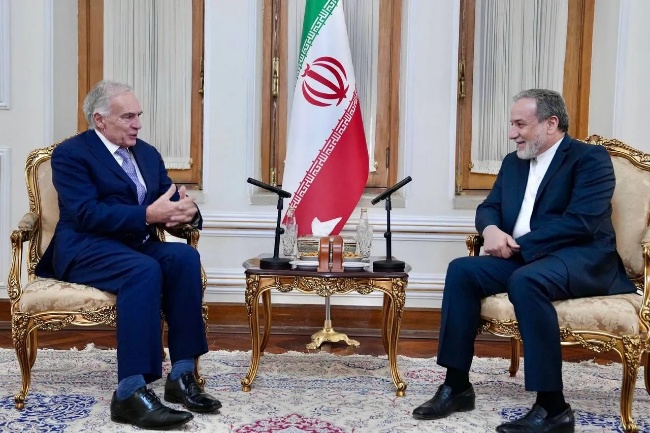
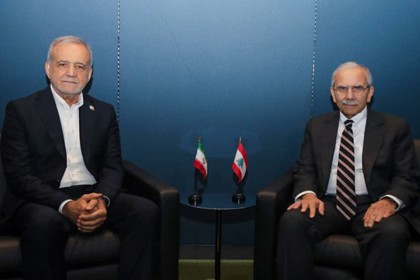
 Iranian President’s meeting with the Lebanese Prime Minister (Iranian President’s website, September 25, 2026)
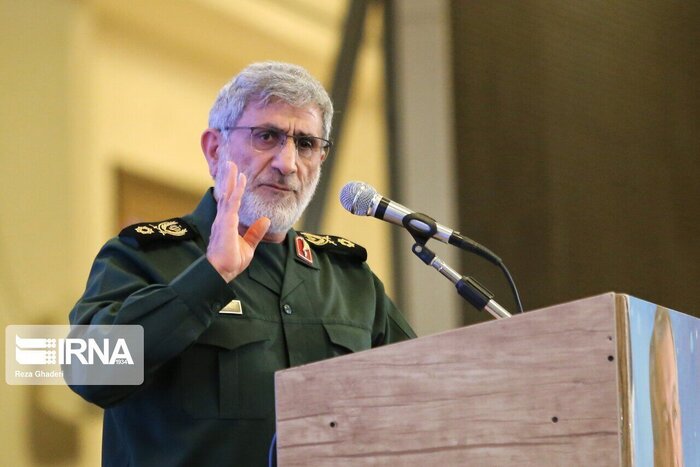 Qods Force commander (IRNA, October 2, 2026)
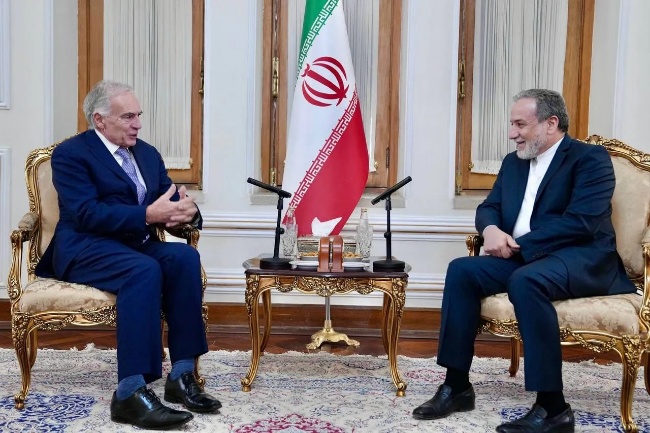 Iranian Foreign Minister’s meeting with the UN Special Coordinator for Lebanon (IRNA, October 6, 2026)
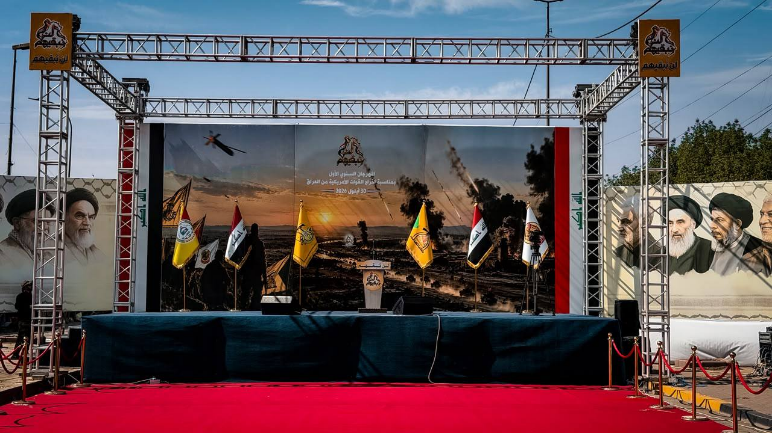 Militia celebrations in Baghdad marking the US (Sabereen News Telegram channel, September 30, 2026)
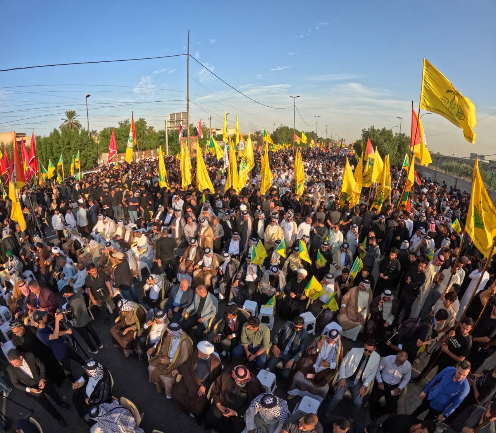 Militia celebrations in Baghdad marking the US (Sabereen News Telegram channel, September 30, 2026)Key Trends
Iran used the anniversary of Nasrallah’s elimination to emphasize its support for the “resistance” in Lebanon.
Iran and the pro-Iranian militias in Iraq portrayed the completion of the US withdrawal from Iraq as a strategic achievement for the Axis of Resistance.
Continued Iranian assistance to the Houthis in Yemen amid the escalation of the campaign against Saudi Arabia.
Highlights[1]
Iranian President Masoud Pezeshkian met with Lebanese Prime Minister Nawaf Salam on the sidelines of the UN General Assembly and claimed that Tehran does not interfere in the internal affairs of any country.
Senior Iranian officials used the second anniversary of the elimination of Hezbollah leader Hassan Nasrallah to emphasize Iran’s support for Hezbollah and the “resistance” against Israel.
The campaign between the Houthis and Saudi Arabia and its allies in Yemen escalated, with Houthi attacks deep inside Saudi Arabia and an attempt by anti-Houthi forces to regain control of areas adjacent to the Bab al-Mandeb Strait. Iran condemned the attacks against the Houthis.
It was claimed that the Houthis are using Iranian air defense systems that could threaten international aviation routes.
The completion of the US withdrawal from Iraq was portrayed in Iran as a significant strategic achievement for the “Resistance Front,” alongside an assessment that it does not necessarily herald the end of US influence in the country and does not justify the disarmament of the Shiite militias. The pro-Iranian militias celebrated the withdrawal and continued to defy demands to disarm.
A “leader” in the pro-Iranian militias in Iraq did not deny that there is cooperation and coordination with other elements of the Axis of Resistance but explained that it is intended to “keep Israel occupied” and confront common threats.
Iranian efforts to resume flights between Iran and Iraq.
Iranian Involvement in Lebanon
Iranian President Masoud Pezeshkian met with Lebanese Prime Minister Nawaf Salam on the sidelines of the UN General Assembly. Pezeshkian stressed the importance of friendly relations and constructive cooperation between the two countries and praised the Lebanese people’s historic steadfastness against “the occupation and aggression of the Zionist regime.” He noted that Iran seeks the independence, development, stability, and prosperity of the Lebanese people. According to him, Iran has always emphasized the need to strengthen cooperation and ties among the countries of the region and to resolve issues through dialogue and mutual respect. Referring to developments in the region, Pezeshkian added that Iran emphasizes its desire to develop relations with all the countries of the region and to respect their national sovereignty and territorial integrity. He said Iran is committed to the principle of non-interference in the internal affairs of nations and will oppose any form of bullying and pressure against independent countries. The Lebanese Prime Minister, for his part, stressed the need to end the occupation, bring about Israel’s withdrawal from Lebanese territory, halt the “aggression” and attacks, and strengthen the authority and sovereignty of the state (Iranian President’s website, September 25, 2026).
Iranian President’s meeting with the Lebanese Prime Minister
(Iranian President’s website, September 25, 2026)
Senior Iranian officials issued special statements marking the second anniversary of the elimination of Hezbollah leader Hassan Nasrallah, in which they praised the path of the “resistance” in Lebanon and emphasized the Islamic Republic’s continued support:
Iran’s Supreme Leader, Mojtaba Khamenei, issued a message marking “Sacred Defense Week,” which commemorates the outbreak of the Iran-Iraq War, and the anniversary of Nasrallah’s death. In the message, he praised Hezbollah Secretary-General Naim Qassem and Hezbollah fighters and stated that they continue along Nasrallah’s path. He noted that Lebanon’s current days would be remembered by history as prominent and glorious days for Nasrallah and all the “resistance” fighters, and, by contrast, as humiliating days that would ultimately bring disgrace upon those who, in the face of the “Zionist enemy,” place their hopes in the false promises of powerful figures and ill-wishers. He added that, unlike Nasrallah and today’s “resistance” fighters, who would continue to shine over time like bright stars and show the way to those seeking a path who remain confused, those people would be buried and quickly forgotten, and if their names were mentioned in the future, they would be associated with evil, lack of wisdom, and perhaps even betrayal (Iranian Supreme Leader’s website, September 28, 2026).
The Iranian Foreign Ministry called for the prosecution and punishment of the “perpetrators of the crime committed by the Zionist terrorists” and those who ordered it. It further stated that there is no doubt that the residents of Lebanon and the region now understand, more than at any time during Nasrallah’s lifetime, the value and importance of his struggles, and that the residents of Lebanon, the region, and the world feel more than ever that confronting “the occupation and warmongering of a racist and tyrannical regime that recognizes no limits to its crimes and brutality and is committed to no covenant or agreement” requires the continuation of the “honorable resistance.” The Iranian Foreign Ministry stressed that the Islamic Republic, recognizing Lebanon’s sensitive position as a country located next to an “occupying and terrorist entity,” adheres to its principled position in support of Lebanon’s independence, territorial integrity, sovereignty, and national unity, and believes that a strong and independent Lebanon capable of defending its residents and its territory is one of the pillars of stability and sustainable security throughout the region (Mehr, September 27, 2026).
Majles Speaker Mohammad Baqer Qalibaf said that the “enemy” believed Nasrallah’s killing would halt the “resistance,” but failed to understand that Nasrallah had established a structure that does not depend on a single individual but rather is cohesive and stable and continues to maintain its deterrent capability with strength. According to Qalibaf, Nasrallah’s legacy is not limited to a name and a memory but is a human and ideological asset that continues to exist in the experience of generations of the “resistance,” in the faith of its fighters, and in the determination of peoples demanding dignity and freedom (Tasnim, September 28, 2026).
Chief of Staff of the Iranian Armed Forces Ali Abdollahi noted that the “Zionist-American enemy” believed that physically eliminating the leader of the “resistance” would cause the central pillar of the “resistance” tent to collapse, but the “enemy’s” calculations had once again failed. The “Resistance Front” had not only remained strong, but had achieved overt and covert strategic unity, and the path of Sayyid Hassan Nasrallah continues resolutely in Lebanon, “Palestine,” Yemen, Iraq, and throughout the sphere of resistance and the pursuit of justice (Tasnim, September 28, 2026).
Qods Force Commander Esmail Qaani said at a ceremony marking two years since Nasrallah’s elimination that Hezbollah had fought courageously in one of the most difficult wars in its history and that throughout its history, the “Zionist regime” had never suffered losses as heavy as those it sustained in this war. According to him, while Israel promoted the claim that Hezbollah had been destroyed and was no longer capable of resisting, Hezbollah fighters entered the battlefield two days after the outbreak of the war and the death of Iran’s Supreme Leader, Ali Khamenei. Qaani added that the sublime deeds of Hassan Nasrallah and his designated successor, Hashem Safieddine, who was eliminated several days later, had transformed Hezbollah into a school of “resistance,” and that the organization had become a model for other peoples and groups inspired by the path of “resistance.” He added that the belt of defense, the aspiration for independence, and dignity throughout the Muslim world, from Afghanistan to Yemen and from Iran to Gaza and Lebanon, must be strengthened (IRNA, October 2, 2026).
Qods Force commander (IRNA, October 2, 2026)
Iranian Foreign Minister Abbas Araghchi met with UN Special Coordinator for Lebanon Jean Arnault. During the meeting, Araghchi emphasized the Islamic Republic’s principled position in support of Lebanon’s territorial integrity and national sovereignty. He called for increased UN efforts and activity to end “the Zionist regime’s aggression and occupation in Lebanon.” Araghchi also expressed Iran’s readiness to continue consultations and cooperation with the UN and the countries of the region to help preserve Lebanon’s stability and security (Iranian Foreign Ministry Telegram channel, October 6, 2026).
Iranian Foreign Minister’s meeting with the UN Special Coordinator for Lebanon
(IRNA, October 6, 2026)
Iranian Involvement in Iraq
Iranian Ambassador to Iraq Mohammad Kazem Al-e Sadeq addressed recent developments in efforts to resume flights between Iran and Iraq. According to him, clerics, political movements, “resistance” organizations, social groups, students, tribal leaders, and various segments of the Iraqi public had called for the resumption of flights, and in several Iraqi cities, calls had even been issued to hold demonstrations demanding that the Iraqi government find a solution that would regulate the matter. He noted that Iraqi officials are in contact with the management of Najaf and Baghdad airports to hold joint meetings and resolve the issue as soon as possible. He stressed that around 25 flights operate daily from Iran to Najaf and around 15 to Baghdad, and that approximately 12,000 to 13,000 people travel on Iranian airlines between Iran and Iraq in both directions. Al-e Sadeq clarified that the ban on Iranian flights to Iraq had also created difficulties for Iraqis themselves, including Iraqi students studying in Iran (ISNA, September 26, 2026). Meanwhile, Iraqi media reported that beginning September 29, 2026, only the Iraqi airline Iraqi Airways is permitted to operate flights between Iran and Iraq, and that Najaf Airport would be open to flights by that airline for one month (Khabar Online, September 29, 2026). Subsequently, “Iraqi sources” announced that Iraqi Airways flights between Najaf International Airport and the airports in Tehran, Mashhad, and Isfahan would resume on October 8, 2026 (Mehr, October 5, 2026).
The Houthis in Yemen
During the period under review, September 24 to October 7, 2026, Houthi military spokesman Yahya Saree reported that the Houthi armed forces had carried out at least 16 “operations” using ballistic missiles, cruise missiles, and drones against various targets in Saudi Arabia, including in the capital Riyadh. The targets included airports, energy infrastructure, command and operations rooms, weapons depots, missile launch sites, and other military targets. Saree warned all international airlines against flying over Saudi territory because it was subject to Houthi military activity (Yahya Saree’s Telegram channel, September 24–October 7, 2026).
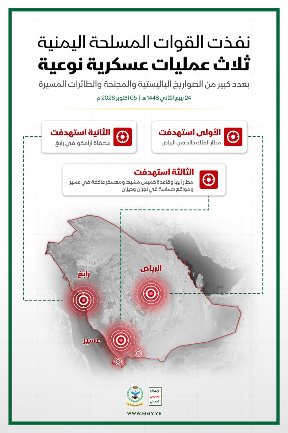
Infographic of the Houthi attacks in Saudi Arabia
(Telegram channel of the Houthi forces, October 6, 2026)
During the same period, Saudi-led coalition spokesman Turki al-Maliki reported that 16 ballistic missiles and six drones launched toward various targets in Saudi Arabia had been intercepted. He accused the Houthis of continuing to attack targets in the holy cities of Mecca and Medina and in other cities, causing numerous civilian casualties throughout Saudi Arabia and attempting to strike Saudi vessels in the Red Sea (Saudi-led coalition forces X account, September 24–October 7, 2026).
Anti-Houthi forces launched a large-scale offensive along the western coast in an attempt to regain control of territories that had fallen to the Houthis in September 2026. On the other hand, it was reported that Houthi forces had succeeded in cutting the road leading from the city of Taiz southward to Aden, thereby completing the encirclement of Taiz (Arab and international media, September 24–October 7, 2026).
Mahdi al-Mashat, chairman of the Houthi Supreme Political Council, saluted the Houthi armed forces confronting the “Saudi aggression,” which he claimed seeks to rob Yemen of its sovereignty and independence while serving the “American-Zionist project” aimed at weakening Yemen and keeping it divided and dependent on external aid. He attacked the actions of “the criminal Netanyahu and the Zionists,” who he claimed were “storming and desecrating” Al-Aqsa Mosque and threatening to destroy it through tunnels they had dug beneath it. Al-Mashat called on all countries that had responded to the Saudis’ “false claims” regarding harm to Mecca to respond in the same manner to the harm to Al-Aqsa Mosque. He reiterated the “promise” that freedom of navigation in the Red Sea and the Bab al-Mandeb Strait is secure and that Houthi activity is directed only against Saudi Arabia (Mahdi al-Mashat’s Telegram channel, September 25, 2026).
Iranian involvement in Yemen
The armed forces of the internationally recognized Yemeni government announced that they had identified Houthi use of Iranian air defense systems employing innovative technologies and methods of operation. According to them, these weapons pose “a serious threat to international aviation routes and civilian aircraft.” Yemeni military spokesman Majed Abdullah al-Nuzaili said that weapons intended for air defense had been converted, using innovative methods and with the assistance of IRGC experts present in Yemen, into “cruise missiles.” According to him, the missiles are launched from al-Hodeidah Governorate toward international aviation routes in the southern Red Sea. He added that the missiles operate using a thermal tracking system and attack any heat source without the ability to distinguish between military and civilian targets. He stressed that this poses a direct and dangerous threat to civil aviation safety, including UN and humanitarian organization aircraft using these aviation routes on their way to Yemen and the region. Al-Nuzaili linked this trend to threats by senior Iranian officials to strike and disrupt airports in the region following sanctions imposed on aircraft operated by Iranian airlines (Al Arabiya, September 27, 2026).
The Iranian Foreign Ministry strongly condemned attacks by Saudi Arabia and Yemeni forces against civilian infrastructure and targets in Houthi-controlled areas of Yemen. A Foreign Ministry statement said that the continued violation of Yemen’s national sovereignty and territorial integrity, along with acts of aggression against its cities and villages, which had previously also been attacked by the “Zionist regime” and the United States, as well as the continued economic blockade of the country, contravene the fundamental principles of the UN Charter and the foundations of Islam (Iranian Foreign Ministry Telegram channel, September 27, 2026).
Members of the Yemen Subcommittee of the Majles National Security and Foreign Policy Committee met at the Yemeni Embassy in Tehran with Ibrahim Mohammad al-Dailami, the Houthi ambassador to Iran. Committee member Alaeddin Boroujerdi congratulated the ambassador on the “recent victories of the Yemeni people” and stressed the need to strengthen relations and cooperation between the two countries. Another committee member, Mohammad-Reza Mohseni-Sani, expressed hope for Yemen’s unification. He emphasized that Yemen currently has a special status in regional developments and in the “Resistance Front,” and that the Iranian people remember well that the Yemeni people courageously demonstrated their position during historic tests (Tasnim, October 3, 2026).
Completion of the US Withdrawal from Iraq
On September 30, 2026, US Central Command announced that all US forces and equipment had been evacuated from Erbil Air Base in northern Iraq, thereby ending US and coalition operations in Iraq as part of Operation Inherent Resolve against ISIS, which had been underway since 2014 (US Central Command X account, September 30, 2026). In Iran, the completion of the withdrawal was described as a significant strategic achievement, alongside an assessment that the move does not necessarily herald the end of US influence in Iraq and does not justify the disarmament of the pro-Iranian Shiite militias:
An IRGC statement said that the US withdrawal was a highly significant historic event and an enormous achievement for the Axis of Resistance. It claimed that the United States had not left Iraq through negotiations or as a favor granted to Iraq, but because of the determination of a people that stood firm, the blood of fighters who sacrificed their lives, and the will of a “resistance” that was never broken. The United States was expelled after 20 years of military intervention, approximately 5,000 deaths, and expenditures totaling four trillion dollars – figures that, according to the IRGC, attest to its severe and humiliating defeat. Its expulsion from Iraq heralds its expulsion from all of West Asia and throughout the Islamic nation. At the conclusion of the statement, the IRGC stressed the need for wisdom and vigilance on the part of the Iraqi government, the Iraqi people, and the “resistance” forces in the face of possible plots and subversive actions by the United States and Iraq’s enemies aimed at renewing insecurity and instability in the country. It further stressed that the IRGC would continue to stand alongside justice-seeking peoples and opponents of oppression in the region to cleanse West Asia of the remnants of the “impure presence” of the American aggressors and of the “child-killing and racist Zionist regime” (snn.ir, October 1, 2026).
Qods Force Commander Esmail Qaani said at a ceremony marking the anniversary of Nasrallah’s elimination that Iraq had celebrated the expulsion of the United States from the country thanks to the steadfastness of the Iraqi people and the heroes of the “Resistance Front.” He stressed that Iraq had now expelled the United States and, with Allah’s help, could advance toward a safer, stronger, and more sovereign future through coordination among the government, the country’s various institutions, and the “sons of the resistance” (IRNA and Tasnim, October 2, 2026).
An Iranian Foreign Ministry statement said that this development was a highly important and necessary step toward strengthening Iraq’s national sovereignty, territorial integrity, and independence. It further stated that the Islamic Republic values the resistance and steadfastness of the Iraqi people in the face of “occupation, terrorism, and sectarianism,” stresses the need to respect Iraq’s national sovereignty and territorial integrity, and recalls that the military presence of the United States and its allies in the countries of the region has produced nothing but the spread of violence, insecurity, the fueling of disputes, and terrorism. The Iranian Foreign Ministry stressed the need to hold the US administration accountable and bring it to justice for the “crimes it committed” and the damage it caused to the Iraqi people and other countries during the period of occupation (ISNA, October 3, 2026).
Amir Hayat-Moqaddam, deputy chairman of the Majles National Security and Foreign Policy Committee, said that Iran welcomes and supports the departure of US forces from Iraq and that their withdrawal would make it possible to establish stable security in Iraq and the region. However, he stressed that ISIS activity in Iraq and the country’s existing political disputes stem from US interference in its internal affairs. He explicitly linked the withdrawal to the activities of “resistance” groups operating against US forces (Khabar Online, September 28, 2026).
Commentator Masoud Barati assessed that the US departure from Iraq was part of a broader trend of reducing the US presence around Iran. He argued that reducing the number of US military bases in the region could enhance Iran’s security. However, he stressed that the development should be viewed as part of a broader picture because the departure of the forces might be merely a tactical move, and the United States might seek to continue the same policy in a new form. He added that strategically, this was a positive development, but it should be examined within the broader context of regional developments. According to him, Arab countries, particularly the Persian Gulf states, should also examine these developments and make decisions regarding the continued hosting of US military bases on their territory (ana.ir, September 30, 2026).
The Tabnak news agency stressed that the disarmament of the pro-Iranian Shiite militias is an entirely separate issue from the US withdrawal, linked to the political balance of power in Baghdad, the organizations’ interests, and regional dynamics. The news agency cited an assessment that eliminating the Shiite militias’ independent operational capabilities would constitute a significant strategic loss for Iran, which seeks to preserve the core capabilities of the factions affiliated with it (Tabnak, September 30, 2026).
The pro-Iranian militias in Iraq celebrated the event, which became known as “Sovereignty Day,” and claimed that they had brought about the US withdrawal. The following are prominent statements:
The Islamic Resistance in Iraq, an umbrella organization comprising the major pro-Iranian militias in Iraq, emphasized its role as a defender of the Iraqi people and claimed that the United States had been the main cause of insecurity and instability in the country and had withdrawn because of the activities of the “resistance” organizations. The organization stressed that it had negotiated with the Iraqi government regarding the “regulation of the resistance’s weapons,” but in view of the government’s lack of cooperation and failure to meet its conditions, it “is not bound by any timetable or agreement that has been or will be mentioned on this issue,” and the weapons of the “resistance” would remain in its hands, with its compass directed against every enemy of Iraq and its citizens. However, the organization noted that it was open to any dialogue that guarantees Iraq’s sovereignty and dignity and its liberation “from American hegemony” (Islamic Resistance in Iraq Telegram channel, September 30, 2026).
Militia celebrations in Baghdad marking the US
(Sabereen News Telegram channel, September 30, 2026)
Kata’ib Hezbollah Secretary-General Ahmad Mohsen Faraj al-Hamidawi claimed that the “Islamic Resistance” had defeated the “American occupation” by imposing its conditions on it. Regarding the issue of militia disarmament, he claimed that no agreement had been reached with the government and that, accordingly, a new agreement should be formulated. Al-Hamidawi called on all “our jihad fighters” to halt all military and logistical activity, except for targeting enemy aircraft violating Iraqi airspace (Kata’ib Hezbollah Telegram channel, September 30, 2026).
Harakat al-Nujaba claimed that the “expulsion” of the American “occupation” forces and their allies marked the end of a “dark period” in Iraq’s modern history. According to the militia, the Americans had been forced to sign an agreement for the withdrawal of their forces to salvage their dignity after being humiliated by the military actions of members of the Iraqi people. It warned against any further US presence in the form of security companies or advisors, called for an end to “American hegemony” over Iraq’s economy and its interference in domestic politics, and called for an end to the use of Iraqi airspace for the needs of US forces (Harakat al-Nujaba Telegram channel, October 1, 2026).
The Pro-Iranian Militias in Iraq
A “leader in the Islamic Resistance in Iraq” “did not deny” the existence of cooperation and direct contact between elements of the Axis of Resistance in Iraq and other elements of the Axis in Yemen, Lebanon, or “Palestine.” According to the “source,” this cooperation takes place within the framework of the joint confrontation against Israel and those normalizing relations with it. However, he confirmed that the operations of the militias in Iraq are currently suspended to allow negotiations with the Iraqi government and that they are not participating in the campaign against Saudi Arabia. According to him, the unification of the arenas among elements of the Axis of Resistance is intended to “keep Israel occupied” and confront common threats, rather than serve as a platform for transferring military operations between the various fronts. He added that the Houthi forces have the capabilities to confront their enemies and confirmed that there is an unarmed Yemeni presence in Iraq, with the knowledge of the government and security services. Similarly, “informed sources” confirmed that there is communication between the Iraqi militias and the Houthis but claimed that it involves the sharing of information and professional expertise rather than a joint operations room (Al-Akhbar, October 7, 2026).
An “official Iraqi source” noted that the Asa’ib Ahl al-Haq militia had handed over only about half of its weapons stockpile despite its commitment to surrender all of it. According to the “source,” the remaining weapons were taken by elements that defected from the militia and established a new militia supported by Iran that cooperates with the Houthis in attacks against energy infrastructure in Saudi Arabia (The Washington Post, September 30, 2026).
Militias in Syria
The Islamic Resistance Front in Syria – Possessors of Might (Uli al-Ba’s, UAB) criticized Israeli Prime Minister Benjamin Netanyahu’s remarks at the UN General Assembly regarding Israel’s connection to the Golan Heights, claiming that the statements were “illusions and ostentatious demagoguery intended for political purposes.” The militia clarified that any agreement or concessions on this issue do not represent the Syrian people and are not binding on them. Finally, the militia claimed that its “current silence” does not constitute a retreat, but rather preparations for a campaign to “curb the aggression of the occupying entity” (Islamic Resistance Front in Syria Telegram channel, September 24, 2026).
In another statement, the militia claimed that the “intensified Zionist aggression” against Syrian sovereignty in southern Syria is being led by Netanyahu, who seeks to use it to “export his crises out of a desire to postpone the elections in Israel to evade his criminal trials.” According to the militia, this “aggression” is taking place in parallel with the Syrian regime’s complete abandonment of its duty to defend the country’s borders (Islamic Resistance Front in Syria Telegram channel, October 2, 2026).
[1] The weekly study includes the activities of Iran, the Shiite militias in Iraq, and the Houthis in Yemen.
Related Articles