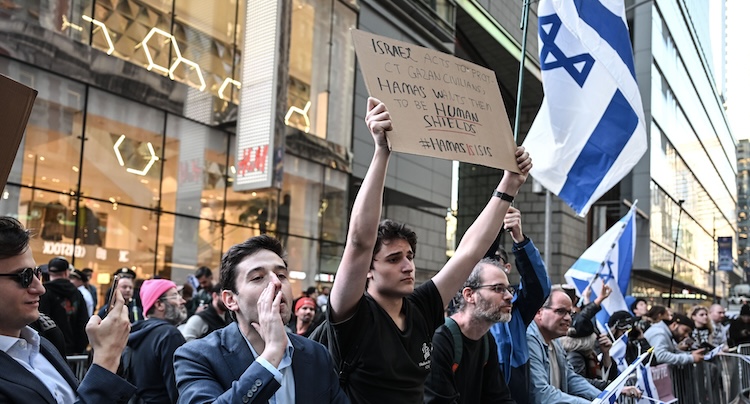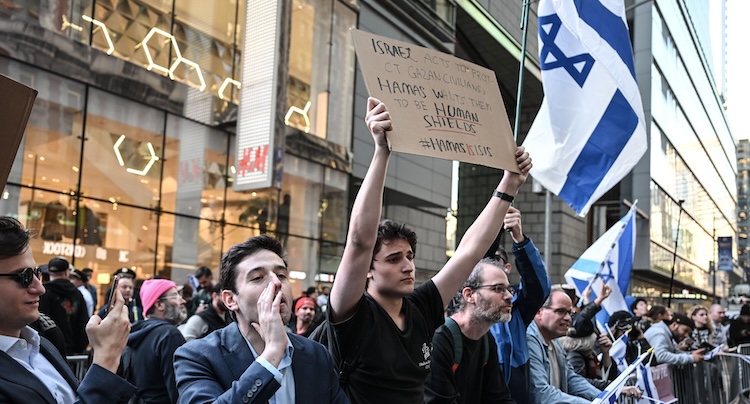
It’s tempting to look at each year’s outpouring of Jew-hatred on October 7 and feel isolated. But moments like these should inspire a deep sense of pride at the way Jewish peoplehood keeps getting stronger despite the societies around it—especially in the West—weakening at an alarming pace.
There’s evidence for Jewish re-dedication all around us. Last year’s Jewish Federations of North America survey found that 31 percent of U.S. Jewish adults “qualified as part of the surge” in Jewish communal engagement, i.e. increased engagement with Judaism or Jewish institutions after October 7.
In the UK, a report released just two days ago found that “More British Jews identified as Zionist following October 7, rising from 59 % in late 2022 to 66% in June 2025. The proportion identifying as anti-Zionist remained broadly unchanged at around 10%.”
Now compare that with another finding from the same survey: “Concern about antisemitism increased dramatically, from 17% describing it as ‘a very big problem’ in the UK in May 2023, rising to 50% by June 2025.
“Feelings of safety as Jews in the UK have seen a significant and ongoing decline since October 7.”
So as anti-Semitism, often expressed as anti-Zionism, increased, British Jews chose the path of peoplehood and communal solidarity despite the dangers inherent in doing so.
Elsewhere, the Wall Street Journal has a story today about the American Jews who went to Israel after the attacks. Many stayed there, such as Yocheved Ruttenberg of Texas, who founded the Sword of Iron Volunteer Network. Others, like Yuval Padel, returned to Jewish service in the States after spending two years in the IDF. Education is part of the story, too. As the Journal notes, “International undergraduate enrollment at Israeli research universities roughly doubled between 2021-22 and 2023-24.”
Anti-Semitism purportedly “in response” to the war initiated by Hamas is an indication of the opposite trend. American Jews’ patriotism doesn’t waver just because they increase their connection to their faith or community. But anti-Semites’ belief in Jews’ Americanness—or Britishness, or Francité—does take a hit when the Jews are in the news.
And that just reveals the weakness of the anti-Semites’ own patriotism. The scholar Flora Cassen describes this phenomenon well in her book Stained Glass: A Reflective History of Antisemitism. Cassen writes of the Western European public’s reaction to the 2014 war between Israel and Hamas:
“In Antwerp, an elderly Jewish woman in medical distress was told by the on-call doctor in the middle of the night that he would not see her and that she should ‘just go to Gaza’ for medical care. In a store, a cashier refused to serve a woman because she was Jewish. Later, the cashier told a Jewish community official who recorded the conversation on his phone that her boss forbids her to sell to Jews. In Paris and other large French cities, anti-war protesters chanted, ‘Death to the Jews,’ ‘Jews, France is not yours,’ and ‘All Jews are terrorists.’”
Cassen points out that when there is a mass shooting in these countries, it is cause for national reflection and days of public mourning. When the victims of such a shooting are Jews, however—such as the one at the Jewish Museum in Brussels in 2014—it is not society’s problem but a “Jewish” problem. If the claimed motive has anything to do with Israel and the Palestinians, it is treated as a foreign problem entirely. Over time, anti-Semitism itself becomes customarily treated this way: some kind of Middle Eastern incident, a clash between outsiders. And since the perpetrator of the 2014 shooting was Muslim, Belgian society decided its hands were clean: “these were neither our victims, nor our crime.”
Think of how small the world of an anti-Semite is. His love of country is conditional, his feeling of national solidarity and community is thin as a reed. But to the Jews, every fellow citizen is our countryman and every Jew anywhere is a kindred spirit. Our cup overfloweth. This, more than anything, has been revealed by the Jewish world’s response to October 7.