
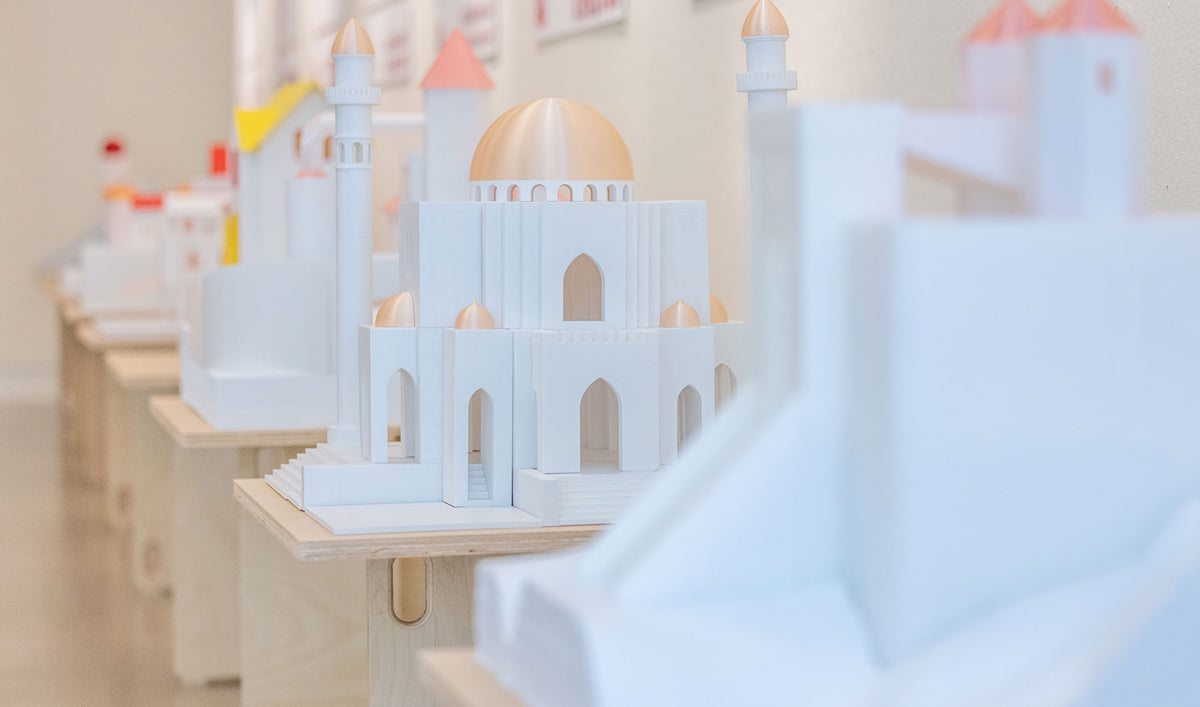

Artificial City, exhibition view. Image courtesy of Alper Turan
Archinect’s Fellow Fellows series showcases individuals who are currently in, or have recently finished, an architecture fellowship. During our conversations, we discuss their architectural journey, areas of research, and their overall experience as academic fellows.
In our latest edition, we speak with architect and graphic designer Alper Turan, who recently completed Tulane University’s Architecture and Design Fellowship. During the fellowship, Turan developed research on the role of artificial intelligence in the creative process and the questions of authorship that arise, building on Turan’s own dual background in architecture and graphic design. In our conversation, we also explore Turan’s reflections on teaching, leading a design-build seminar, and how the fellowship sits within his multidisciplinary work.
What motivated you to apply to Tulane’s Architecture and Design Fellowship?
I always knew that I wanted to try teaching one day. I find a certain happiness in being on a university campus, to the extent that when I visit a new city, I often spend a day walking around one of its universities. By the winter of 2024, it had been three years since I finished graduate school, and I was missing being part of that environment. At the same time, I was working mostly on graphic design projects and found myself missing architecture as well. Teaching architecture felt like a happy medium, a way to reconnect with both.
I already knew Tulane and New Orleans because my brother had done his PhD there. I had visited him many times and always liked the city. It felt very unique and unlike anywhere else in the U.S. I was also starting to notice a change happening at the Tulane School of Architecture back then. There seemed to be a younger generation of faculty coming in, including people whose work I already knew and others doing things I found inspiring. It made me think that I could fit in. So, I thought, “Why not?” applied to the fellowship, and it worked out!
Artificial City. Video courtesy of Alper Turan
During the fellowship, you produced the research and design project Artificial City. Could you give us an overview of the project and an insight into the process of developing it?
When I started, the school had a new faculty orientation. There were more than ten new faculty, and we were asked to introduce ourselves and present our work. I remember everyone having such serious, important, and detailed projects and research agendas. They seemed to know exactly what they wanted to do and how they were going to do it. I, on the other hand, had no idea. I went back home and forced myself to find a specific project to work on.
My immediate thought was that I wanted to work with AI. I was highly critical of almost everything I saw being produced with it, but at the same time, I disagreed with people who rejected using it altogether (I really respect them, though). The second instinct was to work through the medium of a city. I started thinking about the speculative design/research projects I had always admired and realized that almost all of them dealt with the urban context in one way or another, from the work of Yona Friedman and Archigram to Superstudio, O.M. Ungers, and Rem Koolhaas.
 Artificial City. Image courtesy of Alper Turan
I brought these two concepts together and started asking whether I could design an ‘artificial’ city. I was much more interested in experimenting with the process than in the final AI-generated outcome. I never really liked the idea of asking AI to produce the final output, whether it’s an email, an image, or a design idea. The question instead became: Could I reverse where AI typically enters the design process, and could I make it part of my formal thinking instead? Could I use AI early in the design process, while still interpreting what it produces, designing building typologies, and ultimately producing final drawings for them myself?
Rather than treating AI as a tool for visualization, I wanted to see what would happen if it occupied an earlier and less resolved moment in the design process. — Alper Turan
That distinction is important to the project. Rather than treating AI as a tool for visualization, I wanted to see what would happen if it occupied an earlier and less resolved moment in the design process. It could introduce forms, combinations, or accidents that I might not have arrived at myself, but those ideas would then have to pass through the much slower and more deliberate process of drawing and architectural decision-making.
 Artificial City. Image courtesy of Alper Turan
One of the central questions in Artificial City is that of authorship of art and imagery in the age of AI. What stance or conclusion does the project ultimately make, and did it challenge your pre-existing views on the topic?
The project helped me understand where I stand on this much more clearly. To expand on some of the concerns I mentioned in the previous question, I’m very skeptical of the way AI and image generation are being used right now. I find it troubling that styles, visual identities, and artistic languages that designers and artists have developed over years of work can suddenly be reproduced in seconds. I’m also increasingly frustrated by the amount of AI slop we are surrounded by, and by the kind of mediocrity that generative AI makes incredibly easy to produce and circulate. At the same time, I don’t think the answer is to reject it. I think there are ways to use it differently, critically, and experimentally. The Artificial City was my personal attempt to find one of those ways.
I’m someone who genuinely enjoys making drawings, and I would never want to replace my involvement in that process with automation. — Alper Turan
This brought me to the question of authorship. I’m someone who genuinely enjoys making drawings, and I would never want to replace my involvement in that process with automation. What I eventually realized through the project is that perhaps one way to regain authorship is simply to slow down. Nowadays, almost everything is offered instantly: essays can be written without thinking, images and renderings can be generated in seconds. Perhaps what will increasingly make a creative work meaningful and distinct is precisely the opposite: How much time, attention, interpretation, and decision-making went into producing it.
If we measure ourselves against AI through speed and efficiency, we will never be able to keep up with it. But if we stop treating speed and efficiency as the primary measures of creative work, which they never were to begin with, I think there is still a lot of room to preserve authenticity. For me, authorship increasingly lies in that slower process: in choosing, interpreting, redrawing, rejecting, and transforming rather than simply generating.
 Artificial City. Image courtesy of Alper Turan
Artificial City is one of several projects within your studio Post Form. Can you give us an insight into how your two backgrounds in both graphic design and architecture relate to each other within a single studio?
I can’t talk about graphic design without mentioning Paula Scher and my time at Pentagram. I have been extremely lucky to work with one of my idols and to continue that working relationship with Paula and our team even while I was teaching. Through our collaboration, I have learned not just about graphic design but about visual identity and how an identity can move across scales, from typography and images to signage, exhibitions, buildings, and larger spatial experiences.
I try to operate between these two backgrounds in my own work. But I don’t necessarily think there is a clear middle ground between architecture and graphic design, nor do I think every project needs to find one. Some projects are primarily architectural, others are graphic, and some move between the two. What I find valuable is having both perspectives available to me. Every project needs something different, and I can decide what to borrow from each discipline to develop an approach that is specific to the project. Sometimes a graphic system becomes spatial, sometimes an architectural idea is explored through drawing or typography. I think that flexibility will define my future work and Post Form.
 Artificial City. Image courtesy of Alper Turan
During the fellowship at Tulane, you also engaged with a design-build seminar titled Fluid Monuments. Can you give an overview of the seminar and its mission?
Fluid Monuments was a seminar that investigated the relationship between objects, sculpture, and installation. We read foundational texts like Donald Judd’s Specific Objects and Rosalind Krauss’s Sculpture in the Expanded Field, and studied the work that emerged in the period following modernism to understand how the relationship between objects, space, art, and architecture evolved. The seminar was structured around those three scales: Students were first asked to design an abstract, handheld object, then a site-specific sculpture, and finally an interactive installation. For their final project, the class collectively designed and built a full-scale installation in front of Richardson Memorial Hall, the architecture school building.
There was something intriguing about being able to see into this vibrant space without ever being able to enter it. — Alper Turan
As part of the seminar, you developed the Playground and Open Archive installations. Can you give us an insight into the process of designing and building the installations?
The seminar asked them to think beyond designing an object and instead create an installation that was experiential. They spent a lot of time researching and developing concepts that were interactive and could add something new to the life of the campus despite being temporary.
The first iteration was called Playground. It was a simple wooden box with windows that opened onto a colorful and playful but inaccessible interior. There was something intriguing about being able to see into this vibrant space without ever being able to enter it. It was a really playful design, and it instantly became a hit on campus. We received so many emails from people sending us selfies interacting with it, children playing with it, and people spending time around it.
The second iteration, Open Archive, took the same brief but engaged with a completely different set of questions. The students wanted to design a structure that could extend the school outward by exhibiting the work being produced inside it. It was fascinating to see how two groups of students could take the same brief and invent different responses.
 Open Archive installation. Image courtesy of Alper Turan
It was a valuable experience in terms of making and building things with our hands. For many of the students, it was their first time doing design-build, using woodshop tools, painting at that scale, designing connections, and figuring out how something they had drawn would actually be assembled. It was challenging because the course met for only one hour, twice a week, but the students worked a lot to make it happen. That constraint also taught them how to work as a team. One student might be managing the budget and researching materials, while a few others focused on fabrication details, and others produced drawings and renderings.
I am proud of the work that came out of the seminar, and I am glad the students got a glimpse of what it means to take a project from an initial idea all the way through fabrication and realization as a team. That was really meaningful.
 Playground installation. Image courtesy of Alper Turan
Has the fellowship itself, whether working with students or on research, offered you any new reflections on your position between architecture and graphic design? How different is your relationship to those two disciplines now compared to before your recent projects?
I have a phrase that I use a lot: I’m most intrigued by the spatial side of graphic design and the graphic side of architecture. I am constantly moving between the two disciplines to create new work. Teaching actually helped me understand where I stand within that relationship. The freedom the fellowship offered allowed me to pursue the work I was genuinely interested in and realize that I don’t need to choose one discipline over the other.
As I mentioned earlier, I’m happy to have both fields available to me. Right now, I am designing an exhibition in Zurich, building the visual identity for a research center at Tulane, working on environmental graphics for multiple institutions, and editing an architecture publication themed around ‘fragility’. That range keeps me fresh and excited. I like moving from one scale and medium to another rather than doing the same kind of work over and over again.
 Playground installation. Image courtesy of Alper Turan
What’s something you wish you had known before starting this fellowship?
That it is OK to figure things out with your students. I felt a lot of pressure going into teaching, thinking that I had to know everything or have an answer to every question they might have. That is almost impossible when you are teaching in a creative field, where there often isn’t a single right answer. I eventually learned that saying “I don’t know” is completely OK, as long as you are willing to figure it out with the student. In some ways, those moments became some of the most interesting parts of teaching because you are thinking through a problem together rather than just giving an answer.
How has this fellowship served as a platform for your academic and professional career, and what’s next for you?
It was an incredible experience, and I feel very lucky that I had the opportunity to do it. I met amazing people along the way: friends I know I will have for a long time, students whose lives and careers I will always be curious to follow, and collaborators I hope to continue working with. I also met people across different programs and parts of the school whom I probably never would have crossed paths with otherwise.
I’m moving back to New York and shifting my focus fully toward practice. But the fellowship also made me realize how rewarding and exciting teaching can be, and I hope it will remain an important part of my practice moving forward.
 Alper Turan. Image credit: Alper TuranQuick Take 5
What music or background noise is playing when you are working?
Any show I’ve already watched.
Coffee or tea? Or Other?
Çay! (Turkish tea)
What is one city or place outside the United States you think every architect should visit?
My hometown, Istanbul. Every architect should experience what it feels like to sit under the dome of Hagia Sophia and look up.
What’s a non-architectural source of inspiration that has informed your work recently?
Browsing Google Earth. There are so many beautiful patterns, colors, shapes, textures…
If you didn’t pursue architecture and graphic design, what career/industry would you be working in?
Not entirely unrelated, but I’ve always wanted to own an art gallery or a bookstore. Ideally both.