
 Credit: Pexels
Every cell in your body has spent its entire existence inside Earth’s magnetic field. We usually think of that field as a planetary shield, deflecting charged particles from space. But a new experiment suggests its influence may extend much farther inward—to the machinery cells use to make energy.
Researchers at the University of Nottingham found that almost eliminating Earth’s magnetic field altered mitochondrial activity in fruit flies. In flies with a genetic defect that damages mitochondria, the treatment also extended lifespan by about 20%. But there was a catch: the longer-lived flies became worse at climbing. Healthy flies responded differently, improving their climbing ability without a significant extension of lifespan.
This doesn’t necessarily show that Earth’s magnetic field controls human ageing. But it does suggest that magnetism may be part of the physical environment cells respond to—and that its effects depend heavily on what is already happening inside those cells.
“We live our entire lives within the Earth’s magnetic field,” Lisa Chakrabarti, a professor at Nottingham and an author of the study, said in a statement. “It passes through our bodies, our cells and every living organism on the planet.”
Almost No Field
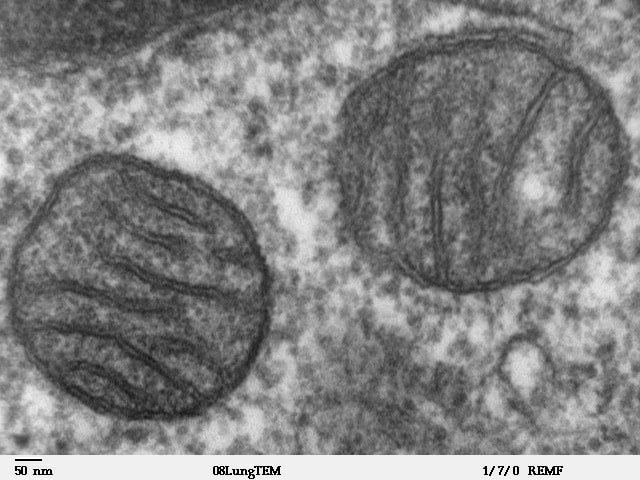 Transmission electron microscope image of mammalian lung tissue mitochondria. Credit: Wikimedia Commons
Earth’s magnetic field measures roughly 25 to 60 microteslas at the surface. The researchers placed flies inside a metal shielding chamber that reduced it to about 0.0056 microteslas—about 4,500 to 10,700 times weaker. Control flies lived under the same light, temperature and noise conditions outside the shield.
The team studied healthy male flies and flies carrying a disabled Pink1 gene. In people, mutations in PINK1 (the corresponding human gene is capitalized) can cause rare inherited forms of early-onset Parkinson’s disease. The gene helps cells dispose of damaged mitochondria; without it, dysfunctional mitochondria accumulate.
When the researchers began shielding the mutant flies at 20 days old, their risk of dying during the experiment fell by about half compared with mutant flies living under normal geomagnetic conditions. Their lifespan increased by approximately 20%. Starting the treatment at 10 days old, however, did not produce a statistically significant survival benefit.
Yet their movement deteriorated. Pink1 flies already struggle to climb as they age, and magnetic shielding made that impairment worse.
×
Thank you! One more thing…
Please check your inbox and confirm your subscription.
And in normal flies, shielding produced essentially the opposite behavioral result: climbing improved at several ages, while survival did not change significantly.
In other words, the same environmental change appeared to benefit survival in one group and physical performance in another. Neither improvement automatically translated into better overall health.
A Possible Explanation Inside Mitochondria
The researchers then looked inside the energy-producing machinery itself; the mitochondria, the famous powerhouses of the cell.
They found that shielding significantly increased respiration supported by Complex II in healthy flies. Complex II is part of the mitochondrial machinery that helps cells extract usable energy from nutrients.
In the mutant flies, Complex II activity showed a similar upward trend, but the difference was not statistically significant. The team also detected changes in reactive oxygen species, including free radicals, using a technique involving fluorescent nanodiamonds.
Those molecules often get portrayed simply as cellular damage. In reality, cells also use them as signals. The researchers propose that removing the magnetic field may act as a mild stressor, prompting mitochondria to compensate. In Pink1 flies, that response might partly offset an existing mitochondrial defect.
However, that explanation remains a hypothesis.
Other Experiments Have Found Surprising Effects
 Drosophila melanogaster. Credit: Wikimedia Commons
Scientists have seen magnetic fields affect ageing-related biology before, although not always in the same direction. A 2022 study of C. elegans worms found that adding a moderate static magnetic field extended median lifespan by 18% and improved movement in older worms. But that experiment used a field of around 10 milliteslas, hundreds of times stronger than Earth’s natural field. It was a very different intervention from the near-total shielding used in the new research.
Removing most of the field can produce less welcome effects. In another 2022 experiment in mice, eight weeks in a hypomagnetic environment impaired cognition and altered reactive oxygen levels in the hippocampus.
Taken together, these studies suggest that magnetic-field exposure can affect animal physiology, but they offer no simple rule about whether stronger or weaker fields are beneficial.
But there’s also reason for skepticism. A massive 2023 Nature study of more than 100,000 fruit flies found no convincing evidence that flies could detect experimentally applied magnetic fields in several behavioral tests, challenging earlier claims of fly magnetoreception.
The new Nottingham experiment asks a somewhat different question: whether removing the background field changes the flies’ physiology and survival rather than whether they can deliberately sense magnetic fields.
For now, the answer appears to be yes—at least in male fruit flies.
Whether the same applies to mammals, much less people, remains unknown. But the results suggest that Earth’s magnetic field may be more than scenery for life. After billions of years beneath Earth’s magnetic field, life may have adapted to this faint planetary force in ways scientists are only beginning to understand.
The study was published in the journal Aging.