
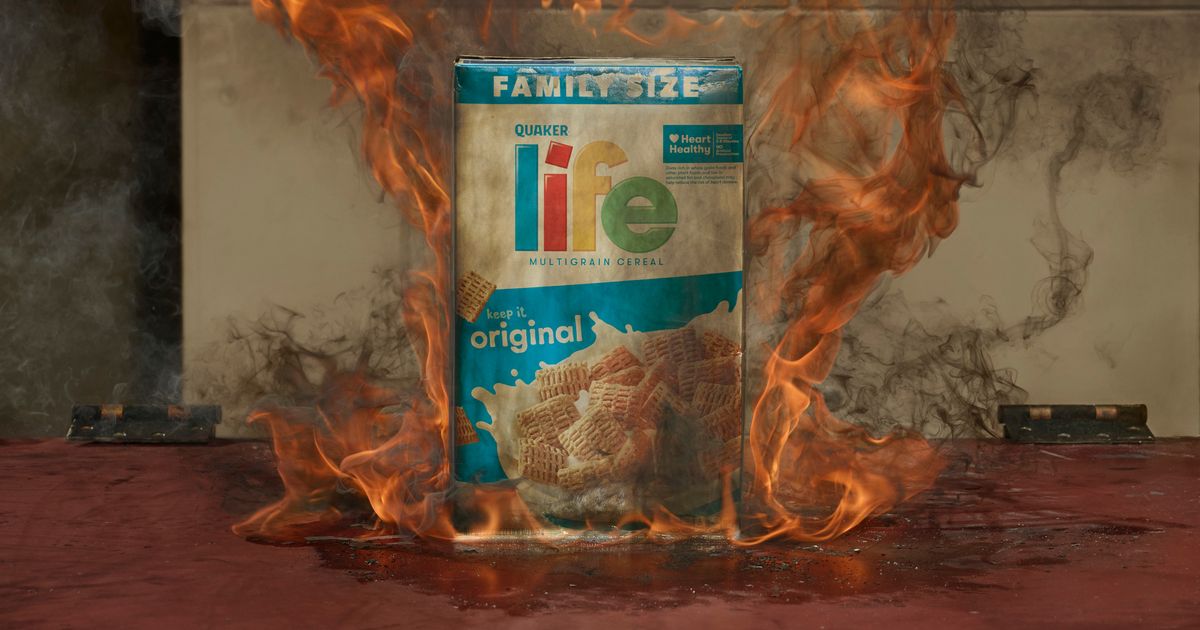
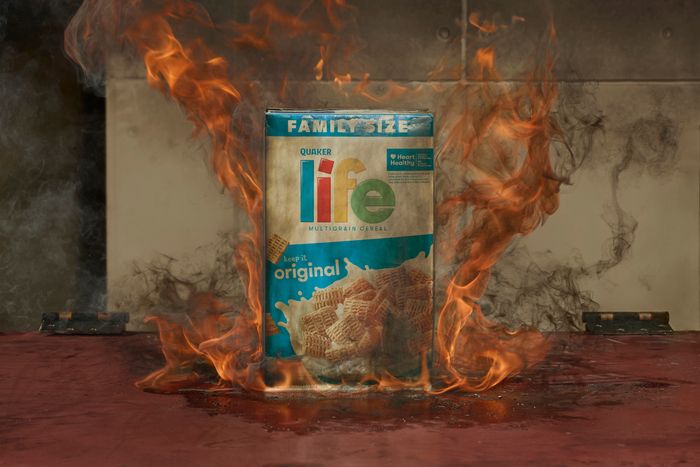
One little room on fire (2026)
Art: © 2026 Taryn Simon
In 1990, then–District of Columbia mayor Marion Barry was the target of a D.C. Metropolitan Police Department and FBI sting operation in which he was lured to a hotel room by an ex-girlfriend, Rasheeda Moore, and recorded smoking crack cocaine. As a result, Barry served six months in prison, and though he was later reelected as mayor, his drug use left an irremediable stain on his reputation and raised larger questions about misgovernance and corruption. In her Guggenheim exhibition, “Father Country I Do Love You,” American artist Taryn Simon, 51, comes at this historical event — and others — from an oblique angle, focusing not on the man at the foreground of the controversy but on those operating behind the scenes, shaping world history while staying out of view. This is a novelistic body of work from the perspective of a federal agent telling the story of his professional life in a series of fact-filled vignettes that are at once enigmatic and revealing of the inner workings of the U.S. government as well as the far-reaching consequences of individual actions. It takes up the entirety of the Guggenheim’s rotunda and is the first monographic photography exhibition to do so, suggesting — along with it being timed to the 250th anniversary of the United States — that the museum has chosen Simon to present work of historical significance at an unprecedented scale.
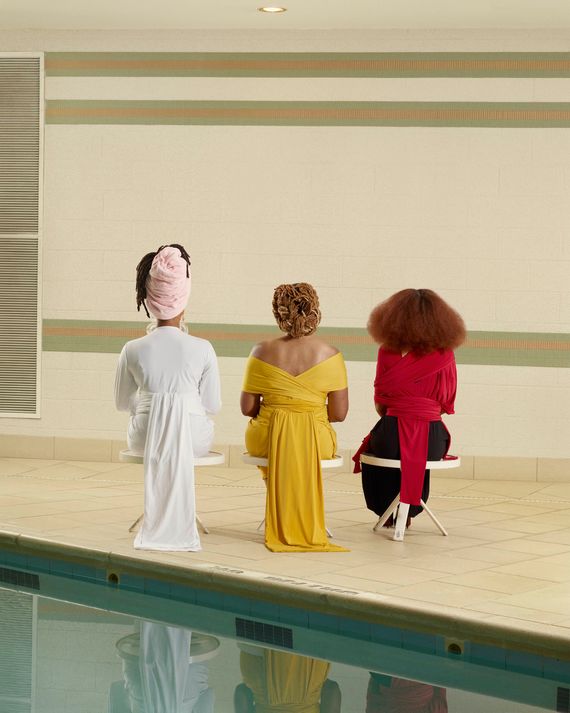
Drawn from nearly a decade’s worth of Simon’s conversations with an actual but anonymized retired FBI agent, these encyclopedic artworks appear to revel in the research that underpins them. Simon takes a hyperreferential and maximalist approach to the transmission of history. At times, the photographs have the glossy, didactic quality of the figures in a textbook. Simon refers to the conversational biographical sketches that accompany her images as “chapters,” and the one concerned with Barry is titled A squad agent informed me I’d be babysitting. In this scene, the agent describes being tasked with looking after Moore’s young children in a Hilton hotel room while she went out on her covert mission. The text concludes with the line “People said the mom and kids would probably go into witness protection because of all the death threats.” It’s a characteristic entry in that it relays, in an offhand way, the precarity and danger the agent came close to, recounted with the unflappability and detachment of a seasoned professional whose position kept him safe. The entry is paired with a suite of portraits of a number of Black men and women wearing MooreWraps, versatile multi-wear garments created by Moore’s sister with proceeds donated to victims of domestic violence and incarceration. Simon took the campy photographs in the same Hilton hotel where Moore’s children awaited their mother, and the images make up what the wall text calls a MooreWrap cruise-collection look book.
This sort of puzzling connection between text and image is repeated throughout the exhibition. Whether you take pleasure in learning about these factoids depends on your appetite for esoteric trivia. In our conspiratorial age, the idea that there are fine, obscure relationships between seemingly disparate things is a thought seductive on the surface but oftentimes shallow underneath. A more charitable way to think about these digressions is to see them as akin to the tangents in a novel, in which minor details accumulate in service of immersing the reader in a narrative that will prove cohesive in the end. The 42 intricate episodes lining the walls of the Guggenheim’s rotunda follow the iconic winding path of the museum’s white spiral — a path not unlike the circuitous course of a life or a nation’s history. But by the end, it’s difficult to know what the narrative amounts to, apart from an accrual of memories that gestures at the sociohistorical only to flesh out the self-mythology of the show’s government-worker protagonist, a nationalistic Everyman whose journey we follow through more than five decades.
A squad agent informed me I’d be babysitting (2026)
Art: © 2026 Taryn Simon
The title of the show, “Father Country I Do Love You,” points to the source of the exhibition’s pathos: a filial devotion best expressed by the extensive and impressive research that went into its creation. Each photograph’s staging is meticulous, and there is an almost exhaustive attempt to interweave the agent’s narratives with the visual language of each image. No symbol is wasted, and no connection feels too tenuous to pursue. When we learn that the protagonist of the exhibition is a stand-in for Simon’s father, who worked for the U.S. government and was diagnosed with Alzheimer’s in 2020, this attentiveness feels all the more resonant, reading like an attempt to salvage the lost or obscure details of the biography of a parent losing their memory. The exhibition’s wall text is set against a wood-paneled backdrop meant to conjure a replica of the Bangkok living room of an intelligence officer who once worked with her father. The warm faux teak making up the room evokes a copy of a copy, and Simon describes building out this childhood living room alongside her father with fondness, as though it was a formative early experience of art-making. She presents it as a task that doesn’t only display a father bringing his global professional context down to the understanding of his child but demonstrates the work of world-making Simon would go on to pursue.
Later in the text, Simon mentions that her father ate his Life Cereal each morning with Diet Coke in lieu of milk, which is to say he did not adhere to convention, and that despite the gravity of his work, he maintained a childlike and whimsical side. That quality is also evident in Simon’s use of bright lighting, stately primary colors that bring to mind early life to mind, and the show’s invocation of a world teeming with curiosities, such as a sun-soaked family film shot on Super 8. Quoting her father, Simon writes, “America … was the best story on earth, if you could find someone to tell it.” It’s clear that Simon luxuriates in the process of storytelling from an offbeat vantage, but the instability of genre and the kind of story she is telling is never quite resolved.
The tension between the artist’s documentarian and novelistic impulses is one viewers come up against repeatedly throughout the exhibition. It’s a series of true stories that use the emotional manipulations of fiction to engage an audience, and because we know the project is at least partly — if not primarily — the excavation of buried family history, the viewer is placed in the role Simon occupies, that of the introspective child speculating about the lionized but imperfect father. In a way, that makes this show an apt allegory for the propagandized American citizen, uninformed, hopeful in spite of themselves, eager to preserve their innocence and yet slowly learning how the sausage is made.
The narrative tone of certain chapters is conspiratorial while demystifying state secrets as if guiding an audience through insider baseball. In How democracy started, we learn of the FBI’s covert presence in Greece and the bureau’s response to the Greek Marxist-Leninist group 17N, who used lethal violence to advance their anti-imperialist goals. The text reads, “I was in Athens to make sure they knew that in America, that gets you prison for life. Punishment is an important part of preserving democracy.” In the final paragraph of this chapter, the agent describes going on a tour of ruins in the country designed to teach tourists about the democracy’s origins. “Made me feel pretty motivated,” he says in closing.
The coupling of violence with law and order is ever present in the agent’s recollections, but tonally, the show feels light. Simon comes across as less of a polemicist and more of a stylist. There is something instructive in the agent concluding a diatribe on quelling revolutionary violence with a note about feeling inspired. This chapter is accompanied by somewhat twee images of an owl doll, a bottle of designer perfume, a high heel, and a golden microphone positioned against various ancient Greek ruins, including the Parthenon and the Monument of the Eponymous Heroes. The photographs represent the props tour guides use with visitors at these landmarks. One interpretation of the image-text pairing is that these epic historical sites are now places of leisure for potentially self-infantilized audiences who are as dislocated from the past as they are from the democratic ideals these locations represent. But the critiques throughout are issued mildly, and I cannot imagine anyone coming away feeling very wounded by this exhibition.
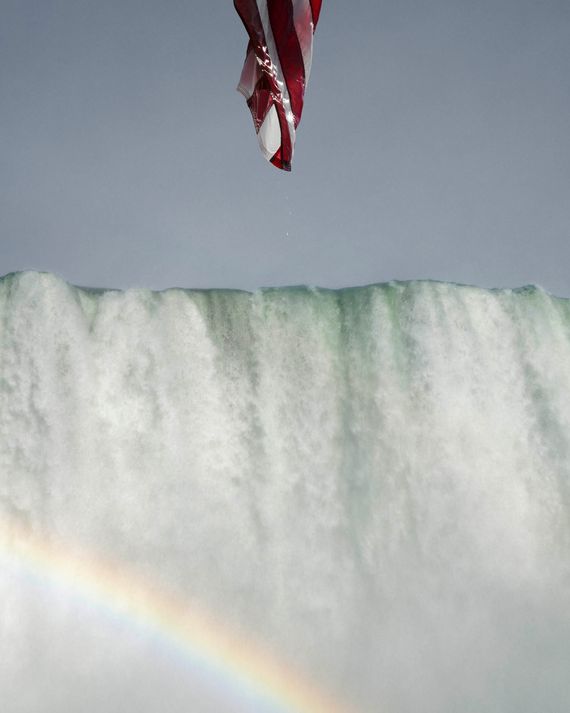
There’s no start or finish (2026)
Art: © 2026 Taryn Simon
“Father Country I Do Love You” benefits from opening during America’s semiquincentennial, as the occasion suggests a broader appeal than this very subtle, conceptual body of work might otherwise offer even the most savvy and curious museumgoers. Simon is an artist’s artist, and arguably a writer’s writer, drawn to minutiae even as she demonstrates ambition in terms of theme and scope. Her interest seems to be the whole world, or at least the way her nation’s tentacles spread into it. Throughout her career, Simon has deftly taken on fraught historical or political baggage but always in a way that prioritizes the emotional core of the material. That’s precisely what she did in The Innocents (2000–2003), which is comprises portraits of the wrongfully convicted taken at the charged sites of misidentification or arrest. It’s a prescient project in that it anticipates how sophisticated and ubiquitous surveillance technologies would go on to become in our age of Flock cameras and Meta glasses. Almost a decade later, in the impressive An Occupation of Loss (2016), Simon recruited professional mourners to reenact their bereavement customs in a sonic performance. This was the result of seven years of research conducted with mourners and anthropologists. As part of orchestrating this project, Simon was also involved in securing visas for the various international performers, encountering in the process the uneven access to travel for cultural workers across classes, nationalities, and milieus. This work evidences both a moral courage and brash authority on Simon’s part and speaks to the deep ethical complexity of her concerns and strategies as an artist. Rather than circumventing the confines placed on herself and her subjects by bureaucracy or borders, she integrates these limitations into the work itself.
In “Father Country I Do Love You,” she attempts to transcend yet more constraints, creating a mammoth body of work that is the first of its kind in this iconic Manhattan institution. There are over 1,000 objects in the exhibition. It is a massive undertaking, and one stands in awe at how Simon managed to conduct so much painstaking archival work while producing this volume of images, videos, and installations that seem to come from a wholly original place that is neither obvious nor derivative. You get the sense that the demands Simon placed on herself as an artist are demands she is content to share with her viewers, trusting them with the material’s complexity. It’s an exhausting show to get through, and like a piece of experimental fiction, part of its reward is piecing together something formally innovative, of making sense of a text that subverts expectations. On one hand, it is a relief to see an exhibition explicitly about imperialism, patriotism, machismo, and memory that is not didactic or anxious about its “aboutness.”
On the other hand, I did occasionally long for Simon to give us a moment of reprieve and offer something simplistic and straightforward. Mercifully, at the top of the spiral, she does. A video of Simon’s father tapping an assortment of Kodachrome slides with his hand is projected on a large screen. The slides feature images of the far-flung destinations he traveled to. The vestiges of his fading memory flash by with a haunting plainness, the melancholy of all this Americana and the sadness of a mind ravaged by time strike the viewer plainly at the end of this maximalist piece of life-writing. But it is a somewhat deflated conclusion for an exhibition that insists so much upon chronology and duration, that claims a considerable amount of time and attention from its viewers, only to deposit them in the same terrain where they began and withhold a conclusion that might meet the lofty narrative promises made.
At the apex of the rotunda, I thought of a line from the opening of Ralph Ellison’s Invisible Man: “Beware of those who speak of the spiral of history; they are preparing a boomerang.” Simon’s historic exhibition takes place in a bright architectural spiral that suggests the possibility of never-ending upward motion, but it does not seem able to move beyond its premise or starting point, flinging its viewers back into the past and stagnating there. “Father Country I Do Love You‘“s inertia may very well be a critique of America’s relationship to its history. Still, it’s unclear whether Simon has any desire to pull herself away from the rich, granular details she has stockpiled and commit to something as overarching and final as a criticism of the nation that fascinates her — though is that what art is even for?
Sign up for the Vulture Daily
An entertainment newsletter for the pop-culture obsessed.
Vox Media, LLC Terms and Privacy Notice
More Art Stories