
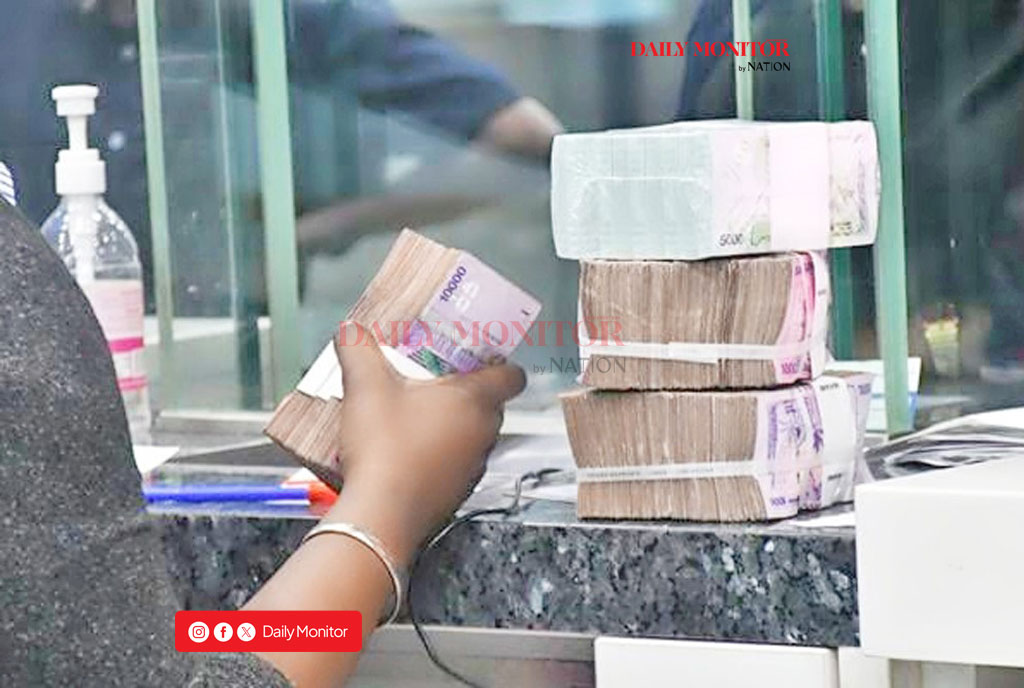
The Bank of Uganda yesterday said its monetary policy action to raise the Central Bank Rate to 12 per cent, saying it was necessary to slow down the depreciation of the shilling.
The Bank of Uganda explains that this is intended to contain inflationary pressures, limit second-round effects from higher energy prices and exchange rate depreciation, and anchor inflation expectations around the medium-term target.
The Bank of Uganda last increased the Central Bank Rate to 10.25 percent in April 2024 from 10 .0 percent and later it reduced the CBR to 9.75 percent in October 2024. It maintained that rate until yesterday.
While answering questions during his news briefing from Thailand where is attending the annual Meetings of the World Bank and the International Monetary Fund, the governor Bank of Uganda Dr Michael Atingi-Ego said: “Bank of Uganda are taking these policy actions to mitigate the impact, and the pace of depreciation of the currency.”
While the decision to undertake tight monetary policy is going to have negative impacts in terms high borrowing cost (high interest rate), Dr Atingi-Ego said: “The trade-off is that, while reducing emerging inflationary pressures, we may experience a reduction in economic growth of approximately 0.5 percentage points.”
He said the Bank of Uganda does not determine the exchange rate. Exchange Rate remains market determined and all do is to ensure that market determined exchange rate moves in smooth action that we have taken since then the action the we are taking today are all aimed at smoothing the movement in the exchange rate.
He said the benefits include controlling inflationary pressures before they become amplified and cause greater macroeconomic instability and lower growth. On the other hand, monetary policy tightening may cause private-sector credit growth to decline and interest rates to rise, with a knock-on effect on economic growth.
“These are the trade-offs we consider when taking a policy measure. It is also important to note that by increasing the price of money, we reduce demand. This can lead to lower demand for imports and lower expenditure, which may help stabilise, the exchange rate,” he explained.
Dr Atingi-Ego further stated: “We must ensure that these expectations do not become entrenched. The policy action may result in reduced growth and higher loan repayments, particularly for borrowers whose loans have variable interest rates. However, it is better to bring these variables under control before they become entrenched, thereby preserving the medium- and long-term stability of the economy.”
Regarding the foreign exchange reserve, Dr Atingi-Ego said the current state of Uganda’s foreign exchange reserve is standing at $6.6 billion, and the central bank is taking a number of actions to ensure that it builds up those reserves.
Dr Atingi-Ego said the Bank of Uganda has taken some measures to ensure that it limits the bleeding of reserves.
“So, for example, we now have what we call the swap transactions with commercial banks. We swap shillings. They swap shillings and we give them dollars. In case there are any demands on their mutual account, they can use the dollars for meeting them. But then, of course, they pay back the dollars,” he said.
He added: “One of the actions that we have taken is to ensure that we diversify even our own sources of reserve accumulation. The Bank of Uganda has started a domestic gold purchase program in order to build those reserves.”
Dr Atingi-Ego further stated: “Going forward, we think that the improvements in the balance of payments, which will be contributed to by the start of the oil exports, is going to improve current account balance and will give us some room to increase the accumulation of our reserves,” he said.
The Ministry of Finance, Planning and Economic Development says the weighted average lending rate on Shilling-denominated credit increased from 16.93 percent in June to 17.32 percent in July. The weighted average lending rate on foreign currency denominated credit increased from 6.93 percent in June to 7.76 percent, partly on account of volatility in foreign currency deposits.
The Bank of Uganda last sold US dollars in June 2022. For now, Dr Atingi-Ego said the central bank is not selling any US dollar in the domestic foreign exchange market
The current economic shocks have already had some negative impacts on Uganda’s economy. In the 12 months to August 2026, the goods deficit worsened to $2.8 billion (Shs 11.597 trillion) from $2.4 billion (Shs9.79 trillion) in August 2025.
Dr Atingi-Ego said nevertheless, global economic conditions have become less favourable. Heightened geopolitical tensions in the Middle East have disrupted key shipping routes and energy infrastructure, contributing to higher global oil prices, elevated freight and insurance costs, and increased uncertainty in international financial markets.
“Significant global risk aversion due to heightened uncertainty and rising interest rates in advanced economies have increased the attractiveness of investing abroad relative to investing in Ugandan financial assets,” he said.
Dr Atingi-Ego said consumer sentiment weakened marginally, reflecting less favourable expectations regarding the economic outlook.
“The October 2026 forecast round projects economic growth of 6.0–6.5 percent in FY 2026/27, revised down from the previous projection of 7.0–7.5 percent,” he said.
The downward revision largely reflects tighter global and domestic financial conditions, the recent exchange rate depreciation, and the adverse effects of heightened geopolitical uncertainty and elevated global energy prices on domestic economic activity.
However, Dr Atingi-Ego said as these headwinds, which are predominantly external, are expected to ease over time, growth is projected to strengthen to an average of about 8 percent over the medium term.
This will be supported by private investment, stronger exports, anticipated oil-sector developments and continued implementation of the Government’s Tenfold Growth Strategy.
State of global economy
The International Monetary Fund (IMF) released the World Economic Outlook (WEO) and said in Thailand where the annual Meetings of the of World Bank and IMF that the global growth is projected at 3.1 percent in 2026 and 3.4 percent in 2027, unchanged for 2026 and revised moderately upward for 2027, relative to the projections in the April 2026 World Economic Outlook (WEO).
“Global headline inflation is projected to increase to 4.7 percent in 2026 before easing to 4.1 percent in 2027, marking a cumulative upward revision of 0.7 percentage point with the temporary increase driven mainly by energy and food prices.
The stable global aggregate masks a reallocation of growth across economies. Countries with limited direct exposure to the war shock and strong participation in the technology upturn are seeing activity hold up or strengthen.
Energy exporters outside the immediate conflict zone benefit from favorable terms of trade. Conversely, energy-importing economies with little connection to the technology value chain face the most difficult configuration: higher import costs and exchange rate pressures, weaker real incomes, more constrained fiscal space, and fewer offsetting demand impulses.
Many low-income and vulnerable countries belong to this latter group, increasing the risk that recent shocks will widen income gaps across and within countries. World trade volume growth is projected to slow in 2026 and stabilize in 2027, reflecting the drag from tariffs, adjustment in production chains, and continued strength in technology-related trade.
The Economic Counsellor (Chief Economist) of the IMF, Dr Silvana Tenreyro said in turn, monetary policy should remain firmly focused on price stability, in line with central banks’ mandates.
“The policy stance should be sufficiently restrictive to return inflation to target in a timely manner, preventing second-round effects. While pass through to core inflation has been contained so far, continued vigilance is required,” she wrote in her blog.
Dr Silvana said where commodity price increases and technology-related investment (or other factors) add to persistent inflationary pressures, monetary policy will need to tighten further. Starting levels of inflation, labor market tightness, and technology and commodity exposures remain key policy guideposts.
“The appropriate stance will differ across countries, but the objective is the same: to ensure price stability. Central bank independence remains vital in achieving that goal,” said.
In a more shock-prone and interconnected world, resilience cannot be built by countries acting alone.
Transparent and predictable trade rules can facilitate long-term planning and enhance investment. Cooperation on energy security and critical supply chains can make adjustment less disruptive when shocks occur.
Rapidly changing technologies, including artificial intelligence, also call for cooperation to ensure that the gains are broadly harnessed and risks prudently managed. In this way, the benefits of innovation should help raise living standards and make growth more durable and inclusive.
“The task ahead is to move from coping to rebuilding, restoring fiscal space and supply-side resilience, lifting productive potential, and ensuring that the next decade is defined by growth and shared prosperity,” she said.