
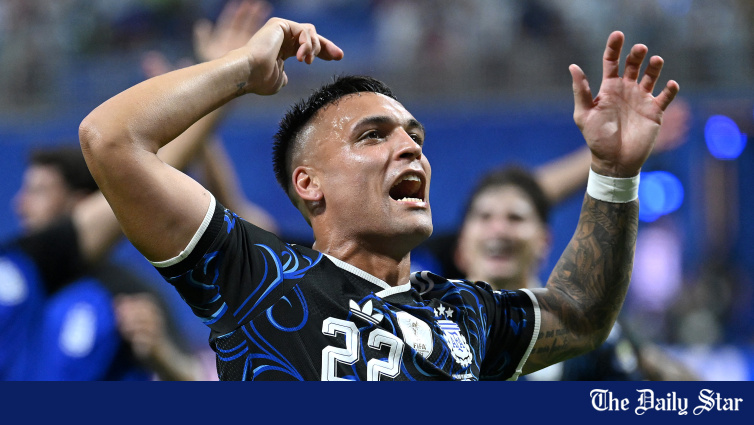
Lautaro Martinez has revealed how Argentina’s long-running dispute with England over the Falkland Islands added an emotional edge to their 2026 World Cup semifinal, describing the clash as far more than a football match and dedicating his decisive goal to veterans of the 1982 war.
The Inter Milan striker scored a 92nd-minute winner as Argentina came from behind to beat England 2-1 in Atlanta on July 15, booking their place in a second consecutive World Cup final. The goal has since taken on a significance beyond the result, particularly among Argentinians who continue to regard the conflict over the islands as a defining chapter in their national history.
In an interview with AFA Estudio, Martínez became emotional when shown footage of a Malvinas War veteran breaking down in tears while celebrating his goal.
“It’s thanks to them [Argentine war veterans from the Falklands war], for how they represented our country back then. Today, the least I can do is dedicate that goal to them. The fact that they can identify with the Argentine National Team today is a testament to everything we’ve built in this last period,” he said.
“All these awards, all this recognition, all this praise and accolade we have is thanks to how they taught us to fight,” he added.
Argentina had played down the prospect of the historical dispute overshadowing the match in the build-up. Coach Lionel Scaloni had said he did not want the fixture to become about the conflict. But Martínez’s latest remarks have offered a glimpse into the emotions within the dressing room, even as the players maintained a public distinction between football and politics, at least in the build-up to the match.
“In front of the cameras we had to behave differently because it’s a football match, but inside it wasn’t a match like the others. It was special because of all the history,” Martínez said.
“The Falklands issue was a special ingredient” that gave the team “that extra boost and that positive energy that is needed to play these matches,” he added.
The history is deeply rooted in the two countries’ rivalry. Argentina and Britain fought a 74-day war in 1982 after Argentine forces landed on the islands, known as the Falkland Islands in Britain and Islas Malvinas in Argentina. The conflict claimed 655 Argentine and 255 British military lives, with three Falkland Islanders also killed. British forces retook the islands in June 1982, but the sovereignty dispute remains unresolved.
The political undertones resurfaced after the semifinal when Argentina players Lisandro Martinez and Giovani Lo Celso held up a banner reading “Las Malvinas son Argentinas” — “The Falklands are Argentine”, while celebrating in front of the stands. It was unclear where the banner had come from. FIFA subsequently opened an investigation into the display, which appeared to breach its rules against political messages inside stadiums.
For Martinez, however, the personal significance of the goal took time to sink in.
The header, replayed repeatedly after the match, “will be a memory I’ll cherish forever,” he said. The striker admitted he “wasn’t fully aware of the goal I’d scored” amid the intensity of the tournament and the final looming just days later.
“When I got back, I felt it when I ran into Argentinians. People were thanking me for what that goal meant, and that’s when I realised its significance,” he added.
Argentina went on to lose the final 1-0 to Spain. Martinez said the physical and emotional demands of the England encounter had taken their toll, but rejected suggestions that his team had not given everything in the final.
“The match against England drained a lot of our energy. We gave everything we had, and that was true in the final as well. Players who had to come off. We left it all on the field, and it showed; there were players who couldn’t walk and kept running,” he recalled.
“We had chances until the very last play. When people talk about those theories, it’s annoying because it’s clear we gave everything. That puts our minds at ease. The opponent was superior,” he added.
The Argentina Football Association has since designated July 15 as National Football Teams Day to commemorate the victory over England, a result that also revived memories of the countries’ famous 1986 World Cup quarterfinal, when Diego Maradona scored both the controversial “Hand of God” goal and his celebrated solo effort.
Reflecting on the wider campaign, Martinez said the team’s connection with supporters had been central to its success.
“It was a very intense World Cup, every match was hard-fought, the fans identified with us, with the process. The World Cup was the perfect summary of everything we’ve built. A team that never gives up, that always wants more, with a leader like Leo (Messi) who taught us not to surrender,” he concluded.