
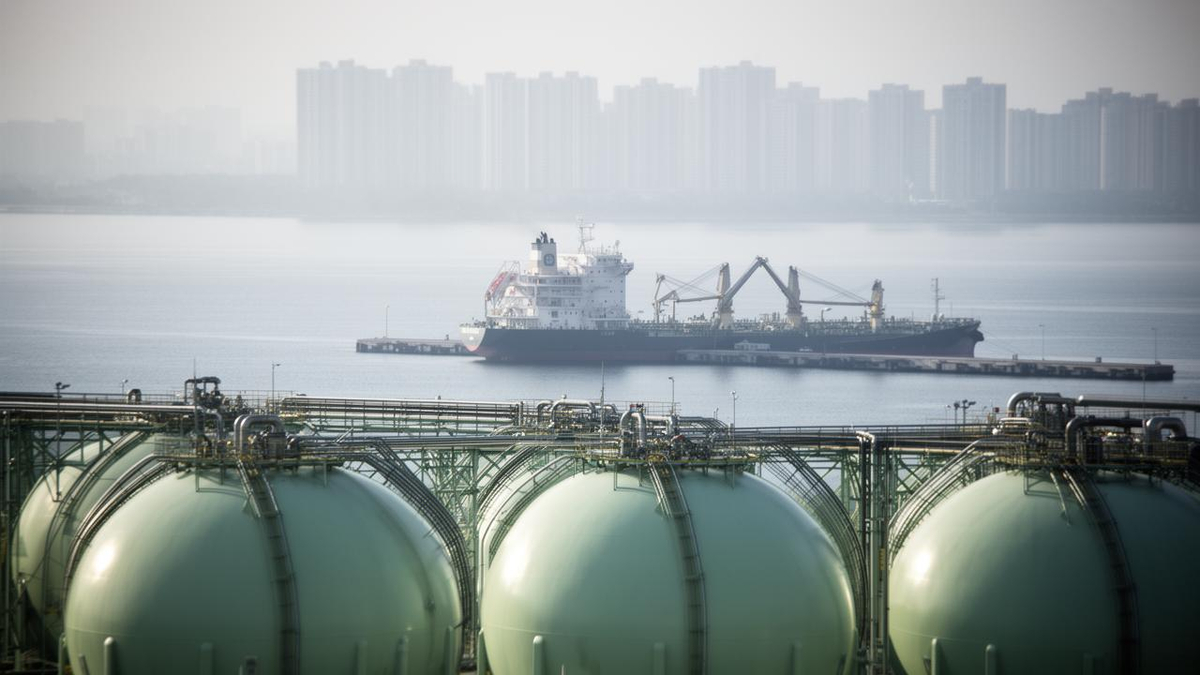
The prolonged Middle East war is fundamentally shaking South Korea’s liquefied natural gas (LNG) import landscape. From January through September this year, Middle Eastern LNG imports plunged more than 66% year-over-year, while North American volumes more than doubled, shifting the center of gravity of the supply chain across the Atlantic and Pacific.
According to Korea International Trade Association statistics released on the 17th, South Korea’s total LNG imports through September reached 32.87 million tonnes, down 6.4% from the same period last year. While the overall pie shrank, regional fortunes diverged sharply. Middle Eastern imports fell 66.2% to 2.42 million tonnes, while Central and South American and European volumes also declined 17.8% and 12.7% to 1.37 million and 1.42 million tonnes, respectively.
Qatar sits at the center of the Middle East supply disruption. From January through September, Qatari LNG imports totaled 1.7 million tonnes, down 68.6% year-over-year. Notably, no imports were recorded at all during April–June and August–September. Qatar was South Korea’s third-largest LNG supplier last year after Australia and Malaysia, but the Middle East war has effectively severed the supply chain.
By contrast, North American LNG imports surged 102.9% year-over-year to 7.82 million tonnes. U.S. volumes rose 41.7% to 4.85 million tonnes, while Canadian imports skyrocketed 587.6% to 2.97 million tonnes. The South Korean government has stated it proactively secured replacement cargoes from the United States and Southeast Asia in response to Middle East supply disruptions.
Price Indicators Are Already Flashing Warning Signs
As the supply chain reshuffles, international prices are climbing rapidly. According to the Korea Energy Economics Institute, the JKM—East Asia’s LNG price benchmark—rose 15.2% month-over-month to $22.0 per MMBtu in August. Over the same period, TTF, the European gas price benchmark, climbed 17.1% to $21.2. With demand likely to increase heading into the winter season, concerns are mounting that global competition for cargoes could further amplify upward price pressure.
The South Korean government plans to continue diversifying import sources while expanding the share of mid-to-long-term contracts to build a stable supply system capable of withstanding international price volatility.
Alaska Project: Between Strategic Value and Commercial Viability
This supply uncertainty is driving a shift in the South Korean government’s stance on the Alaska LNG project, which had been shelved over economic feasibility concerns. Kim Jung-kwan, Minister of Trade, Industry and Energy, said during a National Assembly audit on the 6th that “there is clearly new strategic value that has emerged through the Middle East war” when asked about the Alaska project. He explained that Middle Eastern LNG procurement has faced difficulties, and cargoes departing the Gulf are being rerouted around the Cape of Good Hope due to Panama Canal transit disruptions.
The government had previously maintained that it could not invest in the Alaska project without commercial rationality, but this statement effectively leaves the door open. However, securing commercial viability remains an unresolved challenge.
The Alaska project has long drawn criticism that profitability is uncertain despite massive capital requirements. Reuters reported that the local sponsor estimated project costs at $44.5 billion to $54.5 billion—equivalent to $2.2 billion to $2.7 billion per million tonnes of annual capacity, the highest cost level among U.S. LNG export projects proposed to date. Permitting delays and labor shortages are additional obstacles.
Bing Hyun-ji, a research fellow at the Korea Institute for Industrial Economics & Trade, said: “There is strategic value in being able to supply LNG to South Korea from Alaska across the Pacific, but economic value is a separate matter. We need to carefully assess how much infrastructure costs can be offset, and how offtake rights and supply terms can be secured in the event of investment.”
The South Korean government is reportedly continuing discussions with the United States on ways to improve commercial viability, including potential property tax relief. A Ministry of Trade, Industry and Energy official said, “We are in ongoing communication with the U.S. side,” while adding that “it is difficult to disclose the details under negotiation.”
When global LNG supply will normalize remains unclear. With Middle East geopolitical risks unlikely to resolve in the near term, South Korea’s energy security has entered a phase requiring balance among supply diversification toward North America and Southeast Asia, expansion of long-term contracts, and weighing strategic options such as Alaska.