
Amid continued tensions between Iran, the United States and Israel, a range of considerations will influence whether, when and how the United States and Israel launch an attack on Iran. These include the ability to achieve surprise, avoiding a divided effort by defining and prioritizing objectives, the campaign’s cost-benefit balance, constraints such as weather conditions, the possibility of other fronts erupting, and additional risks.
The ongoing tensions with Iran have heightened alert levels on both sides, reducing each side’s chances of catching the other by surprise, for example, by launching a surprise strike against its leadership, command structure or other key targets.
Israel should seek to bring the ongoing crisis to a conclusion through another round of fighting, potentially followed by a period of relative calm, or by lowering alert levels. This is important, among other reasons, because maintaining aircraft, crews and other assets at high readiness for extended periods is difficult.
Foregoing another round of fighting at this stage would allow both sides to continue building up their capabilities: Iran in ballistic missiles and UAVs, and Israel in various types of bombs and missiles used to intercept incoming ballistic missiles and UAVs or destroy them on the ground. Israel may assess that this arms buildup would work more in its favor, partly because of the damage Iran has sustained so far, the sanctions imposed on it and the pressure it faces.
Weather conditions over Iran in October and November may be relatively favorable for an air campaign, more so than later in the winter. From this perspective, Israel faces a choice: strike in the coming weeks or wait until spring.
Unlike in previous campaigns, Israel may seek to avoid dividing its efforts. There is a connection, but also a tension, between seeking to overthrow the Iranian regime and seeking to weaken it on the assumption that it will survive. Israel may choose to focus on one of these objectives.
From Israel’s perspective, the best, if not the only, way to overthrow the Iranian regime is to assist the Iranian opposition. Such a move could have far-reaching implications for Iran’s nuclear infrastructure, ballistic missiles, UAVs and support for organizations such as Hezbollah and the Houthis. Israel could provide such assistance before and during the next wave of protests, which could erupt at any time. From this perspective, postponing a military campaign against Iran while maintaining economic pressure could lead to renewed domestic unrest in the near future, perhaps even a full-scale uprising.
If Israel nevertheless concludes that weakening the Iranian regime is necessary, it could pursue a limited campaign in terms of duration and scope. Such a campaign, however, could escalate beyond Israel’s intentions—and potentially beyond Iran’s as well.
Other cost-benefit considerations include how many interceptors the Israel Defense Forces (IDF) has left, given the difficulty of manufacturing them quickly and in the required quantities. Although Iran has lost a substantial portion of its ballistic missile arsenal, its missile-launch capabilities have improved to some extent, sometimes requiring Israel to fire more interceptors than it did in the past.
Another dilemma concerns other fronts that could erupt immediately or later, on either a limited or a large scale.
Hezbollah has been significantly weakened in recent years but could still act, particularly under Iranian pressure. Israel would also need to allocate its fighter and strike aircraft to operations against Iran. It could limit its campaign against Hezbollah and rely on ground forces, including artillery, and attack helicopters, which cannot reach Iran in any case. This also highlights the importance of acquiring additional attack helicopters more advanced than those currently in the IDF’s inventory.
The Houthis, under Iranian pressure but retaining considerable independence, could also act against Israel and/or American targets. Israel might again limit its campaign against them to concentrate its airpower on Iran. The Israeli Navy could shoulder part of the burden against the Houthis, despite the challenges of fighting nearly 2,000 kilometers from Israel. Using staging positions closer to Houthi territory, in Somaliland and possibly Saudi Arabia, even covertly, could help.
American considerations must be factored into all these calculations. The Trump administration may want Israel to strike alone, at least initially and perhaps throughout a campaign intended to be short. Alternatively, the administration could adopt the opposite approach or some combination of the two.
Israel and the United States should coordinate their objectives in advance. As noted, overthrowing the Iranian regime would require assisting the Iranian opposition and waiting for the next wave of protests. When that wave occurs, the United States, potentially with Israeli assistance, might again argue that military intervention is necessary to prevent a massacre of civilians, as it did in Benghazi during the 2011 uprising against Muammar Gaddafi.
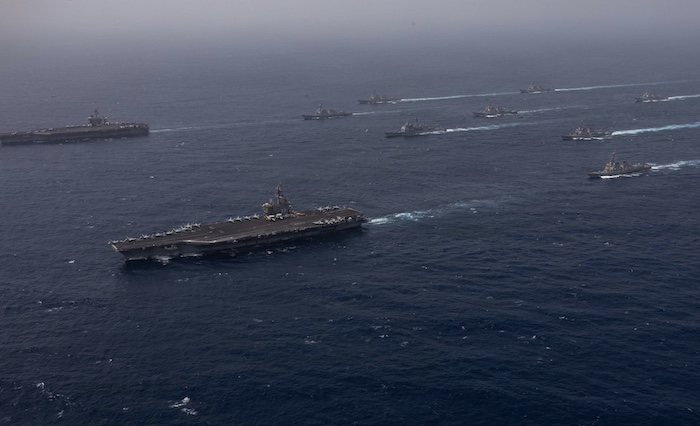
If the objective is to weaken the Iranian regime, the United States currently has two carrier strike groups near Iran. Another carrier strike group, centered on the USS Roosevelt, is expected to arrive in late October. It may still need time to position itself effectively in November. After that, it is unclear how long the United States could sustain a massive, prolonged deployment in the Middle East, given the costs, maintenance requirements and other constraints—particularly if tensions rise or another front erupts, especially in East Asia. From this perspective, November could present a window of opportunity.
Given time constraints and costs, including the need to conserve interceptors and other high-quality munitions, the United States would seek a short campaign.
Saudi Arabia wants the United States to help it fight the Houthis. The Trump administration has so far avoided large-scale involvement. However, if the Houthis substantially escalate their attacks against Saudi Arabia, further disrupt shipping through the Bab el-Mandeb Strait or attack American targets, the administration may be forced to strike them. Such a campaign would divide American efforts and resources in relation to Iran.
The Trump administration has repeatedly emphasized that it will prevent Iran from acquiring nuclear weapons. A campaign against Iran could include strikes on nuclear infrastructure, such as the site at Mount Khondab, requiring bombs available only to the United States.
Whether or not a broader campaign takes place, fighting around the Strait of Hormuz is likely to continue. The strait is a far greater concern for the United States than for Israel. If Iran, following its recent actions, succeeds in preventing or substantially reducing shipping through the route established by the United States, the American response could be broad or limited to the Strait of Hormuz—but even a limited response could escalate into a wider confrontation.
Iran could retaliate and escalate further by attempting to sever undersea communications cables running through the Strait of Hormuz and the Bab el-Mandeb Strait, disrupting communications, including internet connectivity, across Asia.
Israel and the United States should also take into account the positions of Arab countries, particularly those in the Gulf, regarding whether they want a campaign against Iran and to what extent, even if they do not participate officially.
Domestic considerations, including political ones, will also play a role, such as elections in Israel and the United States. For Washington, China’s and Russia’s approaches to Iran will be additional factors.
In conclusion, Israel and/or the United States may launch another round of fighting, but doing so will require weighing a range of considerations, foremost among them military constraints, the campaign’s cost, its cost-benefit balance, and the various risks and opportunities involved.