
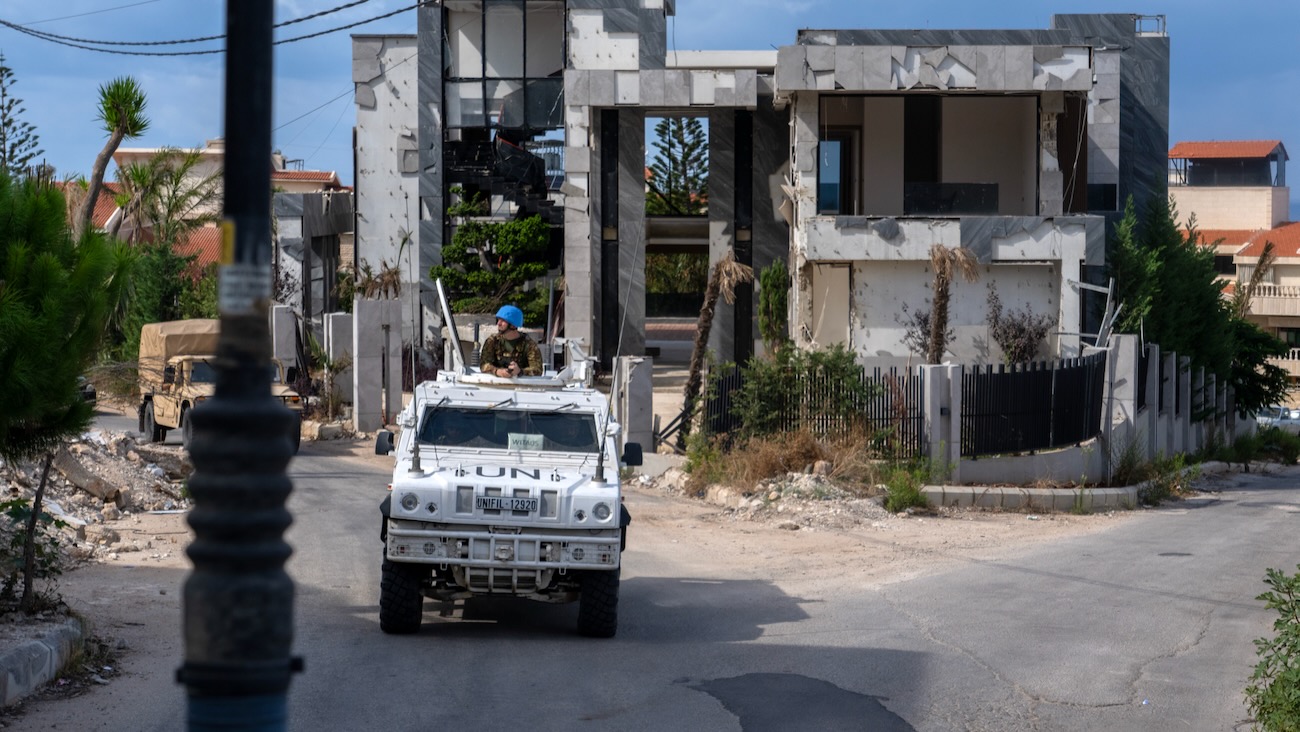
UNIFIL peacekeepers conduct a joint vehicle patrol with the Lebanese Armed Forces in the Tyre pocket area, October 2, 2026. Pasqual Gorriz/UN.
In the recurring cycle of ceasefires and open hostilities unfolding over the past year, we can be forgiven for feeling confused about the difference between the two. Reports indicate that since the ceasefire agreement of October 10, 2025, over 1,400 Palestinians and at least five Israeli military personnel have been killed as a result of military operations in Gaza. In Lebanon, over 1,600 people died through military actions in the two months following the April 16, 2026, ceasefire with Israel, along with three UN peacekeepers and 22 Israeli military personnel operating in Lebanese territory. In both places, ground operations during ceasefires have resulted in new seizures of territory, destruction of homes and public infrastructure, civilian displacement, and extreme humanitarian hardship.
Similarly, the April 7, 2026, ceasefire between the US and Iran, extended indefinitely on April 21st, was marked by recurrent airstrikes and drone attacks. A second ceasefire agreed in mid-June was likewise marred by military escalations, including attacks on infrastructure, military bases, and shipping, until it eventually lapsed 60 days later, leaving observers, markets, and affected populations in doubt as to whether it ever took effect at all. Most recently, on October 11, 2026, an “energy ceasefire” between Russia and Ukraine announced on social media by US President Donald Trump apparently caught the warring parties unawares. Because only one party signaled its readiness to support the ceasefire after its announcement, it stood no chance of taking effect.
In all these cases, cycles of violence continue.
Wider Implications
Despite intense and earnest efforts by mediators and reductions from initial levels of violence, these recent ceasefires appear more than just tenuous: they appear illusory. They have been announced with an air of expediency that betrays a wish for quick political wins and market relief, showing a preference for speed over realism and foresight. Key parties that would be vital for their implementation have not been fully convinced by their terms or have not been included in negotiations at all. Domestic political support for them has remained contested—a recipe for early complications. Critically, the recent ceasefires have been attached to or embedded in broader initiatives—including security sector reform in Gaza and Lebanon and maritime and nuclear files in Iran—that are highly sensitive and remain unresolved. This has had the twin effect of severely complicating the political climate around the ceasefires themselves while also making wider peace aims hostage to their failure.
These ceasefires’ ambiguity threatens the very concept in several ways. Engaging in hostilities during a ceasefire weakens or erases parties’ trust in one another and in the ceasefire option more generally. Lack of trust, in turn, fuels demands for increasingly unreasonable security guarantees or, failing these, for unilateral “opt-out clauses” to resume fighting when one party feels threatened or obliged to act for domestic political reasons. Inevitably, the next ceasefire will be more difficult to attain and, when declared, stands to look even less convincing. Pursuing hostilities during ceasefires also blurs the deeper distinction between compromise and capitulation. Whereas compromise implicitly recognizes parity in the legitimacy of positions and demands, capitulation involves the imposition of a hierarchy of power. And where compromise might be politically acceptable, no one wants to be seen as capitulating. In this sense, using violence during a ceasefire can strengthen parties’ resistance to a meaningful resolution, as proposed terms are nullified by ongoing attacks.
These ceasefires also illustrate a decline of established diplomatic negotiating practice in favor of a rising geopolitical “entrepreneurialism.” Leaders continuously seek to maximize political gains, get a better deal, or alter the balance of forces on the ground, irrespective of ceasefire agreements already in place. Long-established and well-tested protocols of negotiation and implementation are weakened as a result, adding to the erosion of customary international norms and laws. As diplomats and military officers find themselves wrong-footed and often playing catch-up with unforeseen political decisions, the broader diplomatic rules that make international dialogue possible and reliable are increasingly imperiled, raising questions about what norms and standards will hold in future negotiations.
Finally, illusory ceasefires confuse public expectations. Locally, families are left to assess whether it is safe to return to the homes from which they have been displaced, the schools their children attend are safe from military targeting, or recently displaced newcomers will put their neighborhoods or camps at risk. Globally, markets are unsure how to price energy and other vital commodities beyond the horizon of a few days, deepening economic volatility.
Why Are Some Ceasefires Resilient?
As they become more ambiguous, these ceasefires create a sense that the concept itself has become ineffective and short-lived, if not meaningless. Yet the historical record shows that when they are focused, fully negotiated, committed to in good faith, and systematically implemented, ceasefires can be a valuable tool of international diplomacy and conflict management even in situations of acute volatility, uncertainty, and distrust.
Conventionally, ceasefires are meant to be a distinct break in military combat, when guns fall silent and fighter aircraft return to base. The pause they create provides space for humanitarian action, prisoner exchanges, civilian respite, and, where possible, diplomatic negotiations toward a longer-term settlement. The protocols and mechanisms for dialogue that normally accompany them help regulate military behavior, communicate military intentions in advance, and prevent or manage escalations. They work best when they are agreed directly by warring parties and least well when they are imposed from the outside. Some ceasefires are purposely short, as when a religious celebration is observed. Key ceasefires have been open-ended, awaiting conditions for a permanent political settlement to be agreed. And while they may suffer from breaches and do not always lead to full peace agreements, they can remain stable and resilient over long periods.
The 1956 ceasefire following the Suez crisis prevented a potential superpower confrontation and lasted 11 years, until the outbreak of the 1967 Middle East war. The cessation of hostilities agreed between Israel and Lebanon following the 2006 war endured for 17 years until its collapse following Hizbullah’s attack on Israel on October 8, 2023. A de facto ceasefire in Cyprus has been in place for 52 years, since 1974. One of the oldest ceasefires still in effect was signed 73 years ago to end hostilities on the Korean Peninsula. To be sure, longstanding ceasefires can be criticized for “freezing” conflicts without solving them. But it is also true that enduring suspensions of hostilities allow government services to resume, schools to reopen, businesses to operate, and crops to be tended under conditions of relative security and stability. Some, as noted above, have been overtaken by renewed warfare, while others, such as the 1949 armistice agreements between Israel and its neighbors Egypt and Jordan, eventually made way for formal peace treaties.
Each of these ceasefires has a history and rationale of its own. But they all share key characteristics of resilience that the current generation appears to lack. One is that none of them were peace agreements or directly connected to broader peace initiatives. Rather, they were mechanisms built to create stability in situations where no military or political solution to the conflicts in question was available at the time. In the absence of solutions, their focus was on creating a tangible break in hostilities that removed immediate threats to civilian life, private assets, and public infrastructure while regulating military lines and behavior on the ground. Often, they were intended as immediate remedies to stalemate or to the possibility of escalation. And they made it possible for parties to withdraw from hostilities without being perceived as losers—or their adversaries as victors—of a confrontation.
Another common feature of resilient ceasefires is that they have been supported by complex, specialized management regimes built to implement their terms effectively, ranging from mixed military commissions and liaison mechanisms to third-party observer teams and, in cases where external security guarantees were deemed necessary, international peacekeeping forces. At one level, these mechanisms have helped to sustain ceasefires by defining protocols and routines for regulating interactions between the sides, signaling intentions and monitoring compliance, and managing the risks of escalation or miscalculation. Over time, the repeated use of these mechanisms has helped strengthen the predictability and perceived acceptability of ceasefires, lowering perceptions of threat and, at least at the technical level, building a measure of trust.
At a deeper level, the technical quality of these regimes has served to separate—or “quarantine”—ceasefires from the unresolved political divisions and episodic cycles of tension endemic in the wider geopolitical environment around them. This depoliticization, in turn, has provided the space necessary for technical and military experts to function in a relatively protected environment and, in some cases, has given diplomats a basis to separately explore wider agreements. Taken together, these factors help explain the endurance of ceasefires, in some cases over several decades, even where breaches occur or the strategic setting changes.
Finally, although they may have yielded political side benefits, resilient ceasefires have not been driven overwhelmingly by political expediency. Rather, they have reflected deeper strategic considerations of national interest, balance of forces, and international positioning. Although these considerations may change over time, they nonetheless provide a stable basis for serious national commitment.
It is too early to tell whether more recent ceasefires that have come and gone in rapid succession reflect a new era of international practice or only a passing trend. But their performance so far highlights the dangers of abusing a vital, historical instrument of international relations that is meant to engender predictability, regulate interactions, put a stop to violence, and, within a limited scope, build trust. As international affairs become more divided and uncertain, this instrument stands to become more valuable. But for it to work and endure, the concept needs to remain trustworthy and recognizable. Leaders and strategists would do well to preserve it.
Alexander Costy was Principal Political Advisor and Chief of Staff for the Office of the UN Special Coordinator for Lebanon between 2014 and 2021.