

You have finally made it home after a long day, it is already past 8 p.m., and your stomach is growling. Should you open the refrigerator, or would eating this late be a mistake? For years, we have been told that eating at night is bad for our health, disrupts sleep and makes us gain weight. But according to nutrition experts, the truth is considerably more complicated, and the clock may be less important than we think.
The advice to avoid eating late has become almost a universal rule of healthy living. Whether it comes from diet plans, fitness influencers or well-meaning friends, the message is familiar: Finish eating early if you want to stay healthy and maintain your weight. Yet for people juggling long working hours, children, evening workouts and busy schedules, sitting down to an early dinner is not always realistic.

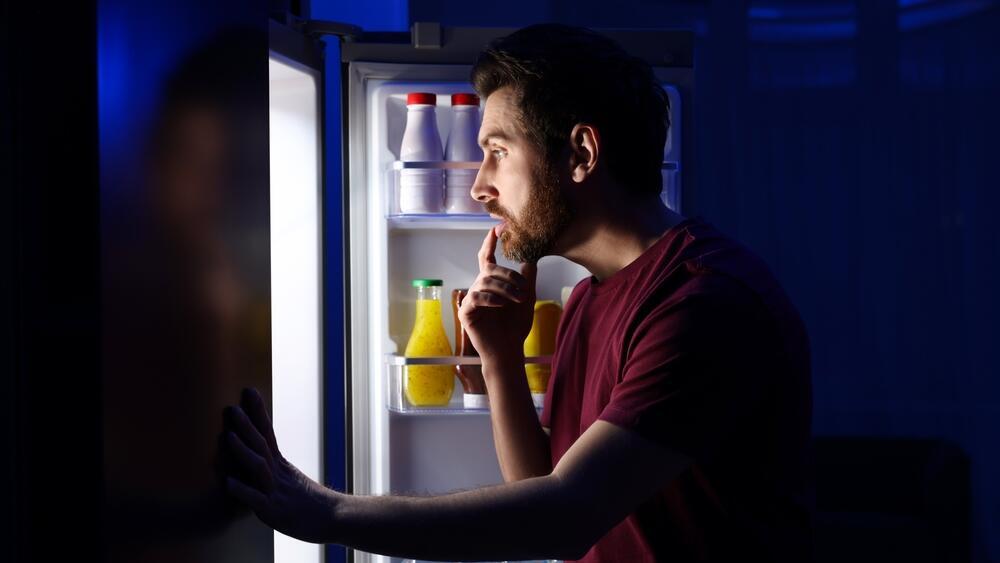
Eating late at night can affect sleep quality, especially for people prone to acid reflux
(Photo: Shutterstock/Nicoleta Ionescu)
So does food consumed at 9 or 10 p.m. affect the body differently from the same meal eaten at lunchtime? Is the problem the time, the amount of food or how soon we go to bed afterward? Clinical dietitian, lecturer and content creator Yarden Ovadia says the answer depends on several factors, and that many popular warnings about late-night eating are exaggerated.
“A lot of things happen in the body when we eat, regardless of the time of day. The hour itself is less critical,” Ovadia explains. “One thing that is somewhat unique to the evening is our sensitivity to sugar and insulin. Our glucose tolerance declines throughout the day. Studies have shown that eating a relatively late meal leads to a higher rise in blood glucose after consuming carbohydrates and less use of fat as an energy source.”
However, the significance of these changes depends largely on the individual’s metabolic health. For people with diabetes, prediabetes or difficulty regulating blood sugar, the timing of meals may be particularly relevant. For most otherwise healthy adults, Ovadia says, slightly higher evening glucose levels are not necessarily a reason for concern.
More immediate problems may arise when a late dinner interferes with sleep, particularly among people prone to heartburn or acid reflux.
“If a late-night meal has a potentially harmful effect, it is mainly related to sleep quality, especially for people who tend to experience heartburn,” Ovadia says. “When you lie down with a full stomach, there is a greater chance of reflux, meaning acidic stomach contents moving back up into the esophagus. This can significantly impair sleep quality, and poor sleep has additional health consequences.”
One of the most persistent beliefs about nighttime eating is that an identical meal will somehow be more fattening if consumed late in the evening. But determining whether the time itself causes weight gain requires separating the effects of meal timing from the other habits associated with eating late.
Ovadia notes that observational studies have found associations between late-night eating and increased risks of obesity, eating disorders, diabetes and high blood pressure. However, he emphasizes that these findings do not establish a direct cause-and-effect relationship.
“What we see is correlation, not causation. That distinction is important,” he says. “People who have less structured eating routines and tend to snack more in the evening usually also have lifestyle habits that are less favorable to their health. They generally exercise less and pay less attention to their nutrition. It may have more to do with the surrounding behavior than with the meal itself.”
Experts caution against sweeping dietary claims promoted by biohacking influencers
(Photo: Shutterstock/New Africa)
Controlled studies attempt to isolate the effect of timing by giving participants the same number of calories while changing when those calories are consumed. The results suggest that the relationship between eating schedules and body weight is more nuanced than the familiar warning about eating after 8 p.m.
In a 2022 study published in the journal Cell Metabolism, 30 adults with overweight or obesity followed two calorie-restricted eating plans, each lasting four weeks. One placed a greater proportion of daily calories in the morning, while the other emphasized evening consumption.
Despite the different meal schedules, participants lost similar amounts of weight under both conditions. Those who consumed more calories earlier in the day, however, reported feeling less hungry throughout the day.
Another study published in the same journal that year examined 16 participants with overweight or obesity who consumed identical meals under different schedules, with one eating pattern delayed by approximately four hours.
Researchers found that the later schedule increased hunger and reduced energy expenditure during waking hours. These findings suggest biological mechanisms through which late eating could influence weight regulation, but the short experiment did not demonstrate that eating late causes long-term weight gain.
For shift workers, the situation can be even more complicated because eating at unusual hours often coincides with disruption of the body’s circadian rhythm, the internal biological clock that regulates sleep, hormone activity and metabolism.
“Shift workers are in the most difficult position because their biological clocks are disrupted,” Ovadia says.
A 2009 study published in the journal PNAS examined participants living on an artificial 28-hour schedule, deliberately shifting their sleep and eating times out of alignment with their natural biological rhythms. Among the eight participants with sufficient glucose-response data, three experienced post-meal blood sugar readings in the range associated with prediabetes.
Importantly, these were metabolic responses observed under experimental conditions. The study did not establish that the participants had developed prediabetes as a result of eating at night.
In recent years, the debate over nighttime eating has expanded into the world of biohacking, where influencers promote dietary and lifestyle strategies intended to optimize the body’s biological processes. One recurring claim is that eating carbohydrates before bed can suppress the release of growth hormone during sleep.
Ovadia cautions against turning limited research findings into sweeping dietary rules.
A small study published in 1996 examined seven children with short stature and found lower levels of growth hormone during the first three hours of sleep after they consumed a snack consisting mainly of carbohydrates. However, a peak in hormone secretion was still observed, even after the snack.
The study did not examine long-term health outcomes, and its findings cannot establish that eating carbohydrates before bed stops growth hormone secretion or harms the health of the general population.
“Most of the advice I’ve encountered online from major biohacking influencers borders on misinformation,” Ovadia says. “They often take a small finding and turn it into recommendations for the entire population. They focus on biological mechanisms instead of long-term clinical outcomes.”
As a research-oriented dietitian, Ovadia says he gives greater weight to evidence showing how dietary changes affect health over time, rather than isolated measurements of hormones or metabolism. “There really is no reason to make such a big deal out of it,” he says.
Rather than focusing on an arbitrary evening deadline, Ovadia recommends planning meals throughout the day to avoid becoming excessively hungry at night. Eating regularly, consuming a larger share of daily calories earlier and keeping evening meals relatively light may make the end of the day easier to manage.
“Choose more balanced meals and move more of your calorie intake toward the middle of the day,” he advises. “Try to keep meals closer to bedtime lighter.”
As for the familiar rule that eating after 8 p.m. is unhealthy, Ovadia is unequivocal.
“It’s a myth. What matters is the time between eating and going to sleep, not a specific hour on the clock,” he says.
Someone who routinely goes to bed at 1 or 2 a.m., for example, does not necessarily need to finish dinner at the same time as someone who goes to sleep at 10 p.m.
“There’s nothing wrong with eating at nine or ten, as long as it’s not too close to bedtime,” Ovadia explains. “The goal is to give the stomach enough time to empty before lying down, roughly two to three hours. This is also the recommendation in reflux treatment guidelines, where the evidence is strongest.”
Studies have found that eating less than three hours before going to bed is associated with a higher risk of acid reflux, while heavy meals immediately before sleep may also impair sleep quality.
Even so, Ovadia stresses that there is no universally applicable cutoff. Large meals, especially those high in fat, spicy foods or accompanied by alcohol, may require a longer interval before bedtime.
But what if you are genuinely hungry just before going to sleep? According to Ovadia, there is no need to force yourself to go to bed with a growling stomach.
“I would tell people not to go to sleep extremely hungry,” he says, while advising against sitting down to a large meal immediately before bed.
Instead, he suggests something small and easy to digest, such as yogurt, a piece of fruit or a modest portion of nuts. A light snack containing some protein can also help satisfy hunger without creating the discomfort associated with a heavy meal.
For shift workers, waiters and others who regularly arrive home late, his advice is to maintain as much of their main food intake during daylight hours as their schedules allow. When eating at night is unavoidable, smaller meals that emphasize protein and are relatively easy to digest may be preferable.
Ultimately, the evidence does not support treating 8 p.m. as a universal deadline for eating. The effects of a late meal depend on factors including metabolic health, overall diet, portion size and the interval before sleep. For most people, paying attention to those factors is likely to be more useful than watching the clock.