
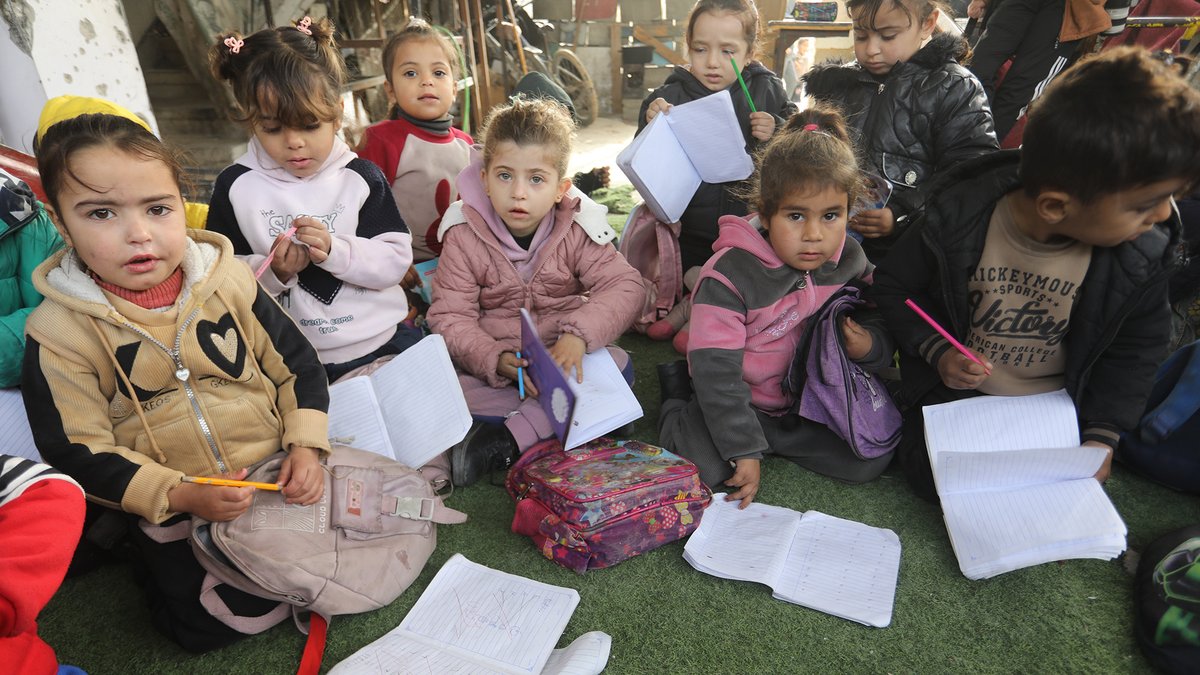
Before the war, a morning preparing for school in Gaza could be ordinary. Children could wake up, get dressed, pack their schoolbags, and depart for class. They might complain about homework or having to wake up early. They could sit in their classrooms, raise their hands, draw pictures, and wait for the bell to tell them it was time to go home. But for many children in Gaza, this daily routine disappeared after Israel began its war on Gaza in October 2023.
By April 2026, 700,000 children in the enclave between the ages of four and seventeen had missed almost three consecutive years of in-person, formal schooling, according to UNICEF. More than 420,000 children are still without in-person learning. Around 98 percent of school buildings in Gaza have been damaged, and more than 93 percent need major rehabilitation or complete reconstruction. UNICEF Global spokesperson James Elder describes this as having left “an entire generation at risk.”
Even the simple excitement of getting ready for school has become out of reach. Backpacks, notebooks, pencils, and other school supplies—which have been hard to access over the past three years due to the Israeli blockade of Gaza—have become an additional burden on families as prices rise and they have less money to spend.
For younger children, learning is about reading and writing, as well as learning how to communicate with others, express themselves, ask questions, and understand the world around them. They need time to play, interact with other children, try new things, make mistakes, and try again. These simple experiences help children build confidence and develop social and emotional skills. Missing out on them can affect a wide variety of things, from brain development and cognitive functioning to the likelihood of pursuing higher education. One Cambridge University study from January estimates that, at best, young children could lose basic literacy and numeracy, and at worst, “the dream and aspiration to learn.”
Another 2026 study from the Algerian Scientific Journal Platform reports that Israel’s scholasticide will adversely impact the psychological development of young children, who are more vulnerable to radicalization and poor mental health. Coupled with malnutrition, trauma, and anxiety about death, these factors set a generation of young Gazans up for educational failure.
Teacher shortages create an additional barrier to early education. Even before the war, teachers faced escalating blockades and overcrowded classrooms. Now, material deprivation, salary cuts, and mental deterioration threaten to choke off meaningful access to early learning.
Many teachers have been forced to leave their homes, and some now live far from temporary learning spaces. Fuel shortages and the difficulty of travelling between northern and southern Gaza have made it even more difficult for them to get to work. Many education workers have also been killed during the war. At the same time, a lack of money to pay teachers has forced some to stop working, while others continue to teach without pay. In April 2026, the United Nations reported the lack of teacher pay was affecting education in Gaza and forcing schools to rely more on volunteer teachers.
For a child who has spent years living with fear and uncertainty, moving from one place of displacement to another, returning to school is not simple. Many children have lost their homes, become separated from their friends, and lived through experiences no child should have to face. This trauma can also make it harder for children to focus in school. Fear, anxiety, and constant uncertainty can make it difficult for them to concentrate on lessons. So even when they have a chance to learn, it may not be easy to sit down, focus, and study as they did before the war. According to multiple National Institutes of Health studies, increased exposure to trauma can disrupt critical developmental trajectories, including attention spans and likelihood of substance abuse.
Crisis-affected children identify education as especially important, according to the Geneva Global Hub for Education in Emergencies. UNESCO has emphasized that education in emergencies is about more than academics. It can give children a sense of stability and protection and help them begin to recover from trauma they have experienced. For children in Gaza, returning to learning can be a step toward bringing back part of their childhood and everyday lives, even as they continue to live through difficult conditions including hunger and the ongoing threat of bombings. Returning to learning is not only about catching up on missed lessons; it is also about bringing back some form of regular routine, social interaction, and sense of safety that children need to learn and grow.
Despite the destruction of schools and trauma of displacement, children are still trying to learn. Free temporary learning centers and education hubs have begun to appear across Gaza, giving children places to continue learning, even if it looks very different from schooling before the war. Many of these spaces have been set up in tents, where children sit on the ground. In some of these spaces, classes last for only three hours a day. They provide children with some access to education, but cannot offer the level of schooling they have missed for years.
At the same time, they show how far Gaza is from providing them with a normal school year. With many public schools damaged or no longer functioning, private schools and education centers have also emerged, trying to provide a more regular alternative. But these options, which require families to pay fees, are out of reach for many.
As Israel continues its assault on Gaza and international entities discuss reconstruction, children are growing up and will continue to need spaces to learn, play, and connect with their peers. The challenge, then, is to rebuild schools and classrooms while also helping children regain what they lost with them: a daily routine, relationships with their classmates and teachers, a place where they can feel safe, and a sense that they have a future they can learn and plan for.