
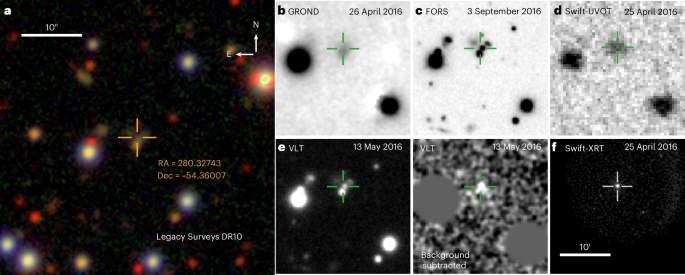
Krimm, H. A. et al. GRB 160425A: Swift detection of an unusual burst with an optical afterglow. GRB Coord. Netw. Circ. No. 19343 (2016).
Melandri, A. et al. GRB 160425A: Swift-XRT refined analysis. GRB Coord. Netw. Circ. No. 19348 (2016).
Bodensteiner, J., Schmidl, S. & Greiner, J. GRB 160425A: GROND observation. GRB Coord. Netw. Circ. No. 19349 (2016).
Cobb, B. E. GRB 160425A: SMARTS optical/IR observations. GRB Coord. Netw. Circ. No. 19354 (2016).
Siegel, M. H. & Krimm, H. A. GRB 160425A: Swift/UVOT detection. GRB Coord. Netw. Circ. No. 19357 (2016).
Tanvir, N. R. et al. GRB 160425A VLT/X-shooter redshift. GRB Coord. Netw. Circ. No. 19350 (2016).
Golkhou, V. Z., Butler, N. R. & Littlejohns, O. M. The energy dependence of GRB minimum variability timescales. Astrophys. J. 811, 93 (2015).
Yi, T., Liang, E., Qin, Y. & Lu, R. On the spectral lags of the short gamma-ray bursts. Mon. Not. R. Astron. Soc. 367, 1751–1756 (2006).
Zhang, Z., Xie, G. Z., Deng, J. G. & Jin, W. Revisiting the characteristics of the spectral lags in short gamma-ray bursts. Mon. Not. R. Astron. Soc. 373, 729–732 (2006).
Bernardini, M. G. et al. Comparing the spectral lag of short and long gamma-ray bursts and its relation with the luminosity. Mon. Not. R. Astron. Soc. 446, 1129–1138 (2015).
Norris, J. P., Marani, G. F. & Bonnell, J. T. Connection between energy-dependent lags and peak luminosity in gamma-ray bursts. Astrophys. J. 534, 248–257 (2000).
Amati, L. et al. Intrinsic spectra and energetics of BeppoSAX gamma-ray bursts with known redshifts. Astron. Astrophys. 390, 81–89 (2002).
Zhang, B. et al. Discerning the physical origins of cosmological gamma-ray bursts based on multiple observational criteria: the cases of z = 6.7 GRB 080913, z = 8.2 GRB 090423, and some short/hard GRBs. Astrophys. J. 703, 1696–1724 (2009).
Qin, Y.-P. & Chen, Z.-F. Statistical classification of gamma-ray bursts based on the Amati relation. Mon. Not. R. Astron. Soc. 430, 163–173 (2013).
Minaev, P. Y. & Pozanenko, A. S. The Ep,I–Eiso correlation: type I gamma-ray bursts and the new classification method. Mon. Not. R. Astron. Soc. 492, 1919–1936 (2020).
Lü, H.-J., Liang, E.-W., Zhang, B.-B. & Zhang, B. A new classification method for gamma-ray bursts. Astrophys. J. 725, 1965–1970 (2010).
Fynbo, J. P. U. et al. No supernovae associated with two long-duration γ-ray bursts. Nature 444, 1047–1049 (2006).
Gal-Yam, A. et al. A novel explosive process is required for the γ-ray burst GRB 060614. Nature 444, 1053–1055 (2006).
Gehrels, N. et al. A new γ-ray burst classification scheme from GRB060614. Nature 444, 1044–1046 (2006).
Rastinejad, J. C. et al. A kilonova following a long-duration gamma-ray burst at 350 Mpc. Nature 612, 223–227 (2022).
Troja, E. et al. A nearby long gamma-ray burst from a merger of compact objects. Nature 612, 228–231 (2022).
Yang, J. et al. A long-duration gamma-ray burst with a peculiar origin. Nature 612, 232–235 (2022).
Levan, A. J. et al. Heavy-element production in a compact object merger observed by JWST. Nature 626, 737–741 (2024).
Yang, Y.-H. et al. A lanthanide-rich kilonova in the aftermath of a long gamma-ray burst. Nature 626, 742–745 (2024).
Zhang, B.-B. et al. A peculiarly short-duration gamma-ray burst from massive star core collapse. Nat. Astron. 5, 911–916 (2021).
Becerra, R. L. et al. Reverse shock emission revealed in early photometry in the candidate short GRB 180418A. Astrophys. J. 881, 12 (2019).
Li, L., Wang, Y., Geng, J.-J., Huang, Y.-F. & Cai, R.-G. Pulse-resolved classification and characteristics of long-duration gamma-ray bursts with Swift-BAT data. I. Precursors versus main bursts. Astrophys. J. Suppl. Ser. 283, 47 (2026).
Li, L. et al. Pulse-resolved classification and characteristics of long-duration gamma-ray bursts with Swift-BAT data. II. Main bursts versus extended emissions. Astrophys. J. Suppl. Ser. 285, 33 (2026).
Li, L. Sub-burst-resolved classification and characteristics of double-trigger gamma-ray bursts. Astrophys. J. 1003, 238 (2026).
Norris, J. P. & Bonnell, J. T. Short gamma-ray bursts with extended emission. Astrophys. J. 643, 266–275 (2006).
Falcone, A. D. et al. The giant x-ray flare of GRB 050502B: evidence for late-time internal engine activity. Astrophys. J. 641, 1010–1017 (2006).
Dai, Z. G., Wang, X. Y., Wu, X. F. & Zhang, B. X-ray flares from postmerger millisecond pulsars. Science 311, 1127–1129 (2006).
Hakkila, J. & Giblin, T. W. Quiescent burst evidence for two distinct gamma-ray burst emission components. Astrophys. J. 610, 361–367 (2004).
Li, L. et al. A correlated study of optical and X-ray afterglows of GRBs. Astrophys. J. 805, 13 (2015).
Li, L. et al. Constraining the type of central engine of GRBs with Swift data. Astrophys. J. Suppl. Ser. 236, 26 (2018).
Ruffini, R. et al. Early X-ray flares in GRBs. Astrophys. J. 852, 53 (2018).
Zhang, B. The Physics of Gamma-Ray Bursts (Cambridge Univ. Press, 2018).
Cobb, B. E. GRB 160425A: SMARTS late-time observations. GRB Coord. Netw. Circ. No. 19454 (2016).
Margutti, R. et al. X-ray flare candidates in short gamma-ray bursts. Mon. Not. R. Astron. Soc. 417, 2144–2160 (2011).
Zhang, B.-B. et al. Transition from fireball to Poynting-flux-dominated outflow in the three-episode GRB 160625B. Nat. Astron. 2, 69–75 (2018).
Ryde, F. et al. Onset of particle acceleration during the prompt phase in gamma-ray bursts as revealed by synchrotron emission in GRB 160821A. Astrophys. J. Lett. 932, L15 (2022).
Burlon, D. et al. Precursors in Swift gamma ray bursts with redshift. Astrophys. J. Lett. 685, L19 (2008).
Burlon, D., Ghirlanda, G., Ghisellini, G., Greiner, J. & Celotti, A. Time resolved spectral behavior of bright BATSE precursors. Astron. Astrophys. 505, 569–575 (2009).
Hu, Y.-D. et al. Internal energy dissipation of gamma-ray bursts observed with Swift: precursors, prompt gamma-rays, extended emission, and late X-ray flares. Astrophys. J. 789, 145 (2014).
Anand, N., Shahid, M. & Resmi, L. Merger delay time distribution of extended emission short GRBs. Mon. Not. R. Astron. Soc. 481, 4332–4341 (2018).
Li, X. J., Zhang, Z. B., Zhang, X. L. & Zhen, H. Y. Temporal properties of precursors, main peaks, and extended emissions of short GRBs in the third Swift/BAT GRB catalog. Astrophys. J. Suppl. Ser. 252, 16 (2021).
Deng, H.-Y., Peng, Z.-Y., Chen, J.-M., Yin, Y. & Li, T. A study of the spectral properties of gamma-ray bursts with the precursors and main bursts. Astrophys. J. 970, 67 (2024).
Geng, J.-J., Zhang, B. & Kuiper, R. Propagation of relativistic, hydrodynamic, intermittent jets in a rotating, collapsing GRB progenitor star. Astrophys. J. 833, 116 (2016).
Lan, L. et al. Characteristics of two-episode emission patterns in Fermi long gamma-ray bursts. Astrophys. J. 862, 155 (2018).
Li, L. & Mao, J. Temporal analysis of GRB precursors in the third Swift-BAT catalog. Astrophys. J. 928, 152 (2022).
Evans, P. A. et al. An online repository of Swift/XRT light curves of γ-ray bursts. Astron. Astrophys. 469, 379–385 (2007).
Evans, P. A. et al. Methods and results of an automatic analysis of a complete sample of Swift-XRT observations of GRBs. Mon. Not. R. Astron. Soc. 397, 1177–1201 (2009).
Vianello, G. et al. The Multi-Mission Maximum Likelihood framework (3ML). Preprint at https://arxiv.org/abs/1507.08343 (2015).
Romano, P. et al. Panchromatic study of GRB 060124: from precursor to afterglow. Astron. Astrophys. 456, 917–927 (2006).
Cash, W. Parameter estimation in astronomy through application of the likelihood ratio. Astrophys. J. 228, 939–947 (1979).
Bloom, J. S., Frail, D. A. & Sari, R. The prompt energy release of gamma-ray bursts using a cosmological k-correction. Astron. J. 121, 2879–2888 (2001).
Evans, P. A. et al. 1SXPS: a deep Swift X-ray telescope point source catalog with light curves and spectra. Astrophys. J. Suppl. Ser. 210, 8 (2014).
Dezalay, J. P. et al. Short cosmic events: a subset of classical GRBs? In American Institute of Physics Conference Series Vol. 265 (eds Paciesas, W. S. & Fishman, G. J.) 304–309 (American Institute of Physics, 1992).
Horváth, I. et al. Detailed classification of Swift ’s gamma-ray bursts. Astrophys. J. 713, 552–557 (2010).
Kouveliotou, C. et al. Identification of two classes of gamma-ray bursts. Astrophys. J. Lett. 413, L101–L104 (1993).
Golkhou, V. Z. & Butler, N. R. Uncovering the intrinsic variability of gamma-ray bursts. Astrophys. J. 787, 90 (2014).
Lü, H.-J., Zhang, B., Liang, E.-W., Zhang, B.-B. & Sakamoto, T. The ‘amplitude’ parameter of gamma-ray bursts and its implications for GRB classification. Mon. Not. R. Astron. Soc. 442, 1922–1929 (2014).
Villasenor, J. S. et al. Discovery of the short γ-ray burst GRB 050709. Nature 437, 855–858 (2005).
D’Avanzo, P. et al. A complete sample of bright Swift short gamma-ray bursts. Mon. Not. R. Astron. Soc. 442, 2342–2356 (2014).
Leibler, C. N. & Berger, E. The stellar ages and masses of short gamma-ray burst host galaxies: investigating the progenitor delay time distribution and the role of mass and star formation in the short gamma-ray burst rate. Astrophys. J. 725, 1202–1214 (2010).
Norris, J. P., Gehrels, N. & Scargle, J. D. Heterogeneity in short gamma-ray bursts. Astrophys. J. 735, 23 (2011).
Cheng, L. X., Ma, Y. Q., Cheng, K. S., Lu, T. & Zhou, Y. Y. The time delay of gamma-ray bursts in the soft energy band. Astron. Astrophys. 300, 746 (1995).
Band, D. L. Gamma-ray burst spectral evolution through cross-correlations of discriminator light curves. Astrophys. J. 486, 928–937 (1997).
Ukwatta, T. N. et al. Spectral lags and the lag-luminosity relation: an investigation with Swift BAT gamma-ray bursts. Astrophys. J. 711, 1073–1086 (2010).
Li, L. & Wang, Y. A novel method of estimating gamma-ray burst peak energies beyond the Swift/BAT limit. Astrophys. J. Suppl. Ser. 283, 18 (2026).
Planck Collaboration et al. Planck 2018 results. VI. Cosmological parameters. Astron. Astrophys. 641, A6 https://doi.org/10.1051/0004-6361/201833910 (2020).
Rosenblatt, M. Remarks on some nonparametric estimates of a density function. Ann. Math. Stat. 27, 832–837 https://doi.org/10.1214/aoms/1177728190 (1956).
Parzen, E. On estimation of a probability density function and mode. Ann. Math. Stat. 33, 1065–1076 https://doi.org/10.1214/aoms/1177704472 (1962).
Scott, D. W. Multivariate Density Estimation: Theory, Practice, and Visualization (John Wiley, 1992).
Virtanen, P. et al. SciPy 1.0: fundamental algorithms for scientific computing in Python. Nat. Methods 17, 261–272 (2020).
Stone, M. Cross-validatory choice and assessment of statistical predictions. J. R. Stat. Soc. Ser. B 36, 111–133 https://doi.org/10.1111/j.2517-6161.1974.tb00994.x (1974).
Newville, M. et al. Lmfit: non-linear least-square minimization and curve-fitting for Python. Astrophysics Source Code Library ascl:1606.014 (2016).
Roming, P. W. A. et al. The Swift Ultra-Violet/Optical Telescope. Space Sci. Rev. 120, 95–142 (2005).
Schlafly, E. F. & Finkbeiner, D. P. Measuring reddening with Sloan Digital Sky Survey stellar spectra and recalibrating SFD. Astrophys. J. 737, 103 (2011).
Oke, J. B. & Sandage, A. Energy distributions, k corrections, and the Stebbins–Whitford effect for giant elliptical galaxies. Astrophys. J. 154, 21 (1968).
Peterson, B. M. An Introduction to Active Galactic Nuclei (Cambridge Univ. Press, 1997).
Li, L. et al. A large catalog of multiwavelength GRB afterglows. I. Color evolution and its physical implication. Astrophys. J. Suppl. Ser. 234, 26 (2018).
Pei, Y. C. Interstellar dust from the Milky Way to the Magellanic Clouds. Astrophys. J. 395, 130–139 (1992).
Cano, Z., Wang, S.-Q., Dai, Z.-G. & Wu, X.-F. The observer’s guide to the gamma-ray burst supernova connection. Adv. Astron. 2017, 8929054 (2017).
Calzetti, D. Reddening and star formation in starburst galaxies. Astron. J. 113, 162–184 (1997).
Clocchiatti, A., Suntzeff, N. B., Covarrubias, R. & Candia, P. The ultimate light curve of SN 1998bw/GRB 980425. Astron. J. 141, 163 (2011).
Zeh, A., Klose, S. & Hartmann, D. H. A systematic analysis of supernova light in gamma-ray burst afterglows. Astrophys. J. 609, 952–961 (2004).
Ryan, G., van Eerten, H., Piro, L. & Troja, E. Gamma-ray burst afterglows in the multimessenger era: numerical models and closure relations. Astrophys. J. 896, 166 (2020).
Lipunov, V. et al. GRB 160425A: MASTER earlier optical observations. GRB Coord. Netw. Circ. No. 19344 (2016).
Balanutsa, P. et al. GRB 160425A MASTER notices: possible host galaxy in the optical error-box. GRB Coord. Netw. Circ. No. 19351 (2016).
Beardmore, A. P., Evans, P. A., Goad, M. R. & Osborne, J. P. GRB 160425A: enhanced Swift-XRT position. GRB Coord. Netw. Circ. No. 19347 (2016).
Selsing, J. et al. The X-shooter GRB afterglow legacy sample (XS-GRB). Astron. Astrophys. 623, A92 (2019).
Stroe, A. & Savu, V.-N. GLEAM: Galaxy Line Emission & Absorption Modeling. Astron. J. 161, 158 (2021).
Kennicutt, R. C. & Evans, N. J. Star formation in the Milky Way and nearby galaxies. Annu. Rev. Astron. Astrophys. 50, 531–608 (2012).
Pettini, M. & Pagel, B. E. J. [OIII]/[NII] as an abundance indicator at high redshift. Mon. Not. R. Astron. Soc. 348, L59–L63 (2004).
Freudling, W. et al. Automated data reduction workflows for astronomy. The ESO Reflex environment. Astron. Astrophys. 559, A96 (2013).
Bertin, E. & Arnouts, S. SExtractor: software for source extraction. Astron. Astrophys. Suppl. Ser. 117, 393–404 (1996).
Bertin, E. Automatic astrometric and photometric calibration with SCAMP. In Astronomical Data Analysis Software and Systems XV Astronomical Society of the Pacific Conference Series Vol. 351 (eds Gabriel, C. et al.) 112–115 (Astronomical Society of the Pacific, 2006).
Bertin, E. et al. The TERAPIX pipeline. In Astronomical Data Analysis Software and Systems XI Astronomical Society of the Pacific Conference Series Vol. 281 (eds Bohlender, D. A. et al.) 228–237 (Astronomical Society of the Pacific, 2002).
Li, Y., Zhang, B. & Lü, H.-J. A comparative study of long and short GRBs. I. Overlapping properties. Astrophys. J. Suppl. Ser. 227, 7 (2016).
Fong, W. -f et al. Short GRB host galaxies. I. Photometric and spectroscopic catalogs, host associations, and galactocentric offsets. Astrophys. J. 940, 56 (2022).
Wang, H., Dastidar, R. G., Giannios, D. & Duffell, P. C. jetsimpy: a highly efficient hydrodynamic code for gamma-ray burst afterglow. Astrophys. J. Suppl. Ser. 273, 17 (2024).
Wang, Y., Chen, C. & Zhang, B. VegasAfterglow: a high-performance framework for gamma-ray burst afterglows. J. High Energy Astrophys. 50, 100490 (2026).
Beniamini, P. & van der Horst, A. J. Electrons’ energy in GRB afterglows implied by radio peaks. Mon. Not. R. Astron. Soc. 472, 3161–3168 (2017).
Aksulu, M. D., Wijers, R. A. M. J., van Eerten, H. J. & van der Horst, A. J. Exploring the GRB population: robust afterglow modelling. Mon. Not. R. Astron. Soc. 511, 2848–2867 (2022).
Götz, D. et al. A detailed spectral study of GRB 041219A and its host galaxy. Mon. Not. R. Astron. Soc. 413, 2173–2183 (2011).
Virgili, F. J. et al. GRB 091024A and the nature of ultra-long gamma-ray bursts. Astrophys. J. 778, 54 (2013).
Huang, Y.-Y., Zhang, H.-M., Yan, K., Liu, R.-Y. & Wang, X.-Y. Detection of GeV emission from an ultralong gamma-ray burst with the Fermi Large Area Telescope. Astrophys. J. Lett. 940, L36 (2022).
Li, L. Multipulse Fermi gamma-ray bursts. I. Evidence of the transition from fireball to Poynting-flux-dominated outflow. Astrophys. J. Suppl. Ser. 242, 16 (2019).
Zhang, B.-B. et al. Unusual central engine activity in the double burst GRB 110709B. Astrophys. J. 748, 132 (2012).
de Wet, S. et al. The ultra-long GRB 220627A at z = 3.08. Astron. Astrophys. 677, A32 (2023).
Tanvir, N. R. et al. A ‘kilonova’ associated with the short-duration γ-ray burst GRB 130603B. Nature 500, 547–549 (2013).
Hjorth, J. et al. A very energetic supernova associated with the γ-ray burst of 29 March 2003. Nature 423, 847–850 (2003).
Dey, A. et al. Overview of the DESI Legacy Imaging Surveys. Astron. J. 157, 168 (2019).
Shi, Y.-R. et al. Statistical properties of X-ray flares in gamma-ray bursts. Universe 8, 358 (2022).
Chincarini, G. et al. Unveiling the origin of X-ray flares in gamma-ray bursts. Mon. Not. R. Astron. Soc. 406, 2113–2148 (2010).