
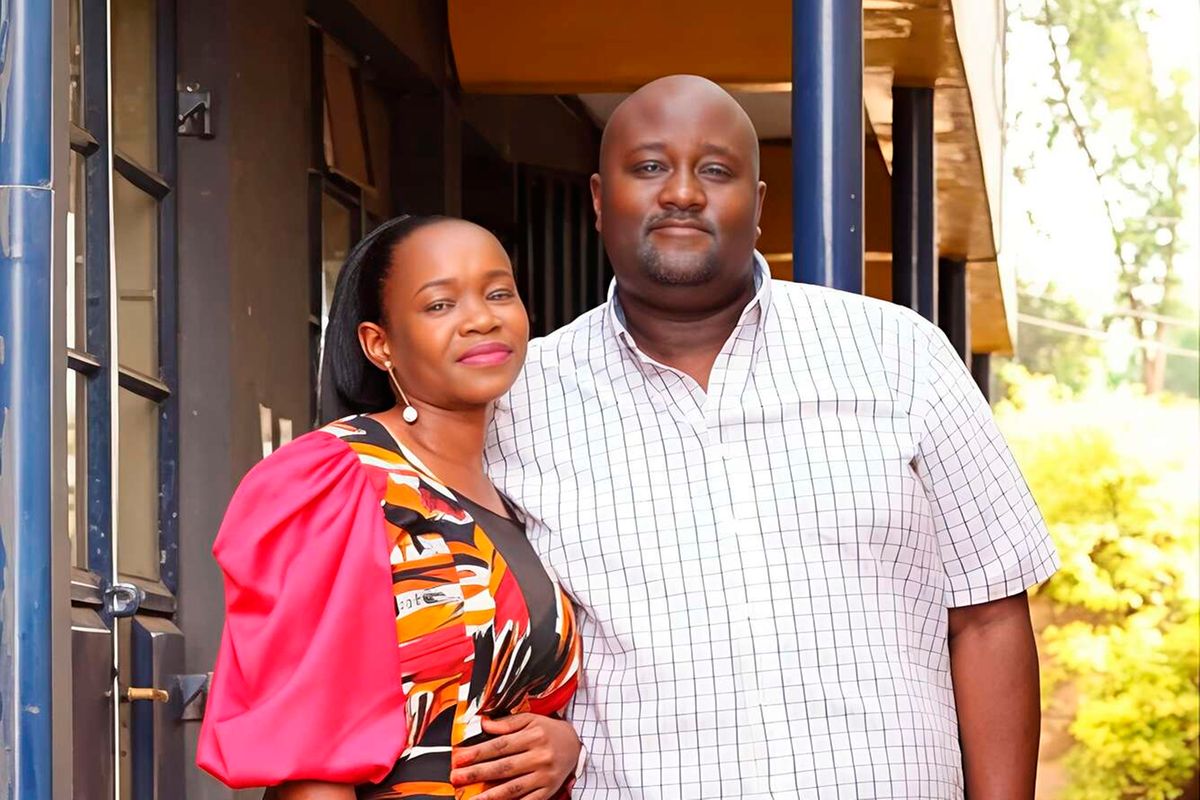
Stephen Odhiambo, 44, is calm and composed as he settles into the interview, dressed in a blue checked shirt. A father of three, he speaks about his wife, Beryl Ouma, with the quiet assurance of a man who has learnt that love is not only expressed in the good times but also in the moments when life becomes uncertain.
Married for 17 years, neither had imagined that one day, a cancer diagnosis would test their marriage in ways they could hardly have anticipated.
In 2019, Beryl, 40, suffered a minor stroke that affected her speech. With the help of a neurologist, she made progress, although her speech did not fully stabilise. In February 2023, Stephen relocated to Nakuru after changing jobs, continuing his career as an automobile engineer.
Life appeared to be settling into a familiar rhythm until one evening in late April 2024, when he returned home from work to find his wife concerned about a lump she had felt in her left breast.
Because she went to the gym frequently, his first thought was that she might have knocked herself against something during exercise.
Read: The women donating their hair to restore cancer warriors’ dignity
“I was like, maybe something has hit you, and perhaps we could find out what it was,” he recalls.
But Beryl was not convinced. “She insisted that the lump was unusual and had not been there before. There was no pain, discharge or other obvious symptom.”
The following day, they agreed to seek medical attention at a hospital in Nakuru.
Initial investigations included a mammogram and an ultrasound, but neither provided a clear explanation of the lump. A biopsy followed, and when the results came back, the doctors referred Beryl to a breast specialist for further assessment.
Given her previous stroke, the couple also sought guidance from their neurologist, who referred them to a breast surgeon-oncologist in Nairobi for additional tests.
For about two weeks, they waited for answers.
“From the time she told me she felt something like a lump on her breast, cancer was the last thing that came to my mind. I didn’t think she could have something like that,” Stephen says.

Beryl Ouma before she was diagnosed with breast cancer.
Beryl, however, had already begun to contemplate the possibility. She repeatedly asked her husband whether he thought she had cancer, but Stephen chose to remain hopeful, encouraging her not to dwell on the worst-case scenario. Eventually, the diagnosis was confirmed: Beryl had Stage Two breast cancer.
“When the news was brought to us, she was almost collapsing. I had to hold her, be strong and assure her that I was going to be there and that everything would be fine at the end of the day,” he recalls. For Beryl, the news was devastating.

Beyond the scars: How women who survive breast cancer struggle
“I cried a lot,” she admits. Having survived a stroke, she drew strength from the fact that she had already overcome a serious health challenge.
“One thing I told God was that if a stroke had not killed me, then even breast cancer was not going to kill me. I would press on,” she says.
The doctors explained that the cancer was manageable and outlined a treatment plan, which began in October 2024. Her care involved a team of six doctors, including specialists in breast cancer surgery, reconstruction, radiation treatment and neurology, among others.
The first stage was chemotherapy, followed by surgery and radiation therapy. For Stephen, understanding the treatment plan was only one part of the challenge. The other was figuring out how to pay for it.
The initial estimate for six cycles of chemotherapy was Sh2.6 million, and the couple had about a month to raise the money.
“By the time we got back to Nakuru from Nairobi, we were confused. We kept asking ourselves what we could do to raise that kind of money because the treatment plan was very strict,” he says.
Their insurance helped cover some of the initial tests, but the costs accumulated quickly, eventually exhausting the available cover. The family had to look beyond their immediate resources for assistance. Stephen is grateful to his in-laws, other family members, a few friends and his employer, all of whom stepped in to help them navigate the financial strain. Contributions from loved ones would become an important part of their ability to continue treatment.
Once chemotherapy began, the couple would leave Nakuru at 4am and arrive in Nairobi at about 8am. Beryl would rest briefly before reporting to the hospital at 9am, with chemotherapy beginning at around 10am and ending at about 2pm.
But completing a session did not mean they could immediately head home.
“I knew my wife needed time to rest before making the journey back to Nakuru. So we booked an Airbnb near the hospital, allowing her to recover and travel home the following day.”
Beryl Ouma in hospital during one of her radiation therapy sessions
Photo credit: Pool
“The side effects often began about three days after treatment and could last for a week and a half, sometimes two weeks. The reprieve between one session and the next was often brief,” he says. She completed chemotherapy on December 20, 2024.
Read: Can breast stimulation during intimacy cause cancer?
Before treatment began, the couple had talked at length about what lay ahead. Beryl also found encouragement online, where she watched other patients share their experiences of undergoing treatment and recovering.
“Seeing other people continue with their lives gave me hope that I, too, could make it through,” Beryl adds.
After chemotherapy, the doctors allowed about six weeks to monitor how her body was responding before proceeding with surgery. They had to choose between a lumpectomy, which removes the cancerous lump while preserving the breast, and a mastectomy, which removes the entire breast.
“After discussions with the doctors, we opted for a lumpectomy. I also underwent reconstruction on the other side of the breast to achieve a more balanced appearance,” she says.
The surgery was estimated to cost Sh1.8 million, adding to the financial pressure the family had already experienced. Once again, insurance, the Social Health Authority (SHA) and contributions from friends helped cover part of the costs.
Radiation therapy followed, with Beryl undergoing 22 sessions at a cost of Sh8,000 per session.

Beryl Ouma after being declared breast cancer free in October 2025.
Photo credit: Pool
By May 2025, she was attending follow-up appointments and undergoing further tests to assess her response to treatment and monitor her surgical wounds. She also continued seeing her neurologist and taking medication related to her earlier stroke.
She is now in a surveillance period expected to last about five years, during which she undergoes regular examinations and imaging tests, including mammograms, magnetic resonance imaging (MRI) scans and ultrasounds.
“It hasn’t been an easy journey, and I wouldn’t want anyone to be in such a situation. It needs a lot of prayers and support from friends and family,” he says.
Along the way, he admits, well-meaning people suggested alternative treatments, including visiting herbalists. “We agreed that we would only follow the doctors’ recommendations, regardless of the financial difficulties involved,” the couple shares.
“Something needs to be done, perhaps by the government, to make treatment accessible to every cancer patient. We are losing people along the way whom we shouldn’t have lost because patients drop out of treatment,” he says.
Read: Life after mastectomy: Four survivors on getting their style and confidence back
Before treatment began, he says, their neurologist, being their closest friend, advised him to focus on supporting Beryl because she would need him throughout the process. Her doctors also emphasised the importance of having a reliable support system.
“At the hospital, I would remain by her side throughout the appointments, to the point that doctors and nurses eventually became accustomed to seeing him there,” he says. “Though some patients arrived with relatives, having a spouse present offered a different kind of reassurance.”
When she was too weak to manage on her own, Beryl shares that her husband would help bathe her. Additionally, their three children had questions as they learnt that their mother had breast cancer, but they gradually understood what was happening and supported her throughout treatment, particularly during chemotherapy.
“My kids and my husband were my support system. I would look at them and find the strength to carry on,” she says.
Her husband, she adds, never stopped reminding her that he loved her and would not abandon her.
“Those assurances mattered a lot to me; my hair fell out, and the skin on my face, hands and legs became darker. But Stephen did not make me feel that these changes had taken away my beauty from his eyes,” Beryl says.
Instead, he would take her out for dinner and lunch dates, giving them opportunities to relax and temporarily step away from the demands of treatment.
The treatment also affected an aspect of their relationship that is rarely discussed openly: intimacy.
“There were times when I did not feel the urge for sexual intimacy, and Stephen would tell me, ‘I’ll still give you time until you are well,” she admits.
“Cancer is not an easy journey, but in marriage, you know some men would have left,” Beryl says. “Marriage is for better or worse, but when it comes to the worse, some will leave. Stephen is here.”
The doctors had also warned them before treatment that chemotherapy could affect her ovaries and fertility. Since completing treatment, her menstrual periods have yet to return, a change the couple continues to navigate.
Stephen often asked himself what he would expect if their positions were reversed and he were the one battling a serious illness. “I would expect her to do the same for me because that’s the beauty of life. We have chosen each other, through the ups and downs, and that has made us even closer,” he says.
Psychologically, he says, he drew strength from Beryl’s determination to fight. Her willingness to keep going encouraged him to remain strong for her, while prayer and the support of friends helped sustain them through the difficult days.
His greatest lesson has been the importance of patience and faith.
“With patience and believing in God, I didn’t know how we would finish the journey, but we made it through,” he says.
One memory that stands out is the day his wife completed her radiation therapy. As she rang the bell to mark the end of treatment, Stephen felt a deep sense of relief and accomplishment.
“It made me a proud husband,” he says as we wind up our interview.
Follow our WhatsApp channel for breaking news updates and more stories like this.