
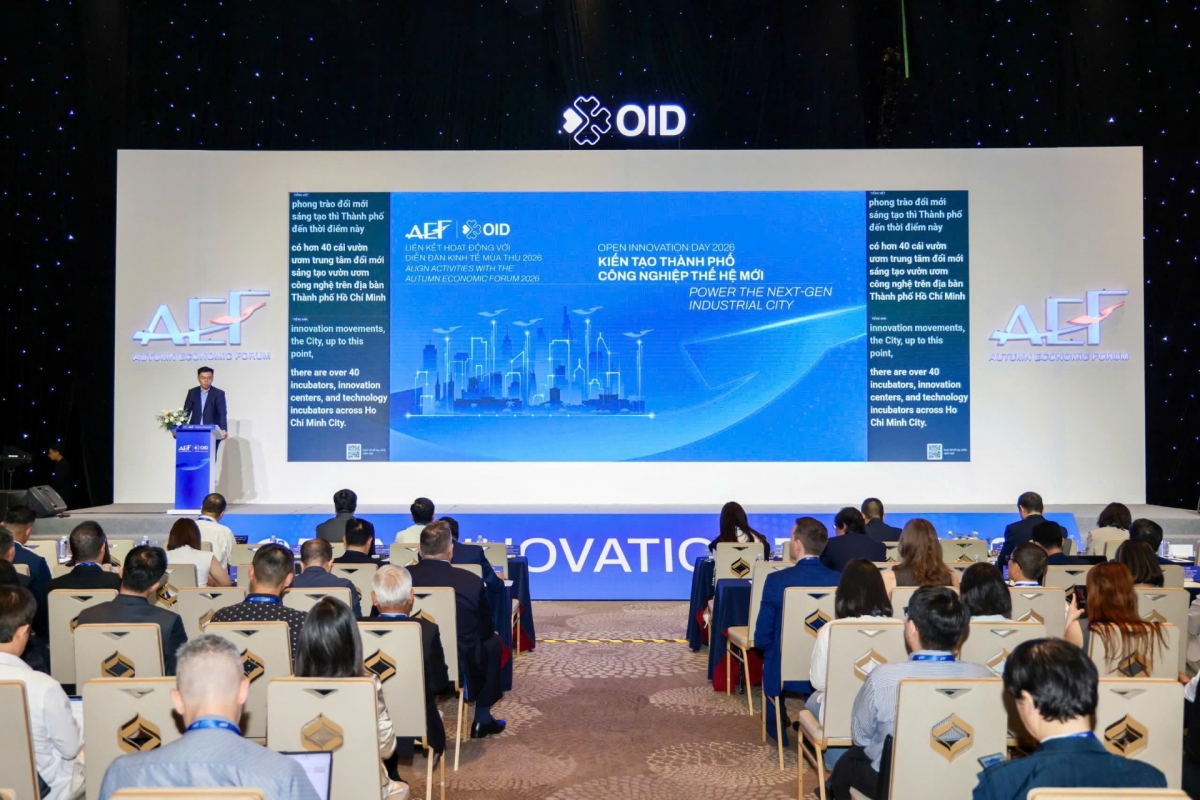
The event was led by SoiHub Open Innovation Centre, in collaboration with the National Centre for Technological Progress, under the Ministry of Science and Technology, Saigon Telecommunications Technology Corporation, and the Ho Chi Minh City Centre for the Fourth Industrial Revolution.
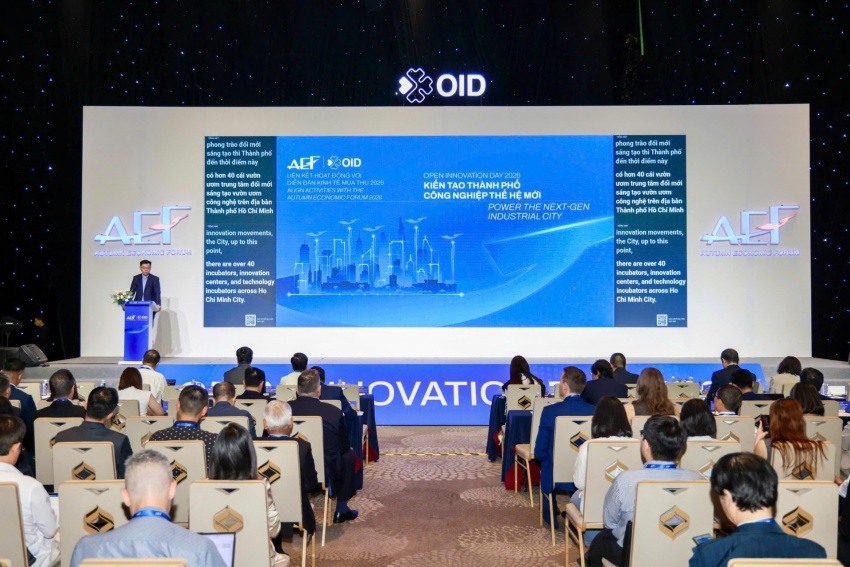 Truong Minh Huy Vu, Vice Chairman of Ho Chi Minh City People’s Committee opened the event. Photo: Le Toan
Speaking at the event, Truong Minh Huy Vu, Vice Chairman of Ho Chi Minh City People’s Committee said that Open Innovation Day 2026 marked the opening of the 2026 Autumn Economic Forum, which is being co-branded with the World Economic Forum for the first time.
“The city’s growth drivers in the coming period must be based on innovation and on integrating innovation into economic development, industry and urban development,” Vu said.
Ho Chi Minh City currently has more than 40 incubators, innovation centres and technology incubation facilities. Many are moving towards direct collaboration with major corporations, businesses and international partners, creating a foundation for linking research activities with market demand.
Vu said that following its merger with Binh Duong and Ba Ria–Vung Tau, the city has gained additional room for industrial development, creating opportunities to reorganise production zones and develop high-tech and digital technology industrial parks, as well as new industries.
According to the city’s development plans outlined by its leaders, areas such as Bac Tan Uyen and Chau Duc have the potential to accommodate large-scale industrial zones supported by energy infrastructure, including solar power, offshore wind and interconnected energy systems.
The city also plans to mobilise resources through public investment, public-private partnerships and the private sector to prepare infrastructure and facilitate investment by industrial developers.
However, Vu stressed that building a next-generation industrial city was about more than developing land and infrastructure.
“The essence of moving towards next-generation industry is not just infrastructure or industrial parks. What matters most is the ecosystem,” he said.
This industrial ecosystem must connect human resources, universities, research institutes, incubators, businesses, investors and policy mechanisms. In particular, the gap between university research and technology commercialisation needs to be addressed to facilitate the application of research findings in production and business activities.
Bui Thanh Hang, director of SoiHub Open Innovation Centre, said the centre was established in 2023 with a focus on businesses, corporations and industry, using market demand as the starting point for connecting technological resources.
Hang said SoiHub focuses on identifying real-world challenges faced by businesses and local authorities, then connecting experts, scientists and technology partners to develop suitable solutions.
To date, SoiHub has connected, collaborated on and developed 50 domestic and international technologies, received and addressed 15 market-driven requests, and established 20 strategic cooperation agreements with technology partners across the region and around the world.
Through these partnerships, SoiHub is advancing programmes and projects in strategic fields, including AI, semiconductors, the low-altitude economy, manufacturing, and new materials.
“To realise our growth ambitions and strengthen competitiveness, Vietnam cannot stop at attracting investment or adopting technology. We must gradually master technologies, develop production capabilities, build a highly skilled workforce and enhance the position of Vietnamese businesses,” Hang said.
The sessions at Open Innovation Day 2026 focused on key foundations for developing next-generation industry.
The morning session explored attracting investment in AI data centres, computing capacity, data security, human resources and green energy infrastructure.
Experts, businesses and investors discussed the conditions needed for Vietnam to develop its technology infrastructure, access international capital and strengthen its competitiveness in industries that rely heavily on data, energy and advanced technologies.
The afternoon session focused on unmanned aerial vehicles, autonomous systems, satellite connectivity, testing infrastructure and the development of specialised industrial parks.
The programme also featured the announcement of strategic partnerships and efforts to strengthen links among businesses, investors, research institutes and technology partners, with the aim of developing projects that can be implemented in practice.
Through Open Innovation Day 2026, the organisers expect to strengthen connections between domestic and international resources, boost technology transfer, application and commercialisation, and contribute to the development of a next-generation industrial ecosystem in Ho Chi Minh City and Vietnam.
 Ho Chi Minh City to unveil new projects worth $13.5 billion at AEF 2026
Ho Chi Minh City is expected to announce at least 12 investment projects with a combined value of more than $13.5 billion at the Autumn Economic Forum 2026.