
For billions of years, Earth has experienced periodic glacial cycles governed by its orbit around the Sun. No force on the planet could disrupt this eons-long cycle—until we came along.
A new study published in the journal Science suggests that a new glacial period was beginning some 2,000 years ago, but by the 1960s, greenhouse gas emissions had raised global temperatures enough to reverse it. Future emissions could forestall the next ice age for hundreds of thousands of years, altering one of Earth’s most fundamental natural cycles.
“It was just getting started, everything was normal, the next glaciation was about to happen—and yet it stopped,” first author Nicolás Young, a geochemist at Columbia University, said in a statement. “It’s a very powerful example of how we have jolted the system.”
The canceled glaciation
The glacial cycles within ice ages are governed by Milankovitch cycles—periodic changes in the shape of the planet’s orbit, the tilt of its axis, or the direction of its axis rotation that influence how much sunlight reaches certain parts of the planet. During an ice age, which can last millions to tens of millions of years, Earth is relatively cold, with large swaths of the planet covered by continental ice sheets and alpine glaciers.
That doesn’t mean the climate remains invariable, however. Over the course of an ice age, shorter periods of warmer temperatures and glacial retreat (called interglacial periods) alternate with periods of colder temperatures and glacial advance (called glacial periods). Right now, we’re in an interglacial period during the Late Cenozoic Ice Age (yes, we’re technically living in an ice age), and the last glacial period ended about 11,700 years ago.
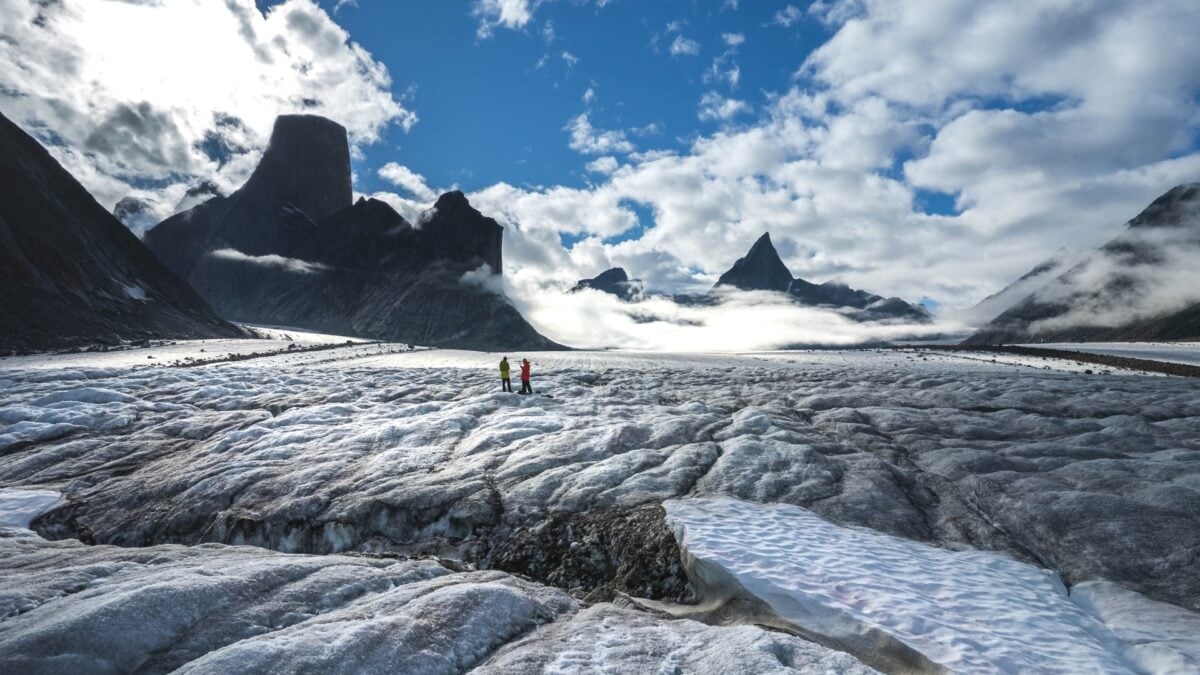
During the peak of that last glacial period, the Laurentide Ice Sheet covered much of Canada and the northern United States. A sole remnant of that ice sheet still survives today as the Barnes Ice Cap, which stretches across an area roughly the size of Delaware on Baffin Island in Nunavut, Canada.
Today, the Barnes Ice Cap is thinning and retreating, but Young and his colleagues found that wasn’t the case not too long ago. The glacier’s shrinking allowed them to analyze newly exposed vegetation that was long preserved beneath the ice cap. By dating those plants, they constructed a timeline of its climatic history, finding that it reached its minimum extent about 3,000 years ago and then started expanding again 2,000 years ago.
The researchers argue that this growth marked the onset of Earth’s next glacial period, but it derailed before it could really get underway. That change came in the 1960s, when global temperatures had warmed so much that the Barnes Ice Cap began losing more ice in the summer than it added in winter. That trend has continued ever since, and thus the next glaciation remains on hold.
An uncertain future
Climate models suggest the Barnes Ice Cap is likely to disappear completely within the next 300 years. For eons, the Laurentide ice sheet has anchored the growth of continent-spanning ice. If this last remnant vanishes, it could change the dynamics of future glaciations and ice ages.
As humanity continues to heat the planet, experts can’t be sure when the next glaciation might occur. In a perspective piece accompanying the new study, glaciologist and University of Wisconsin-Madison professor Shaun Marcott states that future greenhouse gas emissions could forestall the next ice age for hundreds of thousands of years.
It’s astounding that a single species can so fundamentally alter the planet. With global temperatures now set to rise more than 2.7 degrees Fahrenheit (1.5 degrees Celsius) above pre-industrial levels within the next few years, Earth is entering an entirely new chapter in its climatic history—one shaped by us.