
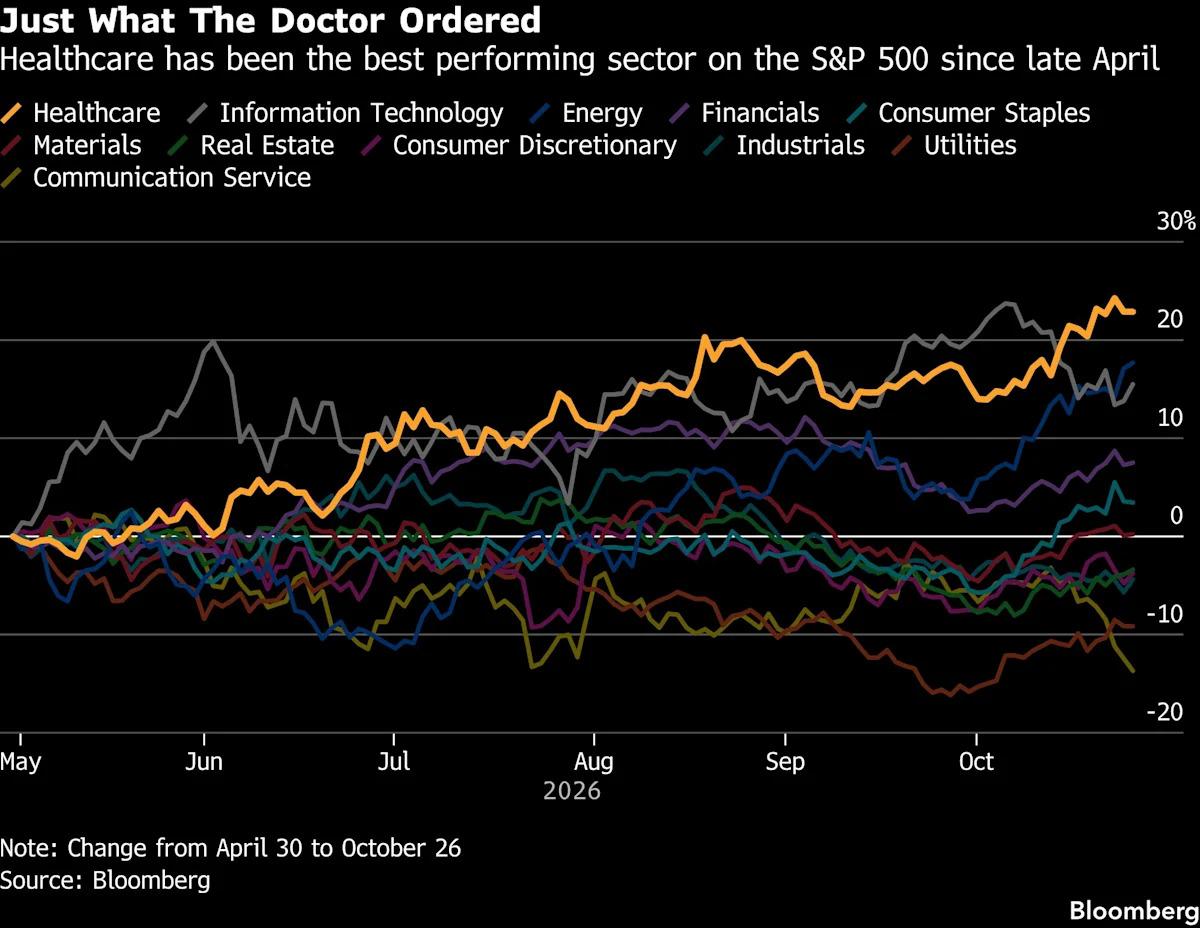
(Bloomberg) — With investor confidence in the artificial intelligence trade under pressure, traders are turning to healthcare stocks for refuge.
Most Read from Bloomberg
Since the end of April, the S&P 500 Healthcare Index has risen about 23% through Monday’s close — outperforming the broader market and every other sector. That includes high-flying technology names and surging energy stocks that have benefited from the ongoing Iran War. Healthcare’s rally has been led by Eli Lilly & Co. (LLY), AbbVie Inc. (ABBV) and Johnson & Johnson (JNJ).
Wall Street has been warming up to the sector, particularly as sentiment around AI — and tech in general — fuels increasing desire for protection from risky assets.
Healthcare is being viewed as an anti-AI trade, said Matt Orton, chief market strategist at Raymond James Investment Management, adding that the cohort has been on the other side of selloffs in names related to AI spending “angst.”
Fund flows also point to a change in fortunes. Healthcare exchange-traded funds have outpaced every other sector on a trailing 65-day basis with about $4 billion of inflows, according to data through Oct. 19 compiled by Baird Strategas. Tech, on the other hand, has seen the biggest outflows — $6 billion — during that period.
Up until about six months ago, healthcare stocks significantly underperformed the broader market. “So, from a valuation perspective it’s more attractive,” Orton added. “I think a lot of investors have viewed it as a place to go for safety.”
When shares of cloud-computing services provider CoreWeave Inc. slumped as its debt reached levels that typically indicate distress, tech stocks had their worst week since President Donald Trump unleashed his tariff agenda in April 2025. At the same time healthcare extended its streak of weekly gains.
Investors were “derisking their portfolios” in response to the CoreWeave drama, said Brian Mulberry, chief market strategist at Zacks Investment Management. “The nervous money that was scared of AI is moving back into healthcare.”
Beyond the flight to safety, healthcare earnings and an improving outlook for 2027 are also contributing to its rally, said State Street Investment Management’s Michael Arone. In Arone’s view, investors are rejiggering their portfolios to be less centered around AI, as opposed to ditching tech entirely for healthcare.
Furthermore, the upcoming US midterm election has investors seeking sectors that will be resilient to potential political changes in Washington. This is where healthcare comes in, said Morgan Stanley analyst Erin Wright, who notes that the sector has “perceived relative insulation” from regulatory noise.
However, with earnings season in full swing, the healthcare rally is vulnerable. Results from Johnson & Johnson earlier this month disappointed the market and dragged the cohort to its worst performance in more than a month.
Then, Moderna Inc. (MRNA) slumped 18% on Thursday after full data from a trial on its widely anticipated personalized melanoma vaccine with Merck & Co. leaked, undermining lofty expectations set by Wall Street earlier this year. The healthcare gauge fell 1.1% on Friday, retreating from an all-time closing high just a day earlier.
With earnings slated to roll out from big names like Lilly, Raymond James Investment Management’s Orton said it’s a crucial time.
“If they do deliver, I think there’s scope for healthcare to keep running just because it’s been such an underinvested part of the market with all of the enthusiasm around artificial intelligence,” said Orton.
Still, so far, healthcare is seen as a natural destination for traders rotating out of tech. Earlier this month, RBC Capital Markets upgraded healthcare to overweight and downgraded tech to market weight.
“I don’t think the leader is going to be semis, so there are going to be areas where they see the benefit flowing out of semis, which is the biggest sector in the S&P right now,” said Ohsung Kwon, chief equity strategist at Wells Fargo. “I still think a lot of that money is going to flow into other tech areas and healthcare.”
–With assistance from Emily Forgash.
Most Read from Bloomberg Businessweek
©2026 Bloomberg L.P.