
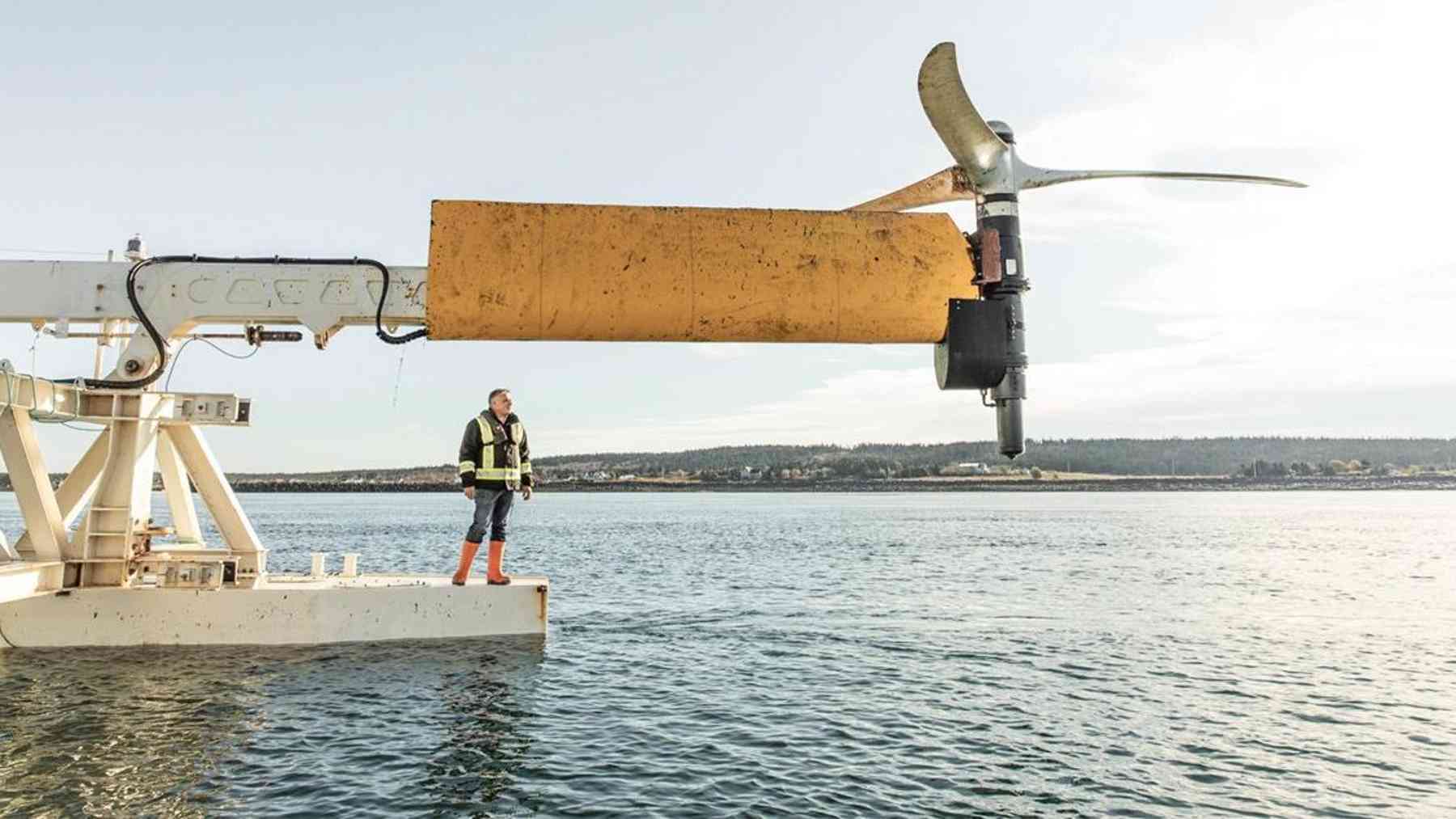
The water in the channel runs hard enough to push a loaded fishing boat sideways.
About 125 miles up the same bay, a five story steel ring sits on the bottom where it was dropped. It has been there since 2018 and it does not work.
Nobody has taken it out because nobody can agree who pays.
Down in the narrow passage, a different machine hung its rotors on arms that folded up out of the water.
Both companies are gone. Only one of them left nothing behind.
So what actually decides whether a dead machine comes back up?
Why a 1 million dollar bond shapes the hardware
A turbine bolted to the seabed is installed by a heavy marine spread, and the only way to recover it is to hire that spread again.
Regulators know this, so a berth licence carries a bond meant to cover the removal if the operator disappears.
The number in that bond is the whole game. Set it below the real cost of a recovery and you have written an invitation, because a company in liquidation will forfeit the bond and walk, leaving the difference on the public.
A floating hull changes the arithmetic completely. It is towed in and towed out, the anchors come up on a winch, and the end of life cost is close to the cost of a working day.
Which means the hinge that lifts a rotor is not really a maintenance feature. It is an exit route.
Removability is a financial property.
4 rotors on 1 hull in a tidal race
The passage sits between two islands at the mouth of the bay that carries the highest tides on earth. Current runs at roughly 10 feet per second.
Related
The platform floated there on a single mooring turret, which let the whole hull pivot like a weather vane and point itself into the stream each time the tide turned.
Four rotors, each about 21 feet across, hung on arms along the hull. Any one of them could be swung clear while the platform stayed on station.
The benchmark its builders used was not a crane barge. The chief executive told a reporter that a visit from a lobster boat would do.
The same hinge doubled as a safety release, lifting the rotors out when current, ice or floating debris threatened them.
The site was picked for charted seabed, clear fast water and easy boat access.
280 kilowatts against 1,400 tons of dead steel
The honest scale is small. All four rotors together were rated at 280 kilowatts, a fraction of one modern onshore wind turbine, so grid scale here would mean many platforms rather than one.
Against that, the machine on the bottom of the other passage is reported at somewhere between 1,100 and 1,400 short tons, depending on which account you read, and its weight is exactly why it is still there.
The monitoring was unusually heavy for a device this size. Subsea cameras, hydrophones, echo sounders and acoustic tag receivers.
Roughly nine months of that produced no marine animals passing the rotors beyond some jellyfish, and a separate camera trial logged small fish and jellyfish near the structure with nothing larger interacting with it.
That trial covered one winter and a limited collection window, which is not a season and not a population.
It is a first look.
Three companies, three bonds, two wrecks
Here is the part the engineering story usually leaves out.
Related
The seabed turbine’s owner collapsed in 2018 and the berth carried a bond of 1,020,000 dollars, while the operations around it ran several million dollars higher than that, in the way that a wave buoy or a solar field gets judged on its good years.
The company that took over that same berth filed for bankruptcy in September 2024 with liabilities of 35.7 million dollars against almost 14 million in assets. Its licence had required a 4.5 million dollar bond for retrieval, and the province held a 20,000 dollar deposit for gravel pads, while four concrete filled rail cars it had sunk as moorings stayed in the channel, as the bankruptcy coverage set out.
The floating operator went bankrupt too, in May 2023.
But it pulled its platforms into storage and cleared its equipment off the seabed first.
Three failures, one clean site.
What the hinge did not save
The limitation matters as much as the lesson.
Being removable did not keep that company alive. It died over permitting, not engineering, after its chief executive said the federal fisheries department would give neither permission to proceed nor a clear pathway, and the trade report carried his words at the time.
So the design question and the survival question are separate, and the bay has now answered only the first one.
Local fishermen put it more bluntly, that the recurring problem with every one of these companies is the gear left behind.
A working tidal platform is an engineering result.
An empty seabed is a different one.
Read the whole thing?
Get the week’s signal, not the noise
Our sharpest reporting on energy, climate and nature — free, once a week.