
Hospitalization in cancer patients can naturally occur during the course of the disease. An Australian study linked prolonged hospitalizations to clinical factors that served as surrogates of disease severity, such as referral to a palliative care team, mechanical ventilation, admission to intensive care units or surgical procedures7. Among the risks associated with inappropriately prolonged hospital stays, the main concerns are clinical – examples include the risk of nosocomial infections, falls and loss of autonomy due to extended immobilization, all contributing to increased morbidity and mortality8.
On the other hand, prolonged hospitalizations may impose economic challenges at multiple levels, requiring the careful management of the available (finite) resources9. The costs associated with prolonged hospital stays are significant, representing a substantial financial burden for healthcare systems and, potentially, for patients and their relatives. In addition to direct costs, indirect costs such as loss of productivity and the economic impact on patients’ families also contribute to the overall financial burden. Furthermore, the need for continued and home care following discharge may also increase the total costs of care.
Discharging patients after a prolonged hospital stay demands the coordination of a wide range of professionals, including healthcare providers, families, caregivers, and social support institutions 8. An American study identified insufficient discharge site coordination as the most frequent non-clinical factor prolonging hospital stays, affecting 56% of patients with prolonged hospitalizations and causing an average delay of 8.5 days in discharge10.
Although the study was limited to a six-month period, the inclusion of all episodes of prolonged hospital stay ensures that the data analyzed are representative of real-world experience, encompassing a diversity of diagnoses and different stages of oncological disease.
Not all correlations tested among the various subgroups were pre-planned, as some were suggested by the data. Although this multiplicity of post-hoc analyses carries a risk of false positives, we consider these findings to carry value, from an exploratory perspective.
Prolonged stays and systemic predictors
The strongest independent predictors of prolonged hospitalization are organizational and systemic in nature – social services involvement (OR 4.71), PCU referral (OR 5.33), intra-hospital department transfer (OR 7.88), and family meetings (OR 3.00) – rather than markers of clinical complexity alone. Whether these associations represent modifiable determinants of prolonged stay or surrogate markers of underlying disease severity warrants prospective investigation. These findings are consistent with the American data on discharge site coordination cited above10.
Social frailty and discharge planning
Social frailty emerged as both a univariate correlate and a multivariate predictor of prolonged stay. The association between social services involvement and prolonged hospitalization is consistent with the hypothesis that, in a subset of cases, the absence of a timely discharge destination—rather than acute clinical need—may contribute to extended stays. This would reflect a structural gap in the coordination between acute hospitals and community services in Portugal, though the cross-sectional nature of the data does not allow causal inference.
Palliative care access
A clinically significant finding is the scale of apparent unmet palliative care need. Of the 138 prolonged stays, 47.8% met formal criteria for PCU admission, yet only 19 patients (43.2% of those referred) were successfully transferred. Sixty-six patients (47.8%) presented clinical criteria justifying referral to a PCU, but the referral process was not completed for three main reasons: reduced life expectancy contraindicating the transfer, patient refusal, or irregular residency status precluding referral to a PCU. Of those referred but not transferred, 80% died during the hospitalization itself. This pattern is consistent with the hypothesis that PCU waiting times may represent a rate-limiting step in access to appropriate end-of-life settings—a finding congruent with the well-documented scarcity of this resource in Portugal. A landmark Portuguese study demonstrated that a hospital stay exceeding 14 days was the most common single indicator of end-of-life therapeutic aggressiveness, with a prevalence of 43%11. Our cohort (LOS ≥ 16 days) falls squarely within this high-risk group. These findings suggest that the oncology ward may be serving, in part, as a default end-of-life environment for patients who cannot access timely PCU placement, though prospective data with timestamped records would be required to confirm this interpretation.
Admission reasons: two distinct clinical archetypes
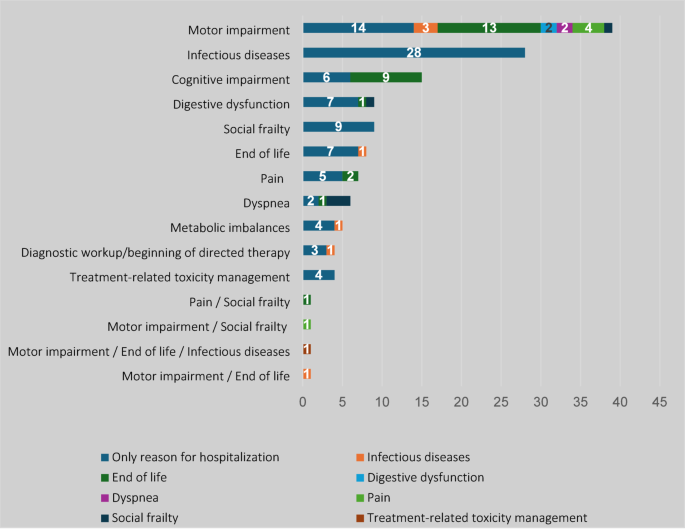
The bimodal distribution of admission reasons is informative. Prolonged stays are characterized by functional and palliative reasons which by their nature do not resolve within days. Non-prolonged stays are dominated by acute, resolvable conditions. The protective effect of a higher number of admission reasons (OR 0.34) reflects that multi-reason episodes tend to be acute and resolvable, whereas single-reason prolonged stays tend to involve intractable functional dependence or lack of a discharge destination.
Cancer type and risk stratification
Gynecological cancers were significantly over-represented in the prolonged group (18.8% vs. 9.8%, p = 0.013) and sarcomas in the non-prolonged group (15.2% vs. 7.2%, p = 0.020). The reasons underlying these differences were not directly studied and warrant further investigation, including analysis of admission reasons, functional status, and social support needs by tumour type.
Limitations
This study has its limitations that should be considered when interpreting the findings described.
As a retrospective study, data collection relied on clinical records, and the six-month time frame, while representative, limits generalizability.
The definition of prolonged hospitalization (≥ 16 days) was center-specific, in the absence of a validated international consensus definition. This limits direct comparison with studies using different thresholds and restricts the generalizability of the findings to settings with a similar case-mix and patient profile.
The absence of a matched control group is also acknowledged. This study was not designed as a case-control study, and given its retrospective nature, formal matching would not have been feasible. The non-prolonged group represents all episodes occurring in the same period that did not meet the prolonged stay threshold, differing from the prolonged group in baseline characteristics and introducing a risk of residual confounding. Future prospective studies should consider matched designs or propensity score adjustment to better isolate the independent contribution of each predictor.
An important characteristic absent from the population description, and relevant in this type of study, is performance status. Whether assessed by the Eastern Cooperative Oncology Group scale, the Karnofsky Performance Scale, or other validated instruments, performance status requires prospective evaluation at a defined point in time and in the direct presence of the patient; it is not systematically documented in inpatient medical records at our institution and was therefore not available for most episodes. Retrospective imputation from clinical notes would introduce unvalidated proxies not methodologically comparable to the prospectively assessed tools and was not attempted. The admission reasons recorded in our dataset—motor impairment, cognitive impairment, end-of-life care, and social frailty—capture partial information about functional trajectory, but are not equivalent to a validated performance scale.
An important interpretive limitation concerns the directionality of the observed associations. Variables such as PCU referral, family meetings, and social services involvement may, in many cases, have been initiated as a consequence of a prolonged stay rather than preceding it. In this retrospective analysis, the temporal sequence of events cannot be reliably established. Furthermore, these palliative care-related variables are strong surrogates of disease severity and clinical complexity; the associations observed may therefore reflect, at least in part, confounding by underlying disease burden rather than independent structural relationships.
The multivariate model was not accompanied by a formal collinearity assessment. Several variables included in the analysis are conceptually related—particularly those reflecting palliative care involvement—as patients with advanced oncological disease tend to trigger multiple concurrent care interventions simultaneously. Residual collinearity between these predictors cannot be excluded and may have influenced the model estimates. This should be considered when interpreting the odds ratios reported. External validation is required before these findings can be used for prospective risk stratification.