
Follow us
Add us as a preferred source on Google
Newsletter
Subscribe to our newsletter
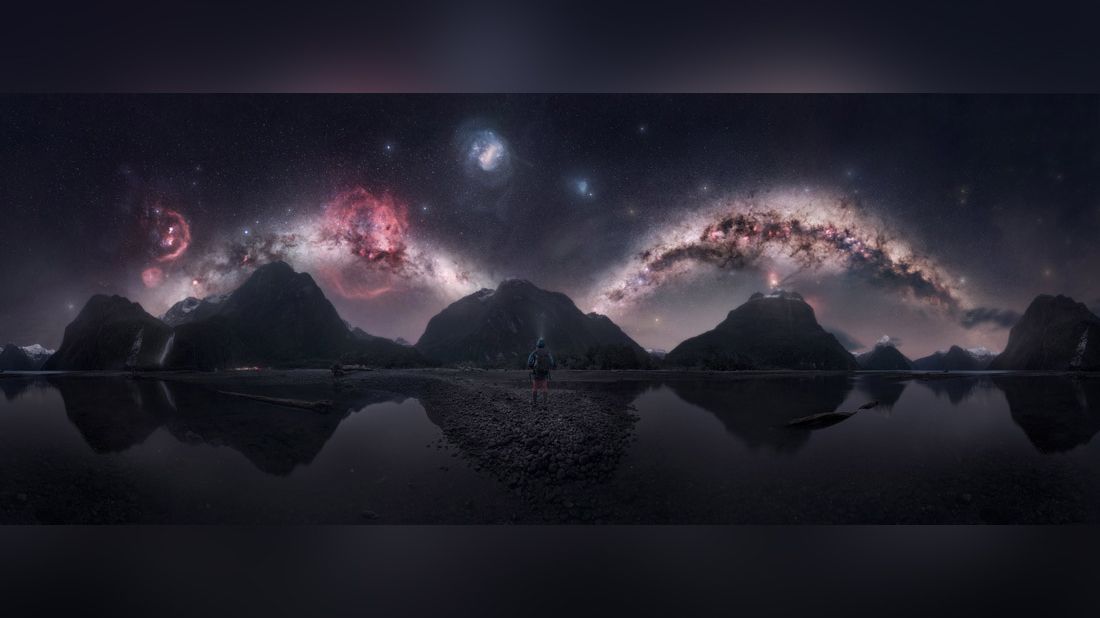
Spanish astrophotographer Mikel Iraeta managed to capture not one, but two beautiful arcs of our galaxy above the world-famous Milford Sound fiord in New Zealand – although it rains an average of 300 days a year here.
Iraeta‘s Double arch in Milford Sound was announced as the Open Nature/Landscape category winner at the 2026 Epson International Pano Awards, the leading global competition dedicated to panoramic photography.
The final image was assembled from 107 photographs (!) and required very specific conditions: no rain, clouds, or moonlight. Iraeta told the awards how he managed to capture a scene that he describes as “a unique photo, one that I have not seen anywhere else and that I think would be very difficult for anyone else to replicate. “
Latest Videos FromDigital Camera World
Category Winner: Open Nature/Landscape
Iraeta explains, “This is what I consider an almost impossible photo because you need some very specific conditions to pull it out.
“In fact, the day before I visited, the access road was closed due to snow avalanche danger. I ventured there without any expectations, with the sole intention of enjoying the place, aware of the improbability of the task.
You may like
“It is very difficult to have an entire clear night with no rain, no clouds, no moon, and for all of this to coincide at the end of September when it is possible to capture the double arc of the Milky Way. But I thought what if…”
The photographer continues, “I still remember feeling excited under the stars, aware of what I was witnessing.”
Iraeta’s shot required a bit of luck, a chain of coincidences and technical skill, both behind the camera and in the editing process.
He says, “The sky is composed of two separate tracked panoramas, each comprising eight panels, with each panel in turn consisting of a stack of four 45-second exposures.
“The first panorama is taken after sunset to capture the spiral arm containing the galactic core. The second contains both Magellanic Clouds, Gum, and the Orion Nebula, captured between 2 and 4am.
What to read next
“It is important to time the shots so that both panoramas are at approximately at the same height above the horizon.
“Finally, the ground needs to be captured for which the moving tides need to be considered. For this foreground I used a 14-panel 360º panorama, where each panel is created from a bracketing of three photographs, plus an additional photograph to include myself. The final image is therefore the result of combining 107 different photographs.”
Browse the best 360 cameras and the best fisheye lenses.
Looking for competitions to enter? Here are 10 global photo contests now open for entries from October 2026 to February 2027.