
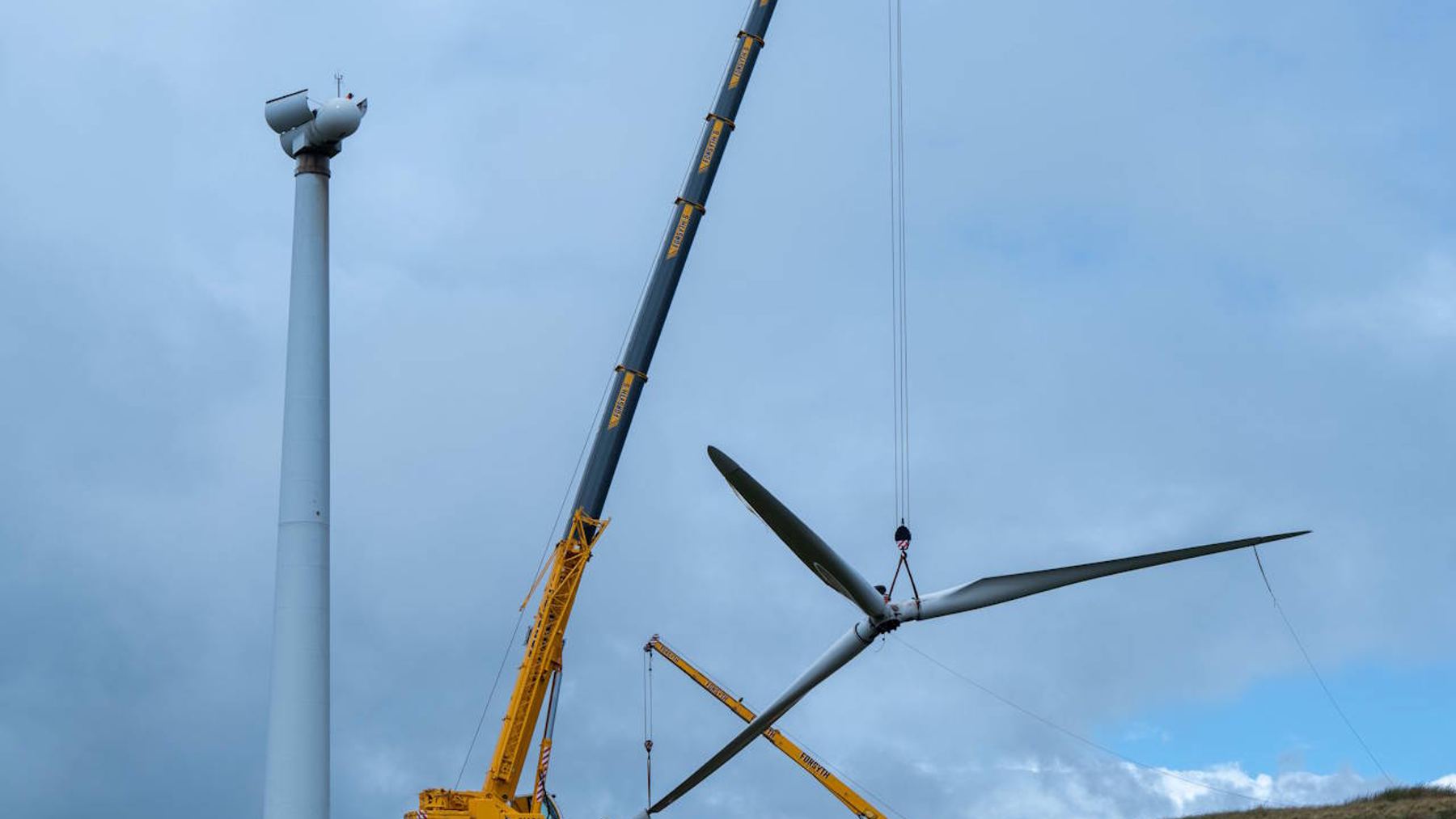
A flatbed pulls off the hill track with a sawn length of blade strapped across it, white and hollow and lighter than it looks.
Behind it, a line of concrete stumps where towers used to bolt down.
The machines came off this ridge in South Lanarkshire in 2023, after turning there since 1995.
What left the site went in two directions, and the two could not have been more different.
Most of it went to a scrapyard half an hour away. The rest crossed the Irish Sea.
Which is the thing a single number cannot show you.
Why 99.9 percent is a weight and not a count
A recovery rate for a wind turbine is a share of its mass, and mass is almost entirely steel.
The tower is a rolled steel tube standing hundreds of feet tall. The nacelle is a box of castings, shafts, copper and a gearbox. Those parts are heavy, and they are the ones a furnace will take without asking what they used to be.
The blades are the opposite. They are glass fibre set in resin, built to be stiff and light, and light is the point.
So a percentage by weight is carried almost entirely by the metal. Recover every ounce of steel and send every blade to a hole in the ground, and the number still looks excellent.
That is not what happened here, and it matters that it is not.
But it is why one figure can cover two different industries.
26 machines at 600 kilowatts since 1995
Hagshaw Hill sits in South Lanarkshire, on high ground above Douglas.
Related
It started turning in 1995 as the first commercial wind farm in Scotland, with 26 machines rated at 600 kilowatts each, which comes to 15.6 megawatts for the whole site.
By modern standards that is one turbine. The replacements going up now are rated several times higher apiece.
When the 26 came down in 2023 it was the first onshore wind farm in Scotland to be decommissioned, which made the site a test case rather than a routine job.
Steel, copper and gearbox parts went to scrap buyers and component dealers, most of them within 30 miles.
The blades went to a single processor in Northern Ireland.
79.5 percent recycled and 20.4 percent reused
The headline figure breaks into two numbers, and the split is the useful part.
A report compiled by an engineering consultancy puts recycling at 79.5 percent and reuse at 20.4 percent, which adds to the 99.9 that has travelled around the trade press.
Reuse here means components kept whole, held as spares or passed on for training rather than melted. Contracts went to at least 10 supply chain companies in Scotland and elsewhere in the United Kingdom.
The blades were turned into a polymer that goes into site fencing, marker posts and drainage parts, replacing concrete, timber and virgin plastic.
That processor says its output this year is half again what it was last year, which was itself a third higher than the year before.
Which is real growth from a small base.
The 0.1 percent nobody describes
Two things sit under the number and neither is hidden.
Related
The report was commissioned by the site’s owner rather than by a regulator, and the operator’s account is where the 79.5 and the 20.4 come from, in the way that an earlier count or a folding rotor turns into a settled question.
The two percentages add to exactly 99.9, so the missing tenth is simply not described anywhere.
And the industry’s own estimate for how much of a turbine is recyclable sits at 85 to 95 percent, below what this site reported, which tells you the usual number and this number are not measuring the same thing.
Most retired blades in the world still go to landfill. One site sending all of them to a polymer line is the exception being celebrated, not the rule being described, and the repowering page covers what replaced them.
None of that makes the result less real.
One gigawatt of towers still standing
The reason this matters is the queue behind it.
The operator’s own development director puts roughly a gigawatt of turbines due to come down across its estate in the next ten years, and the first generation built in the nineties is reaching the same age everywhere.
Hagshaw Hill itself now carries 14 machines instead of 26, rated at 80 megawatts together, about five times the original site on fewer foundations.
Each of those will come down too, with blades several times longer than the ones just cut up.
So the test case worked, and the test was small.
The steel was never the question. The turbine blades always were, and they still are.
Read the whole thing?
Get the week’s signal, not the noise
Our sharpest reporting on energy, climate and nature — free, once a week.