
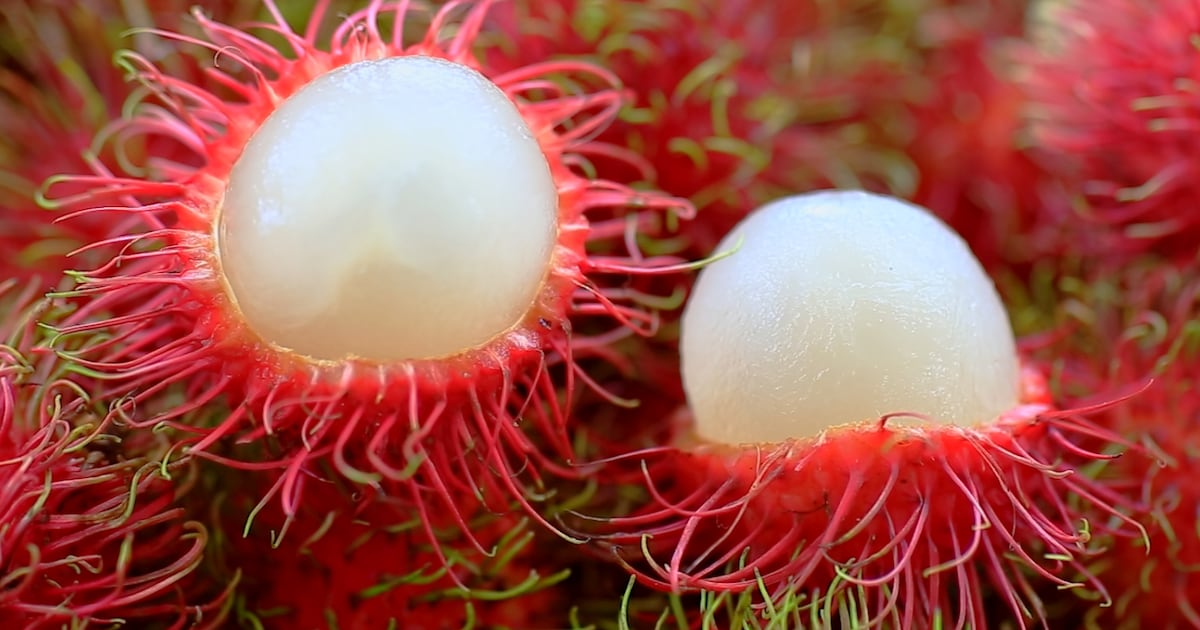
In a study published in Nutraceuticals, researchers at the Autonomous University of Coahuila in Mexico achieved 55% encapsulation efficiency using sodium alginate, with the resulting material retaining antioxidant activity in laboratory testing.
The research comes as ingredient manufacturers consider how to use agricultural by-products. In Lumina Intelligence’s August 2026 Climate-Smart Resilience report, 16.4% of 250 industry decision-makers surveyed identified developing more sustainable ingredients and inputs as one of the three biggest opportunities for improving climate resilience.
Encapsulating rambutan polyphenols
Rambutan (Nephelium lappaceum) peel contains plant polyphenols called ellagitannins, including geraniin and corilagin, but preserving these compounds for use in supplement formulations presents challenges.
According to the study authors, ellagitannins are “susceptible to degradation under environmental conditions such as light, temperature, oxygen, and humidity,” as well as pH changes that can affect their biological activity.
“An alternative to minimize these effects and preserve their properties is encapsulation,” the researchers wrote.
Using rambutan peel collected in Chiapas, Mexico, the team tested different concentrations of polyphenols, sodium alginate and calcium chloride to determine which combination would retain the most extract.
The highest encapsulation efficiency of 55% was achieved using 3,000 ppm of polyphenols, 2% alginate and 5 mM calcium chloride.
While increasing the polyphenol concentration improved encapsulation efficiency, the researchers found that higher alginate concentrations had the opposite effect.
“Increasing the biopolymer concentration from 1% to 3% resulted in a significant reduction in the retention of the phytochemicals,” the authors reported.
They attributed this reduction to the thicker alginate mixture, explaining that “highly viscous solutions restrict mass transfer and hinder the homogeneous dispersion of rambutan peel polyphenols within the polymeric matrix prior to cross-linking.”
Antioxidant activity and cell viability
The researchers also compared the antioxidant activity of the original extract with the encapsulated material, reporting ABTS inhibition of 99% and 76%, respectively, and DPPH inhibition of 93% and 65%.
The authors suggest that dilution and interactions with the alginate matrix during testing may have contributed to the lower antioxidant readings for the encapsulated extract.
To evaluate potential cytotoxicity, the team tested both materials on human embryonic kidney cells and mouse fibroblasts, with cell viability remaining above 75% across the concentrations examined.
“Nevertheless, according to the ISO 10993-5:2009 standard, none of the evaluated concentrations can be considered cytotoxic, as cell viability remained above the 70% threshold established for cytotoxicity classification,” the researchers wrote.
The study authors concluded that rambutan peel ellagitannins encapsulated in sodium alginate “represent a technological alternative for the development of functional foods and dietary supplements.”
Although the findings support further investigation into rambutan peel as a supplement ingredient, the study did not establish whether encapsulation improves stability during storage or digestion, or evaluate safety and effectiveness in humans.
Source: Nutraceuticals (2026), 6(3), 59. https://doi.org/10.3390/nutraceuticals6030059 “Biological and Antioxidant Potential of Alginate-Based Rambutan Ellagitannins Encapsulates: Approach to the Development of Dietary Supplements” Authors: L.E. Estrada-Gil et al.