
Persepolis defeated Esteghlal 2-1 at Shahr-e Qods Stadium west of Tehran, marking the first-ever meeting between the women’s teams of two clubs whose rivalry has dominated Iranian men’s soccer for decades.
Fatemeh Rezaei and Somayeh Esmaeili scored for Persepolis in the first half before Niloufar Azimi pulled one back for Esteghlal after the break.
Female spectators were eventually allowed to attend following days of uncertainty and intervention by government officials. Men, however, remained barred from women’s soccer matches under restrictions that also extended to journalists, photographers and technical personnel.
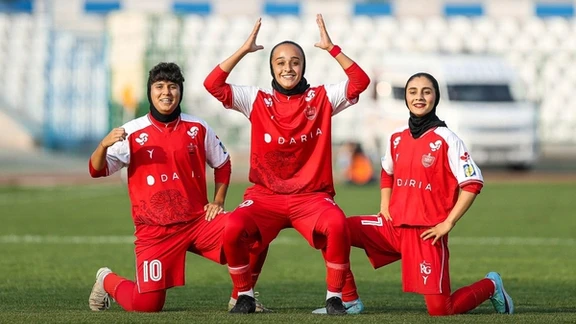 Persepolis players pose during their historic women’s soccer derby against Esteghlal, which they won 2-1, west of Tehran, October 28, 2026.
Prosecutor threatens legal action
Tehran prosecutor Ali Salehi on Tuesday sent separate letters to Sports Minister Ahmad Donyamali and Iranian Football Federation President Mehdi Taj demanding that men be barred from women’s soccer matches.
The restrictions covered male spectators, journalists, photographers, camera operators, security personnel and event staff. Salehi warned that prosecutors would take legal action if they were violated.
The warning followed reports of female spectators attending women’s league matches without the headscarves required under Iran’s mandatory hijab laws, as well as men being present at the games.
Prosecutors described the incidents as violations of Islamic regulations and public decency.
The Iranian Football League Organization had already issued a directive prohibiting men from attending women’s soccer matches, including male media workers and club executives.
Farideh Shojaei, the Football Federation’s vice president for women’s affairs, confirmed ahead of the derby that men would not be permitted to attend.
The restrictions also raised practical questions about organizing the match, particularly the use of video assistant referee (VAR) technology, which relies on technical personnel and match officials.
The league had previously called for a male official to be removed from the VAR team for the derby, adding to uncertainty over how the technology would be operated.
The dispute over attendance came after a series of changes to the arrangements for the historic fixture.
Originally scheduled for Friday, October 23, at Kazemi Stadium, the home ground of Persepolis’ women’s team, the match was moved to Wednesday, October 28, at Shahr-e Qods Stadium.
The league organization cited anticipated demand from supporters and the need for better facilities, although the change also shifted the match from Iran’s weekly day off to a working day.
Ticket sales were suspended twice in the days leading up to the game, while the final decision on whether female spectators could attend was referred to the Tehran Provincial Security Council.
At one point, there were concerns that the encounter could take place behind closed doors despite the anticipated interest from supporters.
Women were eventually permitted to attend following discussions involving Vice President for Women and Family Affairs Zahra Behrouz-Azar and Sports Ministry officials.
Government spokesperson Fatemeh Mohajerani also attended the match, according to Iranian media reports.
Government spokesperson Fatemeh Mohajerani also attended the match, according to Iranian media reports.
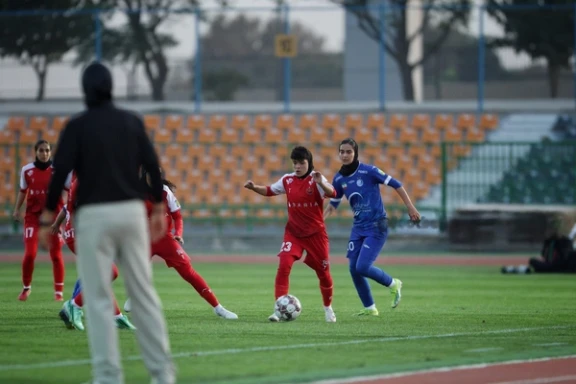 Persepolis (red) and Esteghlal (blue) players compete during their first-ever women’s soccer derby west of Tehran, October 28, 2026.
Women’s soccer struggles for television exposure
The restrictions extended beyond stadium access, raising questions about how widely the first women’s derby would be seen.
Iran’s state broadcaster, IRIB, had announced no plans to televise the match, while reports ahead of the game indicated restrictions on broadcasts through the two clubs’ own platforms.
The uncertainty contrasted with the men’s Esteghlal-Persepolis derby, one of Iran’s biggest sporting events, which regularly attracts large television audiences.
For the women’s teams, limited broadcasting and media access also restrict opportunities to build a following, attract commercial sponsors and gain wider public recognition.
Female soccer players in Iran are required to wear mandatory hijab while competing and have long faced unequal access to sporting facilities and limited media exposure.
The first meeting between the women’s teams of Esteghlal and Persepolis offered an opportunity to showcase their talents to a national audience. Instead, much of the attention ahead of the match centered on restrictions over who could attend, photograph or broadcast it.
A different picture elsewhere in the region
The restrictions surrounding Iran’s first women’s derby contrast with similar fixtures involving major soccer clubs elsewhere in the region, where women’s competitions have attracted television coverage, government support and spectators of both sexes.
In December 2021, Turkish rivals Fenerbahce and Galatasaray held their first women’s derby as a friendly match at Istanbul’s Nef Stadium.
Organized as part of a campaign against violence toward women, the match was attended by male and female supporters, broadcast on national television and watched by Turkey’s justice and family ministers.
Then-Justice Minister Abdulhamit Gul said afterward: “Whatever the result, women are the winners.”
Saudi Arabia staged its first women’s Jeddah derby between Al-Ittihad and Al-Ahli in October 2022, during the opening week of the country’s Women’s Premier League.
The match took place at King Abdullah Stadium, with spectators attending without gender restrictions.
Saudi women’s soccer subsequently secured wider television exposure. Beginning with the 2023-2024 season, Women’s Premier League matches were broadcast domestically on SSC sports channels and internationally through streaming platform DAZN outside the Middle East and North Africa.
Alia Al-Rasheed, head of women’s soccer at the Saudi Football Federation, described the agreement as an opportunity to attract new audiences and inspire future generations of female players.
While Turkey and Saudi Arabia have expanded opportunities for women’s soccer, Iranian female athletes continue to face mandatory hijab requirements, unequal facilities and restrictions on media exposure.
For Iran’s women footballers, the first derby between the country’s two biggest clubs was a milestone. But the restrictions surrounding it showed how far the women’s game remains from enjoying the visibility routinely afforded to its male counterpart.