
Follow us
Add us as a preferred source on Google
Newsletter
Subscribe to our newsletter
Scientists are getting a new glimpse of how the first galaxies came to be. In a stunning new simulation, researchers charted the aftermath of the universe’s “dark age,” including the appearance of the first galaxies that began to shine about 380,000 years after the Big Bang.
Lumina, the program behind the simulation, catalogs 2 billion years of cosmic time and represents a decent chunk of the 13.8 billion-year-old history of our universe. The results were published Monday (Oct. 26) in the journal Monthly Notices of the Royal Astronomical Society.
Latest Videos FromLive Science
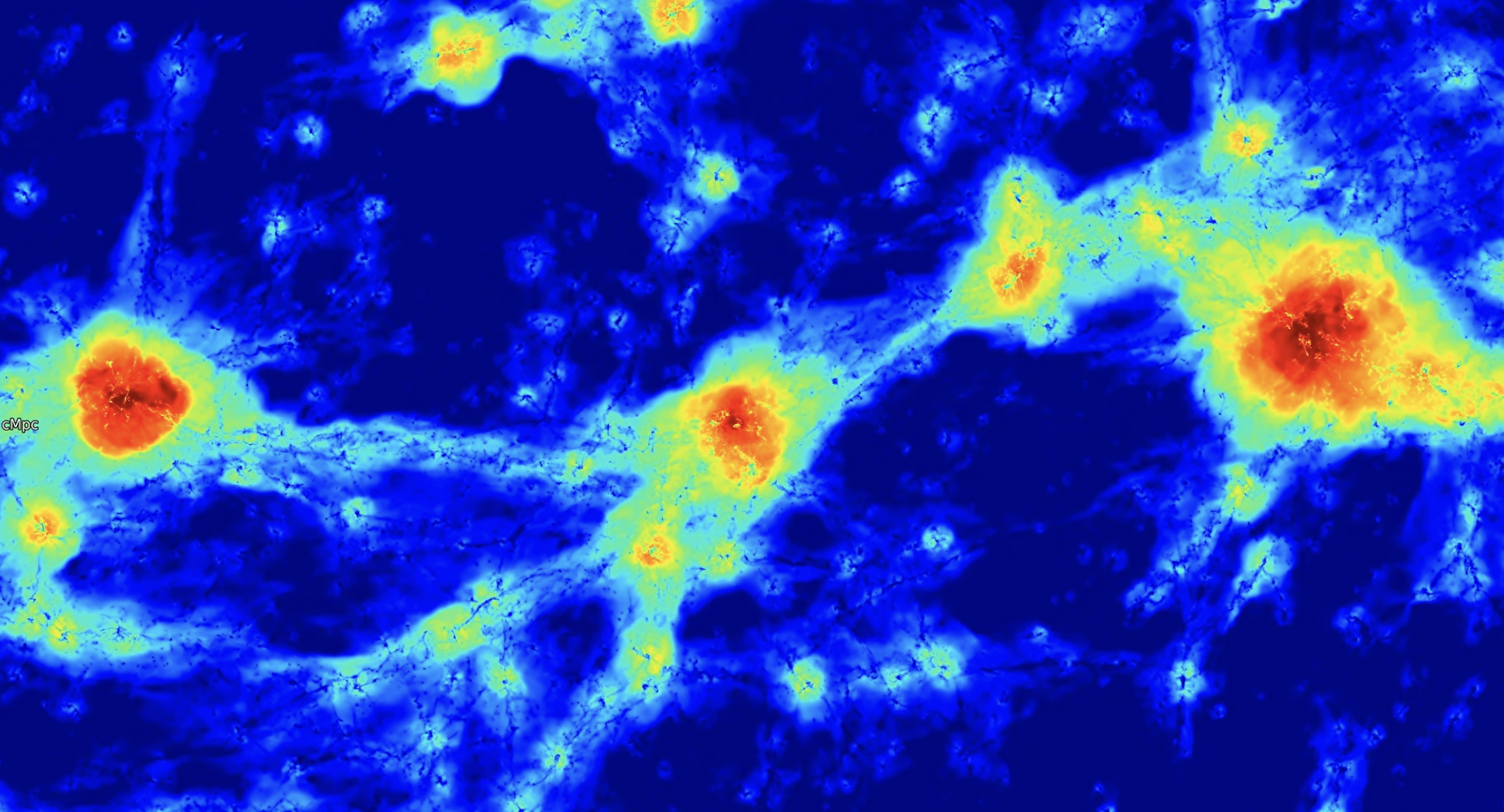
This section of the Lumina simulation shows the gas temperature in different parts of the early universe, with redder areas showing active galaxy clusters.
(Image credit: Lumina simulation)
Lighting up the Cosmic Dark Age
You may like
Zier, O., Smith, A., Shen, X., Liu, R., Kannan, R., Koehler, S. M., Springel, V., Pakmor, R., Vogelsberger, M., Bulichi, T., & Hernquist, L. (2026). Introducing the lumina project: large-volume radiation-hydrodynamic simulations of the epochs of hydrogen and helium reionization. Monthly Notices of the Royal Astronomical Society, 552(4). https://doi.org/10.1093/mnras/stag1469