
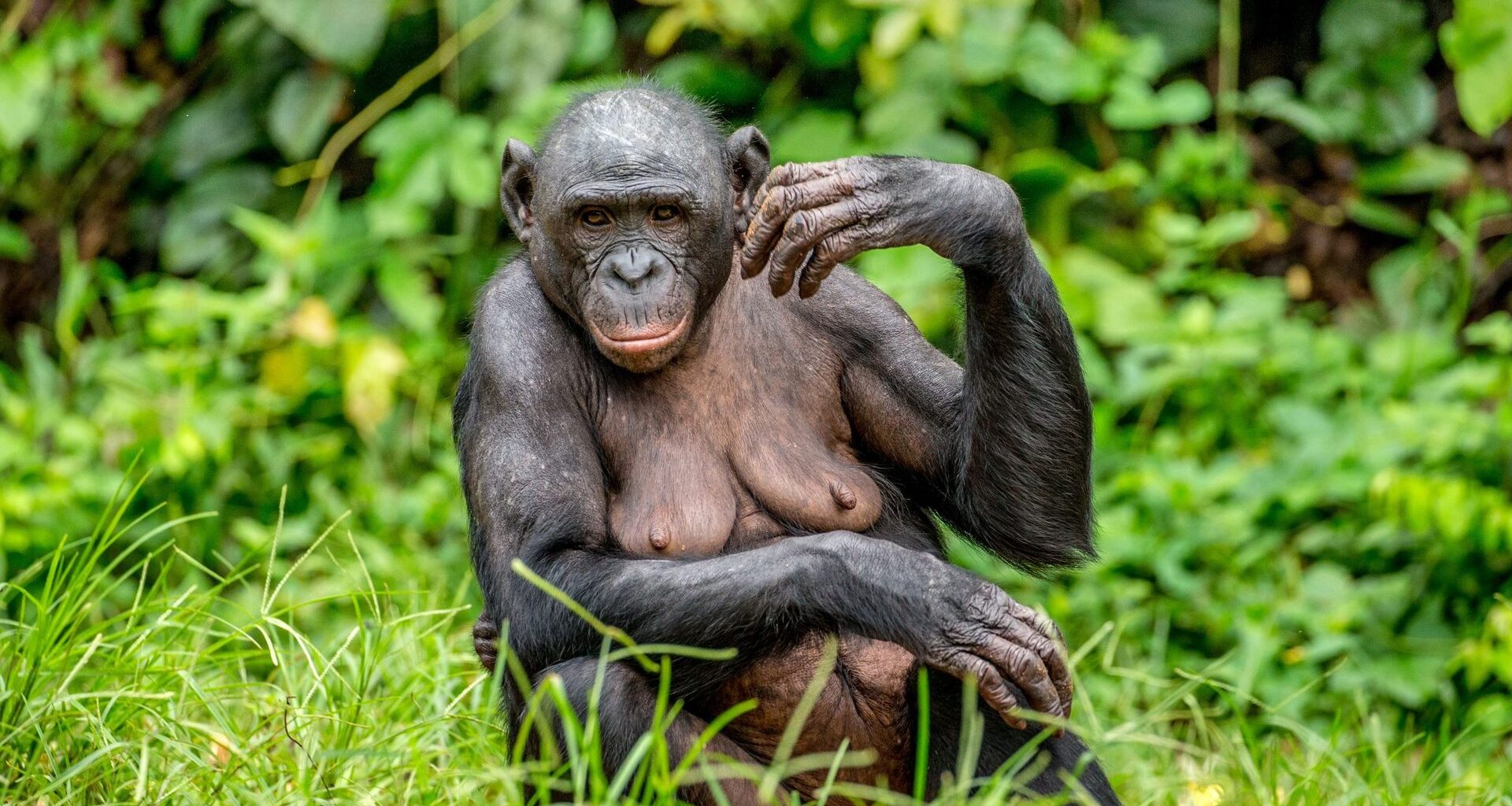
A decade of observations shows female bonobos lead many hunts, challenging assumptions about hunting and our early ancestors.
Deep in the forests of the Democratic Republic of the Congo, female bonobos chase monkeys through the treetops and catch small antelopes on the ground.
And when researchers tracked hunting in two wild bonobo communities, they found something surprising.
Among hunts in which researchers could identify the hunter, female bonobos captured more prey than males.
That finding comes from 10 years of observations. It challenges a familiar picture of ape hunting, drawn largely from chimpanzees, in which males do most of the hunting and control the meat.
Bonobos are just as closely related to humans as chimpanzees are. Their hunting habits could help researchers understand how hunting and meat eating shaped our own evolution.
Gottfried Hohmann was first author and Barbara Fruth senior author of the study, led by Germany’s Max Planck Institute of Animal Behavior.
Hohmann is also affiliated with the Max Planck Institute for Evolutionary Anthropology.
Why female bonobos hunt differently
Researchers have seen hunting in every well-studied chimpanzee group.
In those groups, adult males do most of the chasing, they tend to go after red colobus monkeys, and they usually decide how the meat gets shared.
So why do female chimpanzees hunt less? One reason may be the cost, since a chase burns energy, risks injury, and may not end with much meat.
Males also outrank females, which could make hunting less worth the trouble for a female.
A 2017 study of several East African chimpanzee communities suggested that females pick safer prey, going after mammals on the ground instead of monkeys in the trees.
Bonobos offered a way to test both ideas. Female bonobos form alliances that limit male aggression and give them first access to food.
If male dominance is what holds female chimpanzees back, the gap between male and female hunters should shrink in bonobos.
If avoiding danger matters more, female bonobos would likely stick to prey on the ground and leave the monkeys to males.
Counting the catches
The team followed two neighboring communities at LuiKotale in the Democratic Republic of the Congo, near Salonga National Park.
From February 2014 to August 2023, observers recorded 415 successful captures over nearly 4,000 days.
Monkeys made up 43% of the catches. Hoofed animals, almost all forest antelopes called duikers, accounted for 42%.
Birds, rodents, and other small animals made up the remaining 15%. Among the primates caught, 77% were Thollon’s red colobus monkeys.
Working out who caught each animal was harder. Thick vegetation hid some hunts, bonobos spread out, and chases moved fast.
When observers missed the actual capture, they identified the hunter as the bonobo holding the prey immediately afterward.
The team could identify a hunter in 158 captures. Females accounted for 99 and males for 59, roughly five female catches for every three male catches.
Across both communities, females caught duikers almost three times as often as males. They also caught monkeys almost as often as males did.
In the west community, females caught more of every prey type. In the east, males caught slightly more monkeys than females.
How age influences hunting choices
Female hunters averaged about 28 years old, but their prey differed with age. Younger females tended to catch monkeys, while older females tended to catch duikers.
In the west community, females who caught monkeys averaged about 20 years old. Those who caught duikers averaged about 28.
The east community showed the same pattern, though the smaller age gap could have occurred by chance.
“Young females tear through the treetops to chase monkeys who fight back in defense. This is a seriously dangerous business,” Hohmann said.
A young female could also lose her catch to an older female. Younger females generally rank below older ones, although researchers find it hard to establish a clear pecking order.
Females rarely have clear contests, and other bonobos often step in to support one side.
Younger females are also less likely to have a dependent infant, which could make chasing monkeys through the trees easier.
Still, having an infant or juvenile showed only a weak link to the age pattern in monkey hunting.
Catching prey is only half the battle
Female bonobos caught monkeys about as often as males. The authors say that finding does not support the idea that females hunt less because they avoid danger.
The duiker catches raised another question. These antelopes are considered low-risk prey, so why did males catch so few?
A duiker may be easy to catch but hard to keep. A captured monkey usually dies almost immediately. A duiker tends to stay alive longer, and its distress calls attract bonobos from near and far.
As more bonobos gather, competition for meat grows. A female may take a duiker from the male who caught it, leaving him with less control over his catch.
“Catching prey is one thing but maintaining control of the carcass is another one,” Hohmann said.
“It’s possible that males are not capturing large prey in order to avoid conflicts with females over meat.”
The bonobos caught both duiker fawns and adults. Every successful duiker or monkey hunt ended with meat sharing.
Females may favor duikers because they offer plenty of meat for relatively little effort and risk, the researchers suggest.
Older females may also have enough status to hold on to these catches, which could help explain why they caught more duikers than younger females.
Different hunting habits
The two communities had strikingly different hunting records. The west group made 117 successful duiker hunts and 31 monkey hunts. The east group made 147 monkey hunts and 56 duiker hunts.
Some of that difference could come down to which prey were common in each group’s territory.
To check, the team compared hunts in forest that both communities used. Even there, the east group hunted monkeys more than four times as often as duikers.
The team also checked the forest around each hunt. Some areas stood on firm, dry ground, while others flooded for part or all of the year.
In the west community, duiker hunts tended to occur where more of the surrounding forest was dry. In the east, bonobos tended to catch monkeys when their group included more adult males. Neither link was certain.
A 2020 study of two other neighboring bonobo groups found a similar difference in prey and suggested that hunting habits could be cultural.
At LuiKotale, the researchers also pointed to other possibilities, including monkey group sizes and how often bonobos encountered each kind of prey.
Rethinking human origins
These bonobos hunted monkeys without males controlling the carcasses.
That matters because many ideas about early human hunting assume that the last shared ancestor of humans, chimpanzees, and bonobos hunted much like chimpanzees do today.
“Chimpanzee behavior alone may not provide a reliable picture of how this ancestor hunted,” Fruth said.
The authors offered two possible explanations for bonobos’ smaller gap between male and female hunters.
It may reflect an older pattern that existed before males came to dominate hunting. Or it may have developed later, as female bonobos gained status.
The study cannot settle that question. It followed two communities at one forest site, so the findings do not necessarily describe all bonobos.
Individual skill may also matter more than sex. But the team had too few captures linked to a known hunter to test that idea. Observers rarely recorded how many bonobos joined each chase or what each one did.
The researchers plan to keep comparing the communities and track how their hunting changes over time.
Understanding who hunts, who succeeds, and who controls the meat could reveal how social relationships shape hunting behavior – and offer new clues about the evolution of our own ancestors.
The full study appeared in Current Biology.
—–
Like what you read? Subscribe to our newsletter for engaging articles, exclusive content, and the latest updates.
Check us out on EarthSnap, a free app brought to you by Eric Ralls and Earth.com.
—–