
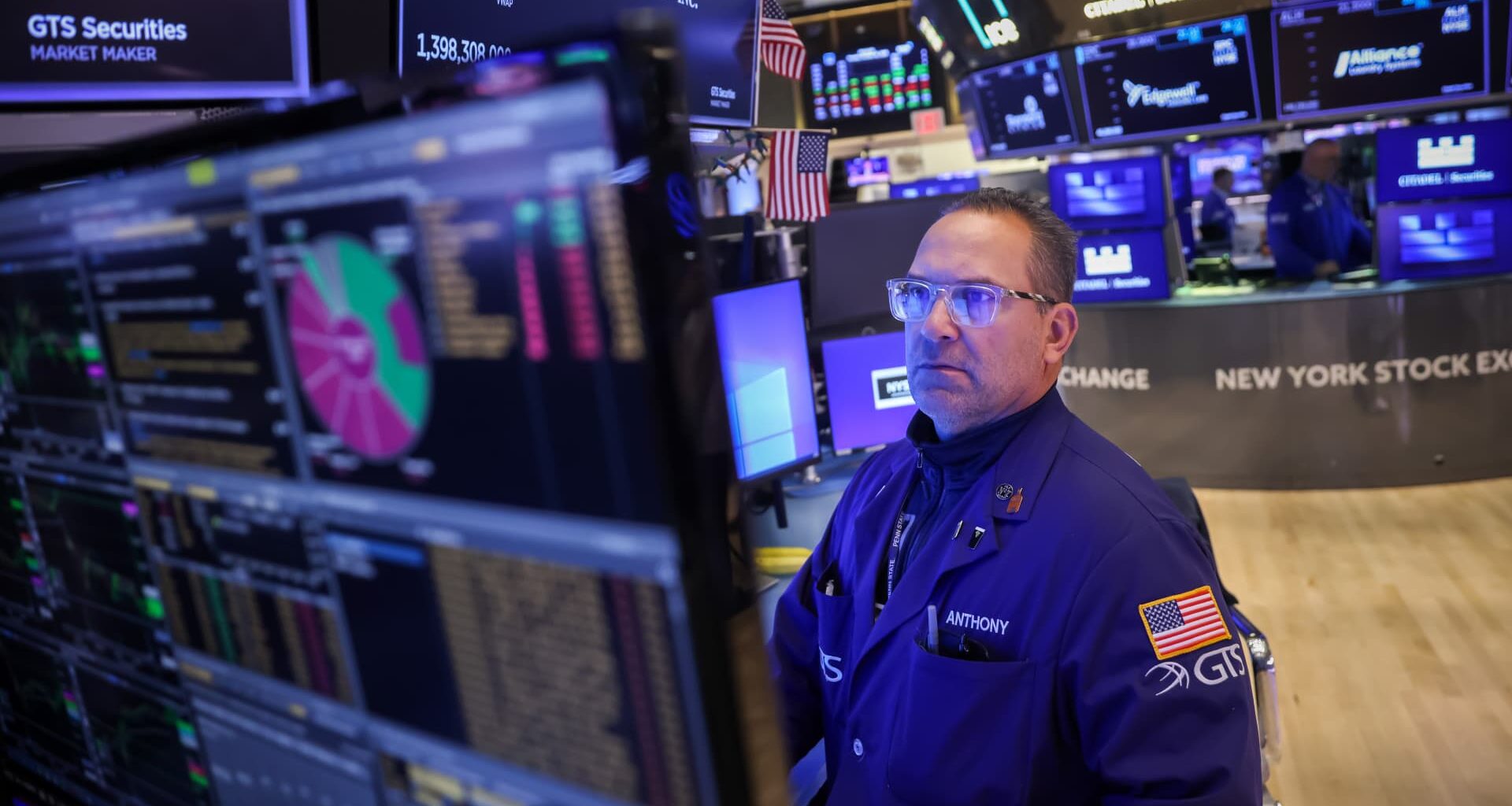
A trader works on the floor of the New York Stock Exchange (NYSE) in New York, US, on Monday, Oct. 26, 2026.
Michael Nagle | Bloomberg | Getty Images
Stocks were under pressure Thursday, weighed down by the latest batch of corporate earnings.
The Nasdaq Composite shed 1.38% to end at 26,184.72, while the S&P 500 slipped 0.3% to close at 7,720.39 and snap a three-day advance. The Dow Jones Industrial Average lost 132.54 points, or 0.25%, to 52,342.56.
Alphabet lost 12% after it missed expectations on adjusted earnings per share and revenue in the third quarter. The Google parent posted negative free cash flow of $9.07 billion. The company kept its full-year capital expenditures forecast at $195 billion to $205 billion.
Fellow Dow member Caterpillar slid more than 9% for its worst day since March 2020. While the industrial giant reported better-than-expected revenue and earnings for the third quarter, sales in its construction industries business came in slightly below estimates.
Microsoft was also down, reversing course from its initial advance after growth in the Windows maker’s Azure cloud infrastructure business helped earnings and revenue to beat analyst estimates in its fiscal first quarter ending in September, according to LSEG. The stock ended the session marginally lower.
Neoclouds pulled back as Microsoft’s lower-than-expected capital spending commitment pointed to infrastructure partners taking longer to deliver data center capacity. Shares of CoreWeave dropped about 5%, while Nebius declined more than 5%.
The results come amid heightened scrutiny of the artificial intelligence trade. AI stocks, such as the iShares Semiconductor ETF (SOXX) and the Roundhill Memory ETF (DRAM), have been through a rough patch for most of October, only to perk up in recent days. On Thursday, both funds were lower, with SOXX down more than 1% and DRAM falling more than 4%.
“I think we’re in a better, more stable place in October and heading into November in the tech trade than we were in August and September. But that said, I think investors are becoming much more selective,” said Art Hogan, chief market strategist at B. Riley Wealth Management. “I think we’re in an environment where there’s less concern and negativity over tech writ large, but I think specifically, you can certainly get announcements from individual players that will move the needle.”
On Wednesday, the Federal Reserve decided to hold steady on rates, leaving the central bank’s benchmark interest rate between 3.75% and 4%. The decision to keep policy unchanged was widely expected after the Federal Open Market Committee raised rates a quarter-percentage point in September.
This time, Fed policymakers said that inflation “remains elevated,” but also that they are awaiting the “accumulation of more information” before taking further steps. The personal consumption expenditures price index — the Fed’s preferred measure of inflation — on Thursday showed that the pace of price increases accelerated in September, with the monthly figure in line with expectations, while the annual rate came in just below Wall Street estimates.