
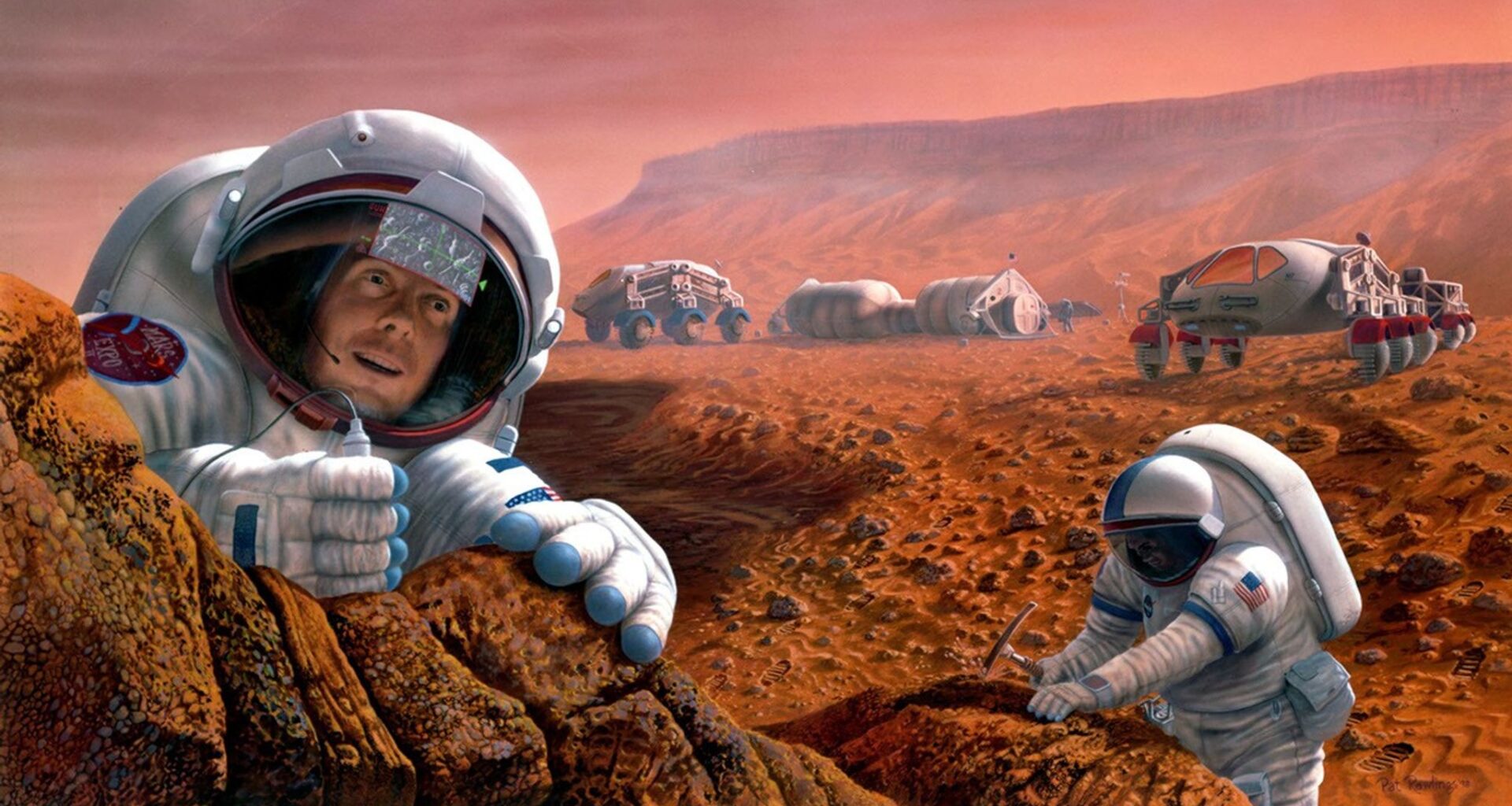
How will the Martian dust influence future human missions to the Red Planet? This is what a recent study published in the Proceedings of the National Academy of Sciences hopes to address as a team of scientists investigated new evidence regarding the abrasiveness of the Martian dust and how future human missions could encounter issues. This study has the potential to help scientists, engineers, and future Mars astronauts address potential crew issues before sending humans to the Red Planet.
For the study, the researchers evaluated pieces of spacesuit material called swatches that are embedded on NASA’s Perseverance rover. These swatches have been exposed to the Martian elements since Perseverance landing on the Red Planet in February 2021, and scientists have been evaluating how each swatch has withstood Martian weather during this time. The primary motivation was to evaluate whether the Martian weather, specifically the heavy dust, could cause wear and tear on spacesuit material, which could provide key insights into developing Martian spacesuits for future human missions. The comes after Apollo astronauts experienced discomfort on the lunar surface, describing the lunar dust as being abrasive, causing microtears on their spacesuits, and even sneezing.
In the end, the researchers were delighted to find that Martian dust isn’t nearly as abrasive as initially hypothesized and especially compared to lunar dust. This could indicate that Mars astronauts might not have the same harrowing experiences as their Apollo counterparts. However, they did note that Martian dust has a tendency to be much finer than even dust on Earth, suggesting they could be breathed in much easier, and even enter the bloodstream.
“We’ve been operating rovers on the surface of Mars continuously for more than 20 years at this point,” said Dr. Scott VanBommel, who is a Research Assistant Professor of Earth, Environmental, and Planetary Sciences at Washington University in St. Louis and lead author of the study. “We know that dust will be a challenge, but it’s something we can prepare for and overcome.”
This study comes as NASA is planning to return humans to the lunar surface for the first time since Apollo 17 in 1972. While they have the long-term goal of establishing a permanent lunar base, they also wish to develop and test technologies that could be used on future human missions to Mars, including spacesuits.
What new insights into Martian dust and human missions to Mars will researchers make in the coming years and decades? Only time will tell, and this is why we science!
As always, keep doing science & keep looking up!
Sources: Proceedings of the National Academy of Sciences, EurekAlert!
Featured Illustration Credit: NASA/JSC/Pat Rawlings, SAIC